
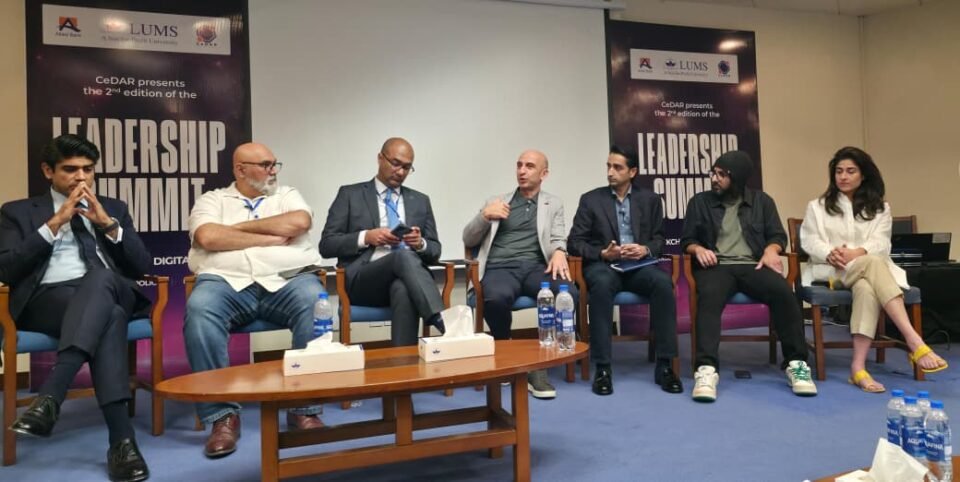
Pakistan already has a robust financial services infrastructure. Over the past decade, mobile-led financial services, supported by enabling policies from the State Bank of Pakistan, have brought millions of citizens into the formal economy. For Ahmet Kayhan, Group Chief Payments and Digital Assets Officer at VEON, the question is no longer about access, it is about what gets built on top. ‘Pakistan is at an inflection point, and the decisions made now will define its digital financial future for a decade,’ Kayhan told delegates today at the Leadership Summit on Blockchain and Digital Assets, hosted at the Suleman Dawood School of Business at the Lahore University of Management Sciences.
Kayhan spoke today at the Leadership Summit on Blockchain and Digital Assets at the Suleman Dawood School of Business, LUMS, as a panelist on the afternoon’s central discussion, Rethinking Trading and Finance in the Digital Era. He was joined by Hamayun Sajjad, CEO of Mashreq Bank; Sharjeel Murtaza, Chief Digital Officer Karandaaz Pakistan; Moe Jangda, Founder and CEO, Pocket Money; Khurram Zafar, CEO Pakistan Mercantile Exchange; Fariel Salahuddin, Founder & CEO UpTrade; and Ali Mukhtar, Director at Fatima Gobi Ventures. The session was moderated by LUMS faculty member Muhammad Yar Hiraj.
VEON is the largest Nasdaq-listed company with its Group headquarters in Dubai. VEON’s digital operators serve 150 million connectivity customers and nearly 135 million monthly active digital users across five markets. In Pakistan, VEON operates through Jazz, JazzCash, and Mobilink Microfinance Bank under JazzWorld collectively serving more than 100 million customers across financial services, entertainment, connectivity, and digital platforms.
When asked whether there is a meaningful use case for digital assets in Pakistan beyond speculation and remittances, Kayhan’s answer was direct. “The biggest use case here is value preservation and wealth management. People need a way to protect what they earn and grow it. That is the same driver that made Turkiye the fourth biggest crypto market by trading volume in the world, where over 80 percent of people under 40 hold digital assets out of necessity.” He pointed to stablecoins as the practical first layer. “Stablecoin is number one. It is usable, it is understandable, and it addresses a real need in markets where currency preservation matters. But more importantly provides a strong alternative for remittance rails for Pakistan to attrack more mone flow into the country.”
On tokenization, Kayhan was candid about the gap between promise and reality. “Tokenization has genuine merit but also genuine challenges. When you buy a token, you are taking on issuer risk and issuer trust. Ownership in the real world is still anchored to government licenses and certificates. That gap has to be closed before tokenization becomes a mainstream tool.”
His broader framing was rooted in problem-solving rather than technology enthusiasm. “If we don’t solve a real problem, digital assets don’t make much sense. Companies may make money in the short term but if there is no genuine problem being solved, you don’t see much longevity.”
VEON’s position in Pakistan gives that philosophy operational weight. JazzCash, VEON’s digital financial services platform, serves 59 million customers and processed PKR 15 trillion in transactions in 2025, equivalent to roughly 13 percent of national GDP. It issues over 200,000 digital loans daily and recently crossed one million Raast QR-enabled merchants. Mobilink Microfinance Bank extends that reach further. For VEON, expanding into digital assets is a natural evolution of infrastructure already operating at national scale.
The summit opened with a keynote from Bilal Bin Saqib, Chairman of the Pakistan Virtual Assets Regulatory Authority and Special Assistant to the Prime Minister, who has consistently framed digital assets as core economic infrastructure.
Kayhan welcomed the regulatory momentum. “What excites me about this moment in Pakistan is the seriousness of intent at the top from SBP, SECP to PVARA. Chairman Bilal Bin Saqib and the PVARA team have a collaborative regulatory approach that enables real innovation, protects consumers, and invites long-term institutional commitment. That combination of speed and rigor is rare, and Pakistan has it.”