

There’s no doubt that money can be made by owning shares of unprofitable businesses. Indeed, White Gold (CVE:WGO) stock is up 513% in the last year, providing strong gains for shareholders. Nonetheless, only a fool would ignore the risk that a loss making company burns through its cash too quickly.
Given its strong share price performance, we think it’s worthwhile for White Gold shareholders to consider whether its cash burn is concerning. For the purpose of this article, we’ll define cash burn as the amount of cash the company is spending each year to fund its growth (also called its negative free cash flow). First, we’ll determine its cash runway by comparing its cash burn with its cash reserves.
When Might White Gold Run Out Of Money?
A company’s cash runway is calculated by dividing its cash hoard by its cash burn. In December 2025, White Gold had CA$20m in cash, and was debt-free. Importantly, its cash burn was CA$6.3m over the trailing twelve months. Therefore, from December 2025 it had 3.2 years of cash runway. A runway of this length affords the company the time and space it needs to develop the business. Importantly, if we extrapolate recent cash burn trends, the cash runway would be a lot longer. The image below shows how its cash balance has been changing over the last few years.
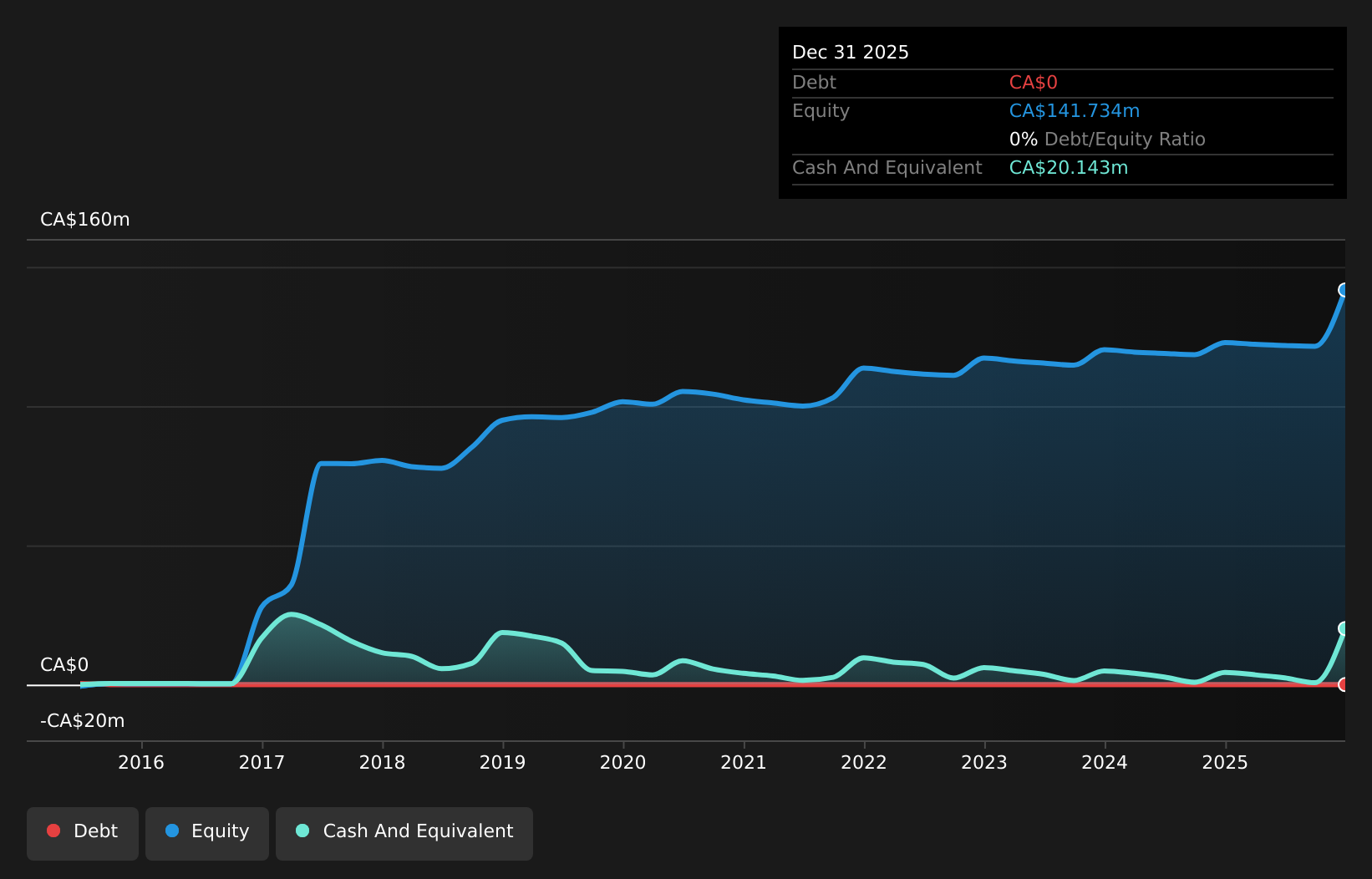
View our latest analysis for White Gold
How Is White Gold’s Cash Burn Changing Over Time?
White Gold didn’t record any revenue over the last year, indicating that it’s an early stage company still developing its business. Nonetheless, we can still examine its cash burn trajectory as part of our assessment of its cash burn situation. Over the last year its cash burn actually increased by 16%, which suggests that management are increasing investment in future growth, but not too quickly. That’s not necessarily a bad thing, but investors should be mindful of the fact that will shorten the cash runway. While the past is always worth studying, it is the future that matters most of all. For that reason, it makes a lot of sense to take a look at our analyst forecasts for the company.
How Easily Can White Gold Raise Cash?
Given its cash burn trajectory, White Gold shareholders may wish to consider how easily it could raise more cash, despite its solid cash runway. Issuing new shares, or taking on debt, are the most common ways for a listed company to raise more money for its business. Commonly, a business will sell new shares in itself to raise cash and drive growth. We can compare a company’s cash burn to its market capitalisation to get a sense for how many new shares a company would have to issue to fund one year’s operations.
White Gold’s cash burn of CA$6.3m is about 1.7% of its CA$379m market capitalisation. So it could almost certainly just borrow a little to fund another year’s growth, or else easily raise the cash by issuing a few shares.
So, Should We Worry About White Gold’s Cash Burn?
It may already be apparent to you that we’re relatively comfortable with the way White Gold is burning through its cash. In particular, we think its cash runway stands out as evidence that the company is well on top of its spending. Although its increasing cash burn does give us reason for pause, the other metrics we discussed in this article form a positive picture overall. Looking at all the measures in this article, together, we’re not worried about its rate of cash burn; the company seems well on top of its medium-term spending needs. An in-depth examination of risks revealed 1 warning sign for White Gold that readers should think about before committing capital to this stock.
Of course, you might find a fantastic investment by looking elsewhere. So take a peek at this free list of companies with significant insider holdings, and this list of stocks growth stocks (according to analyst forecasts)
Valuation is complex, but we’re here to simplify it.
Discover if White Gold might be undervalued or overvalued with our detailed analysis, featuring fair value estimates, potential risks, dividends, insider trades, and its financial condition.
Have feedback on this article? Concerned about the content? Get in touch with us directly. Alternatively, email editorial-team (at) simplywallst.com.
This article by Simply Wall St is general in nature. We provide commentary based on historical data and analyst forecasts only using an unbiased methodology and our articles are not intended to be financial advice. It does not constitute a recommendation to buy or sell any stock, and does not take account of your objectives, or your financial situation. We aim to bring you long-term focused analysis driven by fundamental data. Note that our analysis may not factor in the latest price-sensitive company announcements or qualitative material. Simply Wall St has no position in any stocks mentioned.