
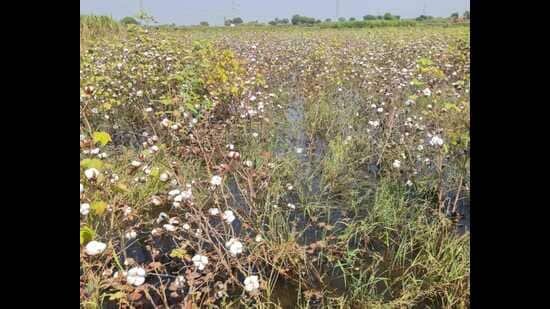
Repeated pest attacks, collapsing yields, rising cultivation costs, and recurring crop failures have pushed Haryana’s cotton farming into crisis. Farmers across the state’s traditional cotton belt are forced to abandon the once-profitable white gold cultivation and shift to water-guzzling paddy for assured returns.

According to farmers and researchers, cotton cultivation is rapidly turning unviable, with the trend most visible in Sirsa, Fatehabad, Hisar, Bhiwani, Charkhi Dadri, Jind, and Jhajjar districts.
The development is considered a jolt to the Haryana government’s efforts to save groundwater under the Mera Pani Meri Virasat scheme. In districts like Sirsa and Hisar, where cotton previously acted as a buffer for the water table, the transition to paddy—which requires significantly higher irrigation—threatens to accelerate the depletion of local aquifers and worsen the state’s environmental footprint.
While cotton fades, the area under paddy reached 18.37 lakh hectares in 2024-25, up from 15.33 lakh hectares in 2021-22. Haryana’s economic survey 2025-26 reports rice production has climbed to 71.37 lakh MT.
Ram Partap Sihag, joint director, cotton, cited multiple factors for the shift: “Besides pest attack, increased labour cost and unfavourable weather conditions are big reasons. Efforts are being made to improve the seed quality.”
Breakdown of Bt-cotton tech
Official data from the department of agriculture and farmers’ welfare shows that the area under cotton has declined sharply from around 7.4 lakh hectares in 2020-21 to nearly 3.9 lakh hectares in 2025-26, falling 47% in five years. Consequently, production dropped from 18.24 lakh bales to 9.75 lakh bales—the lowest in seven years.
Virender Lather, a former principal scientist at ICAR-Indian Agricultural Research Institute, attributed this to the collapse of Bt-cotton’s resistance. “Prolonged use of Bt genes in cotton triggered genetic mutations in pests, enabling them to overcome the crop’s built-in resistance,” he said, adding that Bt-cotton has now become economically unviable.
Farmers are facing devastating losses. Suresh Koth, a farmer leader from Hisar, said, “Last year, cotton farmers suffered a loss of around ₹15,000 per acre as the yield has reduced to two to three quintals from the average 15-20 quintals.” He noted that input costs have also increased manifold. Gurjit Singh Mann, a former cotton grower from Sirsa, explained his own shift: Five years ago, 70% of his 50 acres was under cotton; now, he has avoided it entirely for paddy. “GM seeds were profitable for farmers, but uncontrolled pink bollworm and whitefly became a threat. The latest Bt seeds were not made available, leaving farmers helpless,” he added.
Research lag, economic fallout
The department of agricultural economics at Chaudhary Charan Singh Haryana Agricultural University (CCSHAU) estimated that cotton farmers suffered a net loss of ₹15,143 an acre during the last Kharif season. While researchers are working on new pink bollworm-resistant GM seeds, Karmal Singh, the head of the cotton section at CCSHAU, warned that developing such varieties typically takes four to five years.
Despite the current gloom, state officials remain optimistic about technology and improved seed quality.
State agriculture director Rajnarayan Kaushik said the fresh financial assistance of ₹2,000/acre for cotton and ₹4,000/acre for indigenous varieties, announced by chief minister Nayab Singh Saini, alongside the ₹8,000 fixed under Mera Pani Meri Virasat will eventually get farmers back to cotton.
Officials are also hopeful that the ₹557/quintal hike in the MSP—fixing it at ₹8,667 for long staple—will be an incentive.
However, for now, the transition toward paddy and even bajra in rain-fed areas continues unabated, complicating Haryana’s long-term water sustainability goals.