
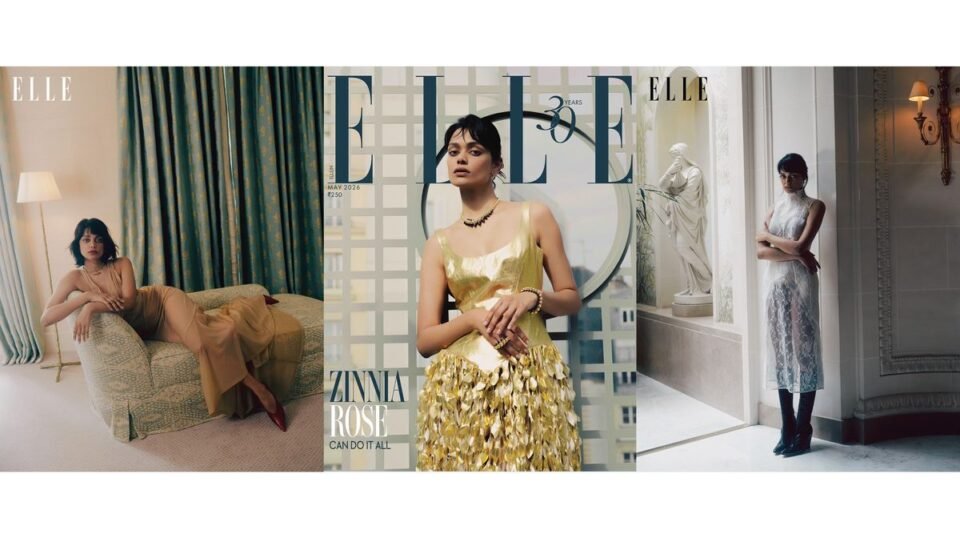
There is a version of Zinnia Rose that fashion understands easily. The model. An image that moves seamlessly between Paris, New York, and wherever the industry gathers next.
/filters:format(webp)/elle-india/media/media_files/2026/05/20/cover-2-2026-05-20-12-03-41.jpg)
It is also the least interesting version of her.
We’re at Le Bristol in Paris and the day carries all the familiar markers of a luxury cover shoot. Controlled light. Precise framing. Cartier anchoring the narrative. But Rose doesn’t perform that script in the expected way. She arrives ready, slips into each look without negotiation, barely checks the monitor. There is no sense of overworking the image, only an instinctive understanding of how to move within it.
She is as comfortable in a sheer look as she is in tailoring, unconcerned with the small negotiations that usually slow a set down. There is a clarity to the way she works. Focused, self-contained, and entirely unbothered by the need to constantly adjust or perform for the room.
/filters:format(webp)/elle-india/media/media_files/2026/05/20/zinnia-watermarked3-2026-05-20-12-03-41.jpg)
“If you wait to be chosen, you don’t define the narrative,” she says. “It gets defined for you.” That instinct has shaped her entire career. For a long time, fashion has relied on recognisable archetypes. The muse. The model. The face that can be moulded to fit a moment. Rose has never quite fit into that system. When she began, the industry did not know what to do with someone who moved between modelling, academic research, and social impact work with equal seriousness.
/filters:format(webp)/elle-india/media/media_files/2026/05/20/zinnia-watermarked-2026-05-20-12-03-41.jpg)
“I couldn’t be put into a conventional box,” she says. “So I created something that didn’t exist before me.” Without waiting for validation, she worked independently, approaching clients directly, shaping her own narratives, controlling the way she was seen. It was not the easiest route, but it allowed her something the traditional mode rarely offered: agency.
/filters:format(webp)/elle-india/media/media_files/2026/05/20/zinnia-watermarked7-2026-05-20-12-03-41.jpg)
That same refusal to simplify carries into the way she speaks about sustainability, a word that fashion continues to reduce the narrative to materials and optics. Rose sees it differently. “Sustainability, to me, is the long-term preservation of dignity, clarity, and emotional wellbeing,” she says. “Nothing endures if people don’t.”
It is a perspective shaped long before fashion entered the picture. Before psychology gave it language. Her understanding comes from lineage. From women who lived in close relationships with care, survival, and community. “My great grandmother was a dhai, a traditional midwife. She sustained life in the most literal way,” she says.
/filters:format(webp)/elle-india/media/media_files/2026/05/20/zinnia-watermarked4-2026-05-20-12-03-41.jpg)
Five generations removed from India, that inheritance has not been diluted. If anything, it has sharpened. Sustainability, in her world, is not environmental alone. It is emotional. Cultural. Psychological. It is about what survives, what is carried forward, and what is protected when systems fail.
Her academic background only deepened that understanding. “Psychology taught me that nothing is sustainable if the emotional architecture is unstable,” she says. “You can build systems, but if people feel unseen or unsafe, they collapse.”
/filters:format(webp)/elle-india/media/media_files/2026/05/20/zinnia-watermarked5-2026-05-20-12-03-41.jpg)
Off camera, that clarity becomes even more grounded. Between takes, she speaks about working with domestic violence and coercive control survivors, particularly within South Asian communities. About helping women reclaim confidence, voice, and agency within legal systems that often fail to recognise the complexity of their experiences.
“The most meaningful work I do isn’t glamorous,” she says. “It’s about helping people rebuild their sense of self.” There is no attempt to reconcile these worlds into something more digestible. No effort to make fashion carry the weight of that work, or vice versa. They coexist, without being forced into alignment.
/filters:format(webp)/elle-india/media/media_files/2026/05/20/zinnia-watermarked8-2026-05-20-12-03-41.jpg)
That extends to identity as well. As a South Asian woman in global fashion, visibility has never been a straightforward gain. It comes layered with projection, expectation, and the pressure to represent more than oneself. “Belonging begins internally,” she says. “Once that is anchored, the room stops being a mirror for old pain.”
There is a growing tendency to frame India as “having a moment” in fashion. It is a narrative that resurfaces every few years. From where she stands, that framing feels incomplete. India has always been part of the global conversation. What has shifted is not presence, but recognition.
Her own relationship to India reflects that complexity. Shaped by diaspora, by fragments rather than fixed geography, it resists easy definition. Home, for her, is not a place. It is something she carries. An emotional inheritance.
/filters:format(webp)/elle-india/media/media_files/2026/05/20/zinnia-watermarked9-2026-05-20-12-03-41.jpg)
For someone whose profession is built on image, there is little interest in maintaining one off set. She speaks directly, answers without deflection, and is comfortable holding contradiction without resolving it.
By the end of the day, we’ve wrapped up the images. The narrative, in many ways, goes on. Because what Zinnia Rose represents does not sit neatly within a single frame. She offers something more layered. Less immediate. Far more reflective of where fashion is trying, and often failing, to go.
/filters:format(webp)/elle-india/media/media_files/2026/05/20/zinnia-watermarked10-2026-05-20-12-03-41.jpg)
And right now, that feels far more interesting.
Team Credits
Editorial Director: Ainee Nizami Ahmedi; Photographer: Noémi Ottilia Szabo; Stylist: Rhia Kapoor , Graphic Designer: Aditi Magesh; Makeup: Claire Gil; Hair: Joel Phillips; Bookings Editor: Rishith Shetty; Production: Elsa Merchadier at Studio KIKI Prod; Location Courtesy: Le Bristol Paris; Artist Management: Ian Loughran