

Kevin Minto expected another corroded bronze coin when his metal detector beeped in a field in Somerset, south England. Instead, the lorry driver and keen metal detectorist uncovered a nearly 48-gram (1.7-ounce) chunk of solid Roman gold.
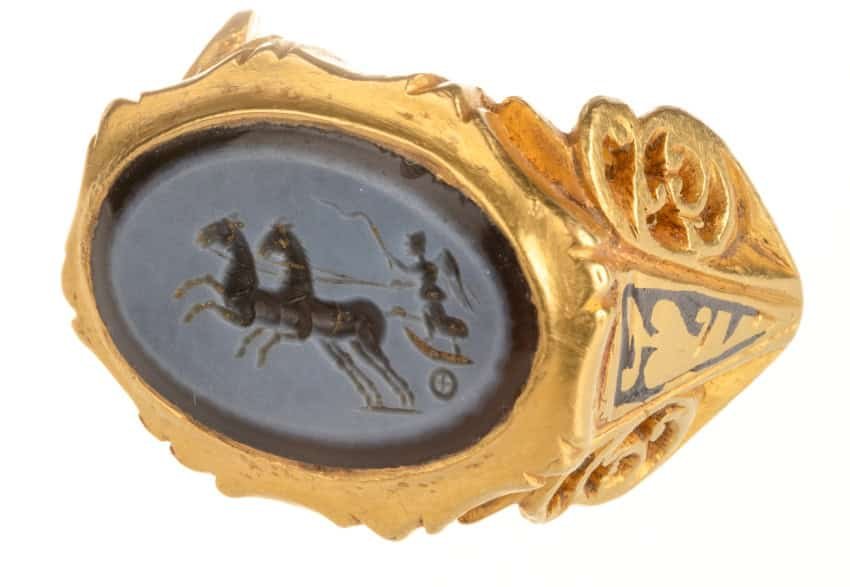
The 1,700-year-old artifact, now known as the Ilminster Ring, features an engraved gemstone showing Victoria, the Roman goddess of victory, driving a two-horse chariot. Experts say it is one of the finest Roman jewelry finds ever made in Britain.
The ring was likely buried around 297 C.E. with a hoard that included 297 Roman coins, along with lead and pottery objects. The owner likely hid the ring deliberately, perhaps intending to recover it later. But for whatever reason, they never came back.
Wealth and Turmoil

The ring is spectacular. It has a broad, heavy gold band and a bluish-gray gemstone set into the front. The image on the stone was carved using intaglio, a technique in which the design is engraved into the surface rather than raised above it.
That tiny carving carries a lot of meaning. It shows Victoria with wings and a helmet, holding a whip and reins as she drives a two-horse chariot with a four-spoked wheel. In Roman art, Victoria was a symbol of triumph, military success, and imperial power.
“The Ilminster ring is both large and heavy, with elaborate gold work and a beautifully executed intaglio,” Amal Khreisheh, senior curator at the South West Heritage Trust, said in a statement. “While other examples are known, these elements combine to create a spectacular ring that is only paralleled by continental discoveries.”
Who owned such a striking piece of jewelry? It’s not your average jewelry. Researchers suggest the sheer volume of gold points to a person of high status, such as a governor, merchant, or wealthy landowner. The owner likely wore the ring for ceremonial functions or important public occasions.
Buried During a Dangerous Decade
The ring dates to one of the most unstable periods in Roman Britain. Between 286 and 296 C.E., Britain broke away from the wider Roman Empire under the rule of Carausius and later Allectus. The episode, often called the Carausian Revolt, left the province politically isolated until imperial forces brought it back under Roman control.
For people with money, that kind of uncertainty could be very dangerous. Invasions, shifting loyalties, banditry, and political purges all made wealth harder to protect. Across Roman Britain, people sometimes buried coins and valuables in the hope of recovering them later.
The owner of the Ilminster Ring never came back, and quite possibly, was unable to come back.
“Its discovery sheds light on how south Somerset’s Roman inhabitants navigated a period of unrest from 286-296,” Khreisheh said. “It is likely the ring was buried shortly after, in 297, as part of a hoard including coins, lead and pottery objects.”

From Somerset Field to Museum Display
Minto, a 68-year-old former soldier, took up metal detecting to stay active. He began finding Roman coins scattered across the Ilminster site in 2017, eventually unearthing the gold ring a year later.
“It’s hard to explain what it feels like when you find something like that,” Minto said, according to The Guardian. “It was like being hit by an express train. At first I thought it was a coin, then a brooch, and then realized it was a ring. You’re a little dumbfounded, really.”
Researchers plan to analyze the ring further to determine whether artisans crafted it in Britain or imported it from elsewhere in the empire. They also hope to investigate whether a lead-lined coffin Minto found in the same field connects to the wealthy individual who buried the gold.
For now, the ring is preparing for a local tour. It will visit primary schools before moving to a permanent display at the Museum of Somerset in Taunton.
“Usually archaeologists handle broken things—such as pieces of pottery or animal bones,” Khreisheh said. “Things like this don’t come along very often.”