


Azerbaijan is increasingly proving that its economic
significance extends far beyond oil and gas. Historically
positioned at the crossroads of East and West, the country has long
served as a reliable trade partner and a natural transit hub.
Today, Azerbaijan is leveraging this geographic advantage to
catalyze the development of the Middle Corridor or the
Trans-Caspian International Transport Route, a strategic
transcontinental transport route connecting Asia and Europe. As
global supply chains face disruptions and congestion in traditional
corridors, the Middle Corridor is emerging as a viable, faster, and
more secure alternative, reflecting both the region’s economic
ambition and its capacity for international cooperation.
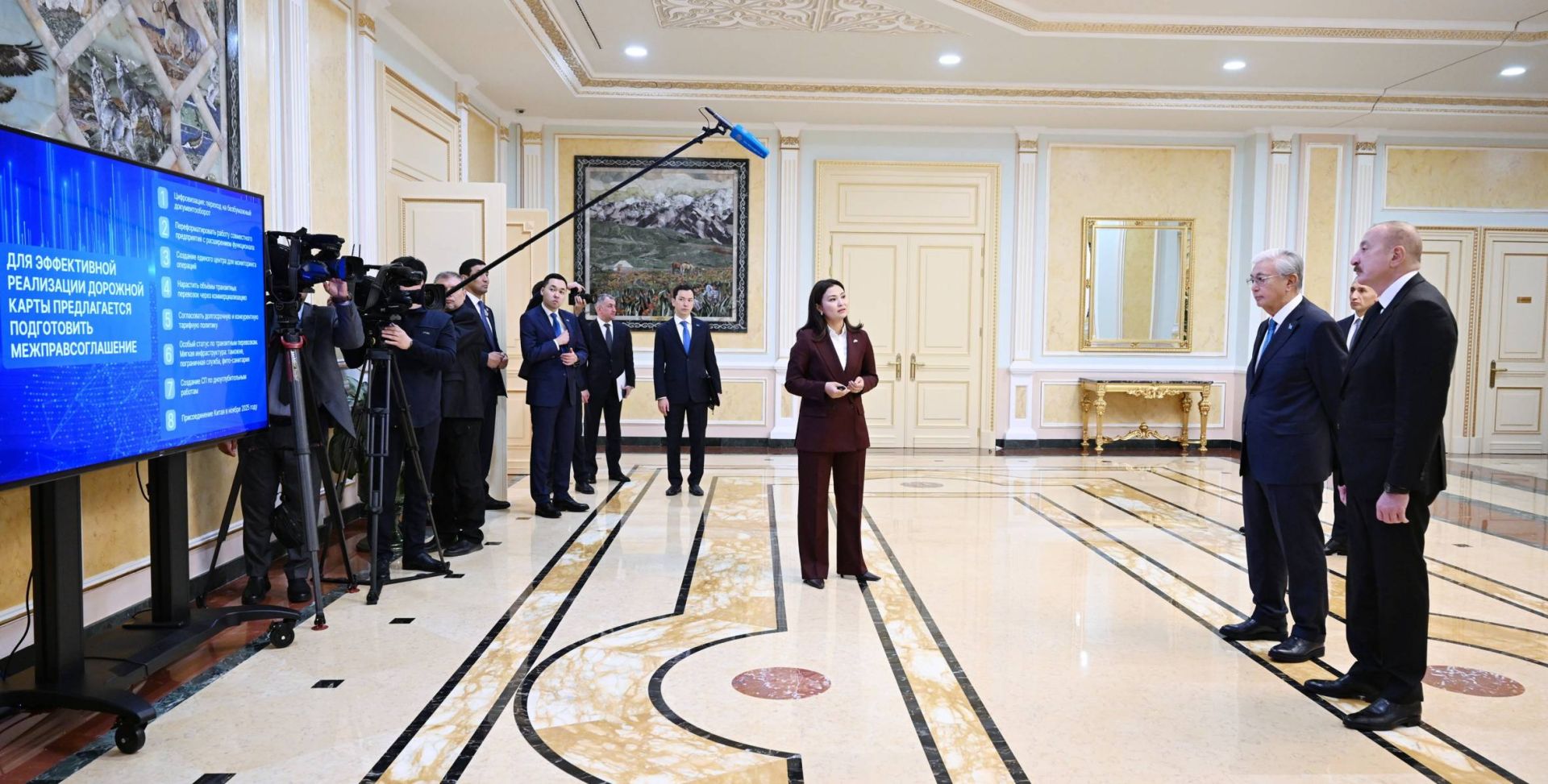
On October 21, the “Middle Corridor Development” project was
presented with the participation of Azerbaijan’s President Ilham
Aliyev and Kazakhstan’s President Kassym-Jomart Tokayev. The
leaders received detailed briefings on the project, highlighting
its current impact and its potential for future growth. Shipments
from China to Azerbaijan along the corridor are steadily
increasing, with projections suggesting a threefold rise by 2030
compared to today’s levels, underscoring the corridor’s strategic
importance for intercontinental trade.
The Middle Corridor is not merely about constructing roads,
railways, and ports. According to IRU Secretary General Umberto de
Pretto, sustainable development of the corridor requires investment
in “soft” infrastructure: digital platforms, harmonized
regulations, streamlined customs procedures, and operational
transparency.
“Infrastructure alone is not enough. Efficient cross-border
transport requires eliminating bottlenecks at borders, reducing
administrative delays, and removing unofficial payments or
excessive checks,” de Pretto noted at the International Transport
Forum in Tashkent. “Without these measures, the potential of the
corridor cannot be fully realized.”
This insight highlights a fundamental analytical point: physical
infrastructure drives capacity, but soft infrastructure determines
efficiency, reliability, and ultimately the corridor’s
competitiveness against maritime and Northern alternatives.
Countries along the corridor are increasingly focusing on
digital solutions to optimize transit flows. Kazakhstan’s “Smart
Cargo” platform exemplifies this trend, offering a unified system
for managing multimodal shipments from Central Asia to Europe. By
integrating logistics operators, port authorities, and rail
operators onto a single digital platform, the project reduces
transit times, increases predictability, and facilitates real-time
monitoring.
Simultaneously, Azerbaijan has expanded cooperation with China
through the Port of Xi’an, opening a 20,000 TEU container yard and
enabling real-time access to port operating systems. This has
translated into measurable outcomes: in the first nine months of
2025, Azerbaijan handled 296 block trains, including 113 transit
trains, marking a 39% increase compared to the same period in 2024.
Container cargo volumes rose 20%, reaching 103,134 TEU,
demonstrating the tangible impact of coordinated operational
improvements on corridor throughput.

The Middle Corridor faces a range of regional and
operational challenges that require coordinated solutions:
– Regulatory differences across countries can create delays in
cargo movement. Efforts toward harmonization and digital management
systems are essential to streamline transit.
– Infrastructure constraints, including limited container
handling capacity at ports and aging rail networks, continue to
require targeted investment.
– Ensuring secure and efficient transit operations remains key
to maintaining confidence among shippers and supporting timely
deliveries.
Regional stakeholders are actively addressing these challenges.
Kazakhstan’s investment in Caspian ports, Azerbaijan’s
collaboration with Chinese partners, and the modernization of the
Baku -Tbilisi-Kars railway demonstrate a shared commitment to
turning the corridor into a high-capacity, reliable alternative.
From an analytical perspective, the corridor’s success depends on
balancing infrastructure expansion, regulatory reform, and digital
management, a strategy that could redefine Eurasian trade
dynamics.
The Middle Corridor’s growth signals more than improved
logistics; it represents a geopolitical and economic realignment.
By strengthening the corridor, Azerbaijan and its partners are
enhancing regional connectivity, diversifying global transit
options, and building resilience against disruptions in maritime or
Northern routes.
For Azerbaijan, the corridor reinforces its historical role as a
bridge between continents. Strategically, it positions the country
not just as an energy exporter, but as a key facilitator of
Eurasian trade, combining infrastructure, technology, and
governance to create a competitive and sustainable transit
corridor.
In analytical terms, the corridor’s development is both a supply
chain optimization strategy and a tool of economic diplomacy, as it
brings together multiple countries under a shared vision of
seamless, secure, and high-volume transit. The Middle Corridor is
no longer a concept—it is a functional artery linking Asia and
Europe, with Azerbaijan at its heart.