
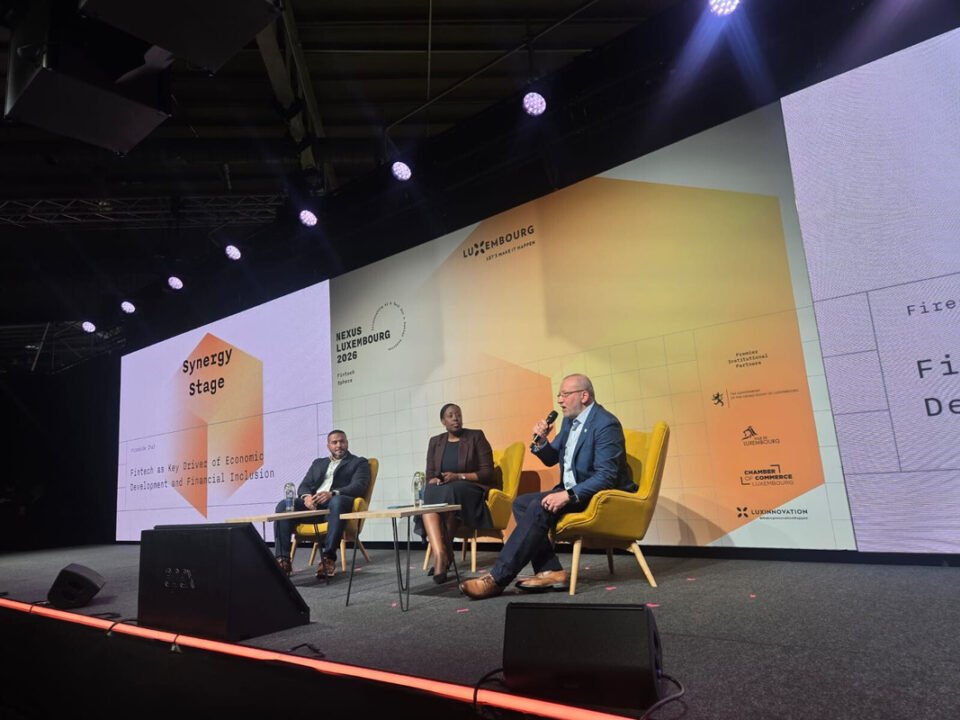
Financial inclusion is no longer just a social objective. Increasingly, it is becoming an economic growth strategy. For years, discussions around fintech have focused on innovation. New payment methods. Digital banking. Mobile wallets. Artificial intelligence. Yet during a fireside chat at Nexus, speakers argued that fintech’s greatest impact may not be technological at all. It may be economic.
The discussion brought together Hortense Mudenge, CEO of the Kigali International Financial Centre (KIFC) and Waleed Sadek, chairman and CEO of Fintra Holding, a company that develops payment infrastructure in Africa. Their message was clear: financial infrastructure has become a key driver of economic development.
Financial inclusion starts with infrastructure
According to Hortense Mudenge, financial inclusion is often misunderstood. Many observers focus on technology. The reality is broader. “It’s about both technology and regulation,” she explained.
Across Africa, the rapid growth of mobile money has demonstrated how access to financial services can expand when the right infrastructure and policy frameworks are in place. Millions of people who previously lacked access to banking services can now make payments, save money and access financial products through their mobile phones.
The next phase goes even further. Digital identity systems, digital public infrastructure and interoperable payment networks are expected to expand access to credit, investments and savings products. For Mudenge, financial inclusion is no longer just about enabling payments. It is about creating pathways into the broader economy.
Payments as economic infrastructure
The strongest intervention of the discussion came from Sadek, who framed payments not as a financial product but as a critical economic infrastructure. Fintra Holding develops payment and financial infrastructure used by governments, central banks and financial institutions across Africa.
According to Waleed Sadek, efficient payment systems have a direct impact on economic activity because they accelerate the circulation of money. To illustrate his point, he referred to a well-known economic formula: GDP=M×V. Where: M represents the money supply. V represents the velocity of money.
By increasing the speed at which money moves between consumers, merchants, businesses and governments, digital payment systems can stimulate economic activity without increasing the money supply itself. “We speed up the circulation,” he explained. “And that boosts economies.” The argument shifts the discussion away from convenience and towards macroeconomics. Payments are not merely a service. They are infrastructure.
The Egyptian example
Waleed Sadek also shared a concrete example from Egypt. According to him, the deployment of digital payment infrastructure helped expand the number of merchants accepting electronic payments from approximately 80,000 to 9.2 million within sixteen months.
If sustained, that type of transformation can have significant implications for financial inclusion, tax collection, transparency and access to credit. More importantly, it demonstrates how infrastructure investments can rapidly increase participation in the formal economy.
Beyond payments
Both speakers stressed that Africa’s fintech story is moving beyond mobile money. The next challenge is interoperability. Financial systems must communicate seamlessly with one another if broader access to financial products is to become a reality.
Hortense Mudenge highlighted that access to finance increasingly includes: savings, investments, insurance, capital markets, entrepreneurship financing. Artificial intelligence and digitalisation are expected to accelerate this transition by reducing costs and simplifying access to services. The foundations have largely been built. The challenge now is scaling adoption.
What Europe can learn?
The discussion also explored whether mature financial centres such as Luxembourg can learn from Africa’s experience. Hortense Mudenge believes they can. One lesson concerns adaptability. “What works for one continent will not necessarily work for another.”
Africa’s success with mobile money emerged because solutions were designed around local realities rather than imported wholesale from more developed markets. The broader message is that innovation often succeeds when it responds directly to real economic needs. In many cases, emerging economies can move faster because they are not constrained by decades of legacy infrastructure.
Rwanda’s ambition
Hortense Mudenge also outlined Rwanda’s ambition to become a regional financial and innovation hub. Through the Kigali International Financial Centre, the country is positioning itself as a platform where entrepreneurs, investors and fintech companies can test and scale new solutions.
She described Rwanda as a proof-of-concept market where innovation can be validated before expanding across the continent. With Africa home to the world’s youngest and fastest-growing population, she believes the opportunities for fintech, digital finance and investment remain significant.
Fintech as a development strategy
For years, financial inclusion has been discussed primarily as a social challenge. The objective was to provide financial services to underserved populations. The conversation at Nexus suggested something broader.
Financial inclusion is increasingly becoming an economic strategy. Payment infrastructure. Digital identity. Interoperability. Digital public infrastructure. Together, they create the conditions for faster economic activity, broader participation and stronger financial ecosystems.
For Europe, the lesson from Africa may be that fintech is not simply about innovation. It is about building the infrastructure that allows economies to grow.