
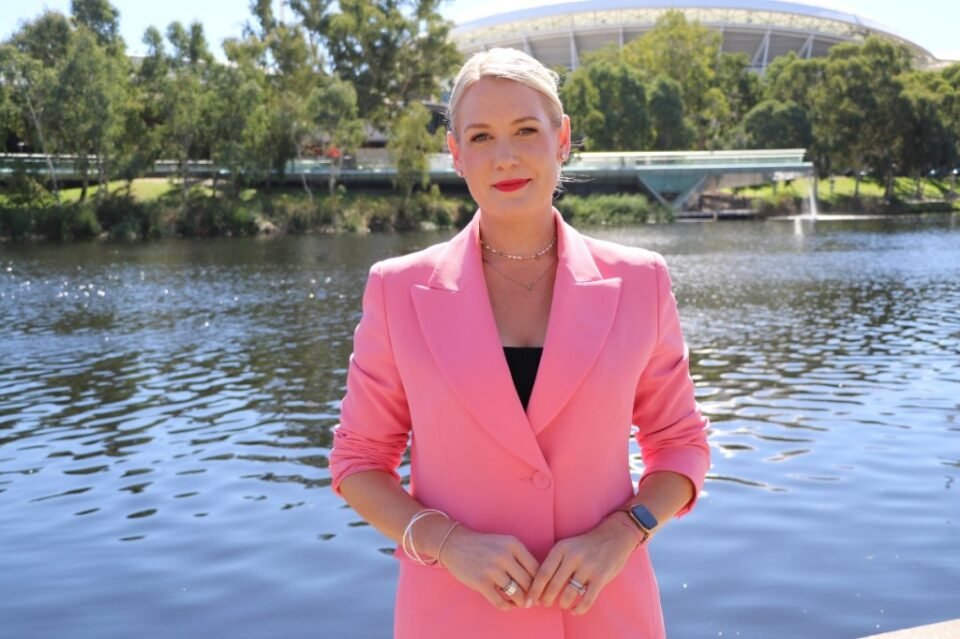
Opposition Leader Ashton Hurn delivered her first budget reply speech in the House of Assembly today, foreshadowing the introduction of a bill designed to reduce government overspending as state debt was set to soar towards nearly $54 billion.
The state’s Opposition was set to introduce the Public Finance Transparency Bill 2026 this week, which would force ministers who blow out their departmental budgets to justify the spending to State Parliament.
“The Bill we are announcing today will force the Premier and his Ministers to be upfront with the public and explain exactly where taxpayer money is being spent and why,” Hurn said.
Treasurer Tom Koutsantonis handed down the 2026-27 State Budget on June 4, with major projects such as the North South Corridor and new Women’s and Children’s Hospital contributing to a ballooning state debt set to reach almost $54 billion by 2030.
The State Budget focused on cost-of-living, support for regions and a new productivity fund to build complexity into the state’s economy, with a partial hiring freeze in the public service estimated to save the state $120 million annually.
In her speech today, Hurn called the projected state debt an “extraordinary figure” and “one that we’ve never seen in the history of South Australia”, claiming “this Labor government can simply not manage money”.
The Opposition Leader claimed there had been $6 billion worth of budget blowouts since the Malinauskas Labour Government was elected in 2022.
“It’s done that through carelessness, it’s done that through blatant mismanagement, and it’s done that through pursuit of vanity projects,” she said, in reference to the scrapped $600 million Whyalla hydrogen power plant.
Hurn said 27 out of 28 departments had blown out their budgets this financial year alone, with a combined blowout of $1.3 billion across government departments.
She told Parliament the Department of Premier and Cabinet had overspent its budget by $134 million, infrastructure by $195 million, child protection by $132 million, the police by $48 million and tourism by $85 million.
“Those numbers are shocking, but they’re actually not surprising because overspending is becoming somewhat of a hallmark of this Malinauskas Labor government,” she said.
Other measures in the Liberals’ Public Finance Transparency Bill include a stipulation that, if a department becomes aware it will overspend its budget for a financial year, the responsible minister must table an explanation for the blowout to parliament within a month.
The Treasurer would also be obliged to give a monthly statement on how much flowed in and out of the public purse, and how this impacts state debt, and would have to release an “up-to-date” economic and fiscal outlook within seven days of a general election being called.
While on Budget day, the Treasurer would have to release a 10-year economic budget position, with the aim of preventing spending from being hidden outside of forward estimates.
Additionally, after major events and projects are finished, the responsible minister would have to disclose relevant contracts and spending commitments to both chambers of Parliament.
“If this government truly believes in a budget of no surprises, then it should have no hesitation in supporting these measures, because transparency should not be feared by any government that is confident of its economic management,” she said.
A theoretical Hurn Liberal government would use the additional $1 billion in GST revenue above forecasts over the next four years to pay back state debt.
It would also save money by reducing the public service by 4000 back-office positions, while reducing spending on consultants, advertising and ‘spin doctors’, which Hurn said could save $2 billion over four years.
In addition, it would increase the payroll tax threshold for small to medium-sized businesses from $1.5 to $2.1 million, while employers training “the next generation of tradies” would be exempt from the tax.
A Hurn Liberal government would also introduce stamp duty concessions for first home buyers on existing homes and introduce a six-point fuel security and resilience framework, including grants and low-interest loans “to help farmers install and expand compliant on-farm storage”.