
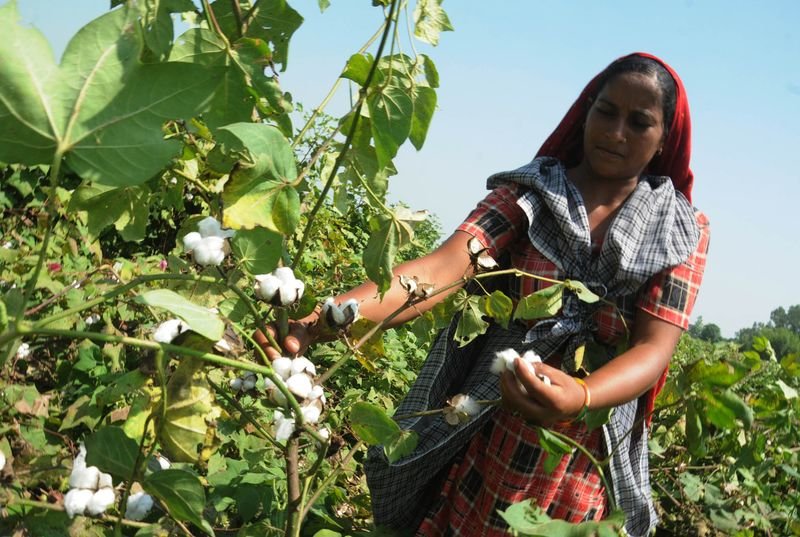
A study by agricultural economists and extension specialists at Chaudhary Charan Singh Haryana Agricultural University (HAU), Hisar, has painted a grim picture of cotton farming in Haryana, explaining why the crop’s acreage has fallen to its lowest level in seven years.
According to the Haryana Agriculture and Farmers’ Welfare Department, cotton cultivation in the state has declined sharply from more than 8 lakh hectares in 2019-20 to just 2.82 lakh hectares in the 2025-26 kharif season — a fall of nearly 5.17 lakh hectares or about 65 per cent. The decline reflects the successive losses suffered by cotton growers over the years.
The HAU study found that cotton farmers incurred an average net loss of Rs 15,143 per acre during the 2025 kharif season. The average gross return stood at Rs 24,882 per acre, far below the total cultivation cost of Rs 40,024 per acre.
The analysis was carried out by HAU experts Dr Vinay Mehla, Dr Ashok Kumar, Dr Gulab Singh, Dr Sanjay Kumar, Dr Parveen Kumar and Dr Sumit.
According to the report, cotton is one of Haryana’s major irrigated cash crops during the kharif season and is primarily cultivated in Hisar, Bhiwani, Fatehabad, Mahendragarh, Rewari, Charkhi Dadri and Sirsa districts. However, the average cotton yield declined to 4 quintals per acre from 5.70 quintals per acre in the previous year. At the same time, the average market price fell to Rs 6,020 per quintal from Rs 7,071 per quintal last year.
The findings, which form part of the university’s report on the economics of major kharif crops in Haryana, point to a sharp deterioration in the profitability of the state’s principal cash crop due to declining yields and lower market prices.
Although farmers earned a return of Rs 2,060 per acre over variable costs, the study noted that this does not reflect the true financial position. Once management charges, risk costs, transportation expenses and the rental value of land are included, cotton cultivation resulted in substantial losses.
The state-level analysis shows that the total cultivation cost averaged Rs 40,024 per acre against gross returns of Rs 24,882 per acre, leaving farmers with a net loss of Rs 15,143 per acre. The study attributes these losses primarily to lower productivity and weaker market prices.
Farmers, therefore, faced a double setback — producing less cotton while receiving lower prices for their produce.
The detailed cost analysis highlights the high investment required for cotton cultivation. Farmers spent an average of Rs 22,821 per acre on variable costs, including land preparation, sowing, seed, fertilisers, irrigation, weeding, plant protection measures, picking and threshing operations.
In addition, the rental value of land was estimated at Rs 12,191 per acre, management charges at Rs 2,282, risk factor charges at Rs 2,165 and transportation expenses at Rs 564 per acre. Together, these pushed the total cultivation cost to Rs 40,024 per acre.
The report found cotton cultivation to be loss-making across all surveyed districts. Farmers in Hisar recorded the highest average loss of Rs 17,515 per acre, followed by Fatehabad (Rs 17,315), Charkhi Dadri (Rs 15,276), Bhiwani (Rs 14,852), Mahendragarh (Rs 14,114), Sirsa (Rs 11,250) and Rewari (Rs 9,548).
The economics become even more challenging considering the cost of inputs. According to the report, farmers spent an average of Rs 1,622 per acre on seed and about Rs 2,773 per acre on fertilisers alone.
However, the report does not specifically examine the impact of recurring pest attacks, including pink bollworm and whitefly or unseasonal rainfall in several parts of the state. Farmers have repeatedly cited these factors as major reasons for poor yields and successive crop failures over the past seven years.
The farmers maintained that pest infestation remains the biggest challenge to cotton cultivation. They alleged that despite repeated outbreaks of pink bollworm and whitefly, the agriculture authorities have not been able to provide an effective, affordable and sustainable solution to control the pests.