
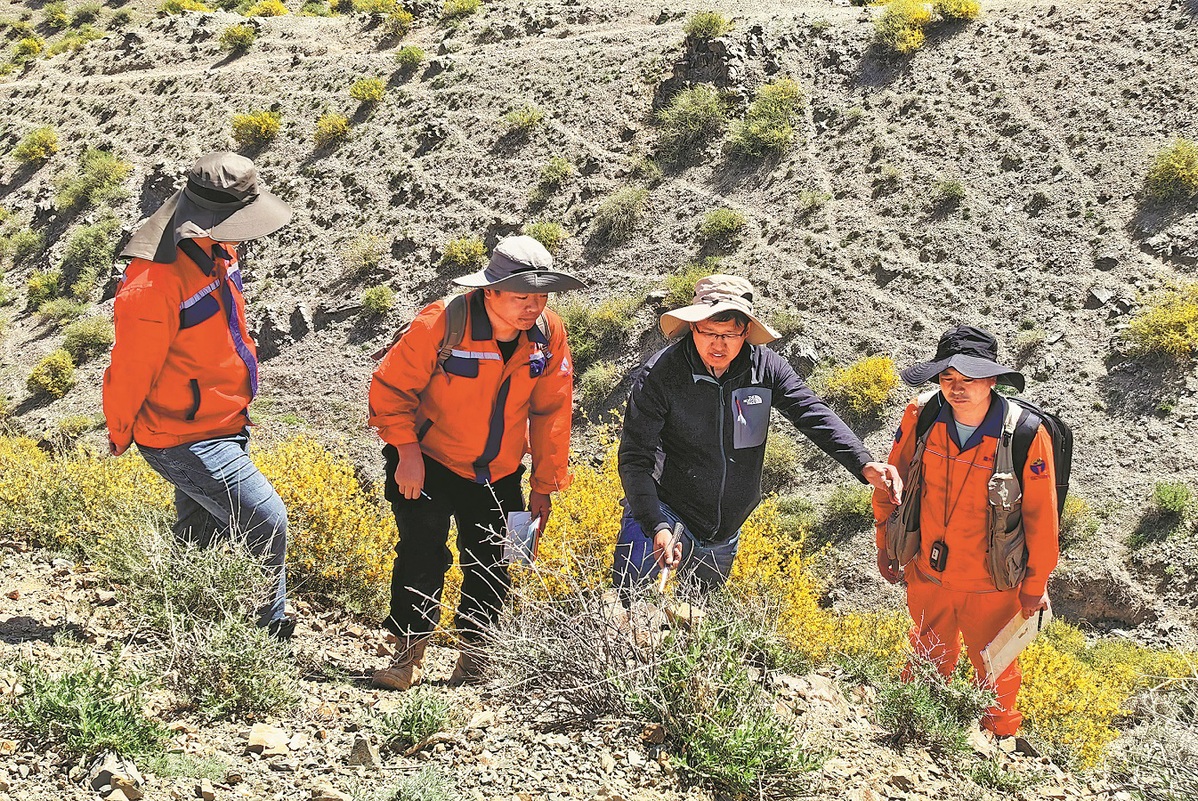
For generations of geologists on the No 6 Geological Team of the Shandong Provincial Bureau of Geology and Mineral Resources, members of the Communist Party of China have set the standard by volunteering for the toughest assignments, pressing ahead where others saw only dead ends and passing on a spirit of dedication that has transformed China”s gold exploration.
That spirit has helped the team discover 14 superlarge gold deposits and 128 large, medium and small deposits in nearly seven decades, reshape international gold metallogenic theory and identify more than 2,800 metric tons of gold reserves, which is nearly one-fifth of China’s total discovered gold reserves.
As the CPC marks its 105th anniversary on Wednesday, 198 Party members, who make up around half of the team’s strength, reaffirmed their commitment to carrying forward the tradition.
“As Party members, we answered the State’s call to find gold without hesitation, and we delivered. And that promise will continue to echo beneath the mountains and the seas,” said Ding Zhengjiang, leader of the team, who started working as a geologist in 1999.
Efforts praised
In 2022, the team received a letter of reply from Xi Jinping, general secretary of the CPC Central Committee, who praised generations of geologists for enduring harsh conditions to yield rich fruits in mineral resource exploration and encouraged them to strengthen exploration efforts and pursue sci-tech breakthroughs.
Ding, 49, said that Xi’s reply to the team’s letter came as a great surprise and a source of encouragement.”Some of our veteran members teared up. To be remembered, recognized and asked to go deeper — that means everything,” he added.
In the 1950s, China produced only about 6 tons of gold each year, while the country’s industrialization drive demanded far more. In 1958, a group of 94 young geologists were sent to the mountains of Zhaoyuan in East China’s Shandong province.
Back then, gold was of vital importance for the newly founded People’s Republic of China, because it was a crucial source of foreign exchange reserves, Ding said.
“Zhaoyuan was chosen as the starting point of the mission, because despite decades of war that left the mines there shattered, it was once the richest gold belt in the country. However, the task was challenging — finding the gold everyone thought had been mined out,” he said.
Spirit of dedication
Party members took the lead under conditions Ding described as “cruel”, because “every step forward could have been the last”.
Team members slept on wooden planks in drafty thatched huts and survived on coarse grains and pickled vegetables. Armed only with hammers, compasses and magnifying glasses, they entered abandoned mine shafts by the dim glow of carbide lamps, recording geological data while risking cave-ins.
After four years of mapping and trenching, the team identified 48 gold-bearing quartz veins in the Linglong mining area, breathing new life into the century-old mining district.
The defining breakthrough came by challenging prevailing international theory, which held that the principal fault zones of the Jiaodong Peninsula were incapable of hosting large gold deposits. In late 1965, three team members trekked through knee-deep snow to Sanshan Island and collected 105 rock samples. Laboratory analysis showed that more than half of these samples contained industrial-grade gold.
The team then decided to drill directly into the fault zones. In 1969, it discovered a superlarge deposit containing 67 tons of gold, giving rise to the Jiaojia-type altered-rock gold deposit model and reshaping geological understanding of gold mineralization.
The pioneering spirit continued as shallow resources became depleted. In 2007, the team discovered a 51.83-ton superlarge deposit in the deep section of the Sizhuang mining area in Laizhou, Shandong, opening a new era of deep exploration. More discoveries followed, transforming the Jiaojia fault zone into a gold belt with reserves exceeding 1,000 tons.
The team’s technological advances have matched its determination. It has completed more than 5.2 million meters of drilling, which is 600 times the height of Qomolangma, known as Mount Everest in the West. The team has also broken the national record for small-diameter drilling efficiency six times and set a national drilling-depth record on three occasions.
Ding said the team has also expanded offshore, leading China’s first combined land-sea seismic survey for deep gold deposits in the waters off Shandong and identifying a new offshore gold belt.
In addition, the team has carried out geological surveys in more than 10 countries, including the United States, Algeria, Sudan, Tajikistan and Australia, and identified 156 tons of gold resources overseas, he added.