
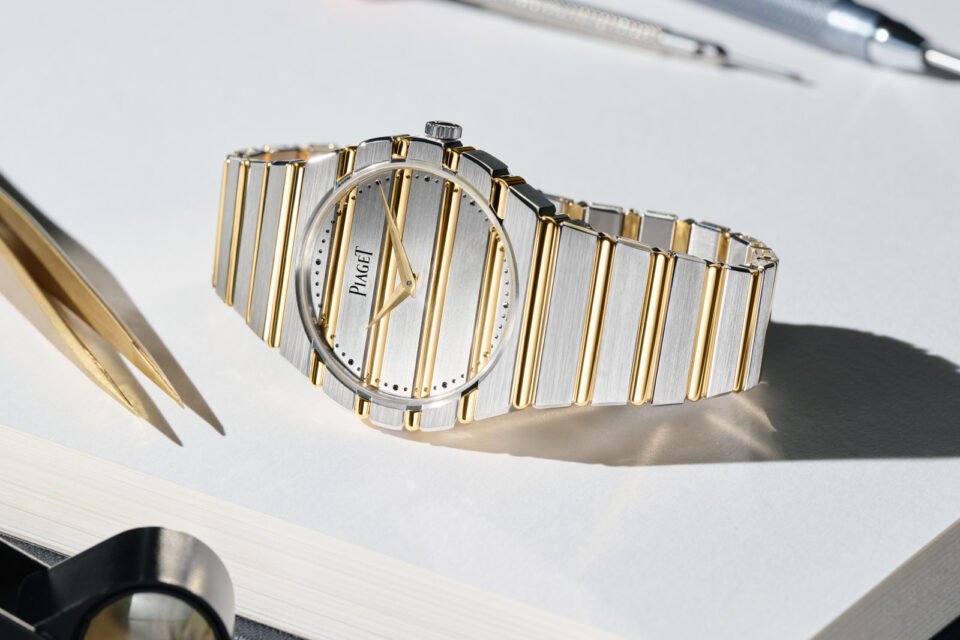

The Piaget Polo 79 has in relatively short order become one of my favourite integrated bracelet watches. It has an undeniable air of confidence in its bold shapes and the alternating finish across its brushed bars and polished gadroons. After the original yellow gold and subsequent white gold editions they’ve followed the natural progression with the launch of the Piaget Polo 79 Two-Tone.
Bi-metal watches typically follow a similar pattern where the case body will be in the silver tone metal while the bezel and centre bracelet links will be golden. Here though, Piaget have used the distinctive structure of the Polo 79 to brilliant effect. The main portion of the case and bracelet are made from white gold while it’s the gadroons that switch things up with yellow gold. It creates a distinctive, almost striped appearance with the alternating colours that looks unlike any other watch I can think of from the top of my head.


Structurally, it has the same dimensions as it predecessors with a 38mm diameter and 7.45mm thickness, giving it slim proportions that suit its dress watch status. The continuous flow of the design across the case body into the integrated bracelet does make the watch seem larger than it is on paper. Especially in combination with the sharp, vertical sides of the design that create a strong geometric appearance almost like brutalist architecture.

In fact, the links where it transitions from case to bracelet have a trapezoid shape that reminds me somewhat of Toledano & Chan’s signature case shape. Further to that, the combination of white and yellow gold on the Polo 79 Two-Tone is a precious metal parallel to the b.1-3r’s titanium case and gold dial. Most dress watches tend to lean either towards Art Deco or Classical styles so to be honest, I am totally here for the expression of beauty through an alternative route like brutalism using big, imposing shapes.
Powering the watch, and visible through the exhibition caseback, is the calibre 1200P1. It’s Piaget’s ultra-thin micro-rotor movement with hours and minutes and 44-hour power reserve. It uses the version from the original yellow gold Polo 79 with its matching yellow gold rotor, rather than the white gold rotor seen in the white gold edition. It’s a choice that makes sense because it plays stronger into the Two Tone theme. It’s finished with Geneva waves and perlage.

For pricing, it’s more or less where you would expect it to be in terms of progression from the existing models. The original yellow gold is £70,000, the white gold is £77,000 and given its combination of materials, the Two-Tone crosses over into the £80,000 bracket at £84,000.
Price and Specs:
Model: Piaget Polo 79 Two-Tone
Case: 38mm diameter x 7.45mm thickness, brushed white gold case with polished yellow gold gadroons
Dial: Solid gold, brushed silver-toned finish with horizontal gadroons
Water resistance: 50m (5 bar)
Movement: Piaget calibre 1200P1, automatic, micro-rotor
Frequency: 21,600 vph (3 Hz)
Power reserve: 44h
Functions: Hours, minutes
Strap: Integrated white and yellow gold bracelet
Price: £84,000
More details at Piaget.