
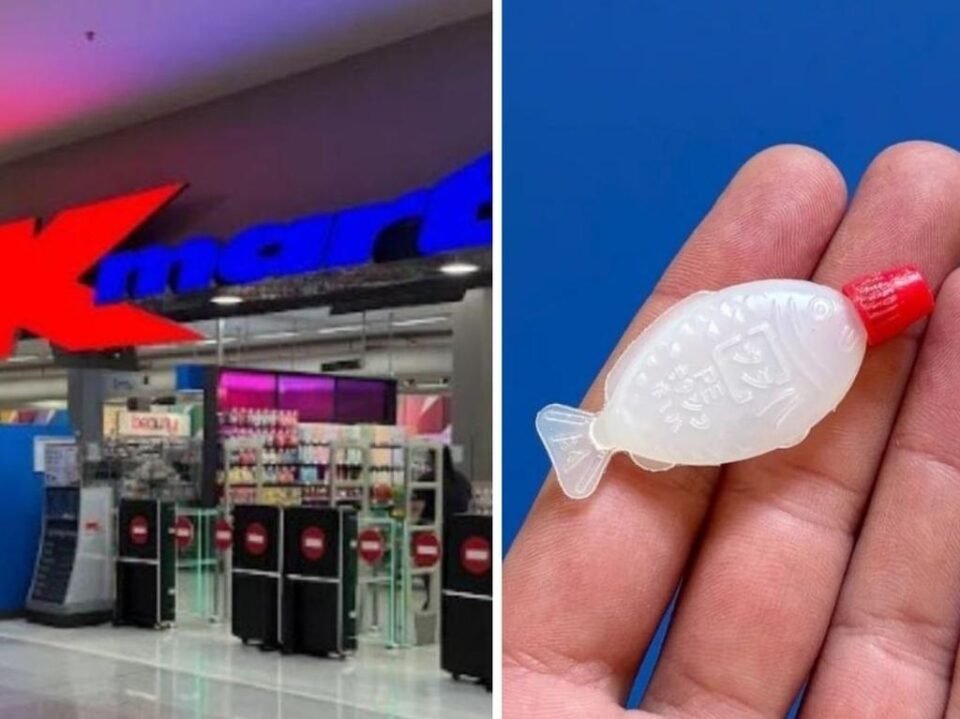

Kmart has been called out for its plastic load on the environment.
Retail giants Kmart, Coles, Woolworths and Aldi have been slammed over a common move that’s swamping Aussie homes, with even neighbourhood takeaways in the firing line.
Just weeks after the inaugural Unpackit Awards – Australia’s first national campaign to name and shame, and celebrate, the country’s best and worst packaging – handed down their verdicts, a new survey has found Australians want things to change.
Anko’s plastic packaging was slammed, including wrapping weights in plastic and then placing them in hard plastic. Source: Unpackit Awards
Aussies across the political spectrum backed action on unnecessary packaging, according to polling by YouGov commissioned by the Australian Marine Conservation Society, with nearly two thirds (63 per cent) of voters now supporting mandatory packaging laws to replace failed voluntary targets, with support rising to 70 per cent among Labor voters.
This as one of Australia’s most purchased product lines – Kmart’s Anko range – earned the Unpackit Iceberg Award, named for the waste hidden below the surface that shoppers only discover after they get home.
Kmart’s Anko dumbbell set was among products flagged given individual weight plates were wrapped in plastic and then placed inside a hard protective plastic case.
One nominator was flabbergasted: “Why do weights, of all things, need to be protected in plastic bags? Who told the manufacturers that this is what Aussies want?”
Three of Australia’s biggest supermarket chains – ALDI, Coles and Woolworths – shared the Nature Had It Covered Award for wrapping avocados in plastic netting that sheds microplastics when opened.
“I hate myself for buying produce in net bags but often there is no choice, so I do,” one nominator said.
The plastic soy sauce fish was banned by South Australia in September last year with the move spreading into pockets of New South Wales and pressure building for more such action. Image: Heliograf / Vert Design
The home-compostable Holy Carp! alternative, made from bagasse pulp. Image: Heliograf / Vert Design
National packaging laws promised by the Albanese Government in 2022 are still not in place, with the survey coming just over nine months after the South Australian government’s single use plastic ban extended to tiny fish-shaped soy sauce containers popular with Asian takeaways.
Susan Close, who was deputy premier at the time, said the small plastic soy sauce bottles were “too small to be captured by sorting machinery” in recycling plants, often ending up in landfill instead.
Some innovation has resulted, with a South Australian design studio Heliograf – working with Vert Design’s Angus Ware – developing Holy Carp! as a direct response to the ban, crafting a home-compostable alternative that decomposes within four to six weeks. It functions identically to the plastic original: squeeze the belly, dispense the soy sauce.
There is no current Australian legal limit on how much packaging a product can include, no requirement for packaging to serve a functional purpose, and no obligation to disclose hidden packaging that consumers cannot see on the shelf.
AMCS plastic campaigns manager Cip Hamilton did not mince words. “It’s clear that Australians have had a gutful of unnecessary packaging and want laws that stop pollution at the source, not another decade of voluntary promises that industry can ignore,” she said.
“The Albanese Government promised in 2022 to deliver much-needed national packaging laws. Four years on, we’re all still waiting.”
Label from a Woolworths disposable plastic bottle on a beach. Source: Unpackit Awards
Coles disposable juice box made with plastic on a beach in Victoria. Source: Unpackit Awards
The overall worst packaging award went to the neighbourhood takeaway – or more precisely, the fill-on-site plastic sealed can increasingly appearing at cafe counters across the country which combine plastic and metal in a way that makes them unrecyclable.
“Filled-on-site plastic cans somehow manage to combine the worst parts of single-use plastic and performative branding into one unnecessary package,” said expert panel member Murray Richards. “In 2026, packaging should solve problems, not indulge in ‘greenwash cosplay’ while sending more disposable plastic into the world.”
Western Australia has already banned them, but expert panels and campaign organisers alike warned that state-by-state bans will always play catch-up against a rising tide of plastic overproduction.
The best packaging award went to a Tasmanian business that asked a simple question: why does every cafe in the country start its morning by opening thirty plastic milk bottles and throwing them all in the bin?
The Udder Way delivers 18-litre reusable milk kegs – roughly the size of a standard milk crate – that connect to a tap, dispense milk, then go back to be cleaned, refilled and returned, exactly like a keg at the pub.
Disposable plastic bottles in the ocean in Australia. Source: Unpackit Awards
Since launch, the company estimates more than 4.5 million single-use plastic milk bottles have been avoided, displacing more than 246,000 kilograms of plastic waste. Australia uses more than 500 million single-use plastic milk bottles every year.
“Refillable milk is a no-brainer,” one nominator said. “I wish it was more mainstream.”
Packaging makes up 60 per cent of all litter collected across Australia, with the Unpackit Awards organisers warning without mandatory national packaging laws, businesses can keep producing packaging that serves no purpose, hides waste from consumers and sends plastic into the environment with no legal consequence.
The YouGov poll, conducted across 1,501 voters between May 5 and 12 2026, found support for mandatory laws at 84 per cent among Greens voters, 74 per cent among independents, 66 per cent among Coalition voters, and 58 per cent among One Nation voters. Nine in ten Australians (89 per cent) say the country should reduce its reliance on imported single-use plastic packaging.
“Every day the government delays, the more unnecessary packaging ends up polluting our beaches and ocean,” Ms Hamilton said. “Sea turtle hatchlings have been found with hundreds of plastic fragments in their guts. Corals are 20 times more likely to be diseased after contact with plastic. This is not a problem we can voluntarily think our way out of.”
A parliamentary hearing into the Extended Producer Responsibility Scheme for Packaging Bill 2026 was held in Canberra on June 26. The Albanese Government has not committed to a timeline for legislation.