
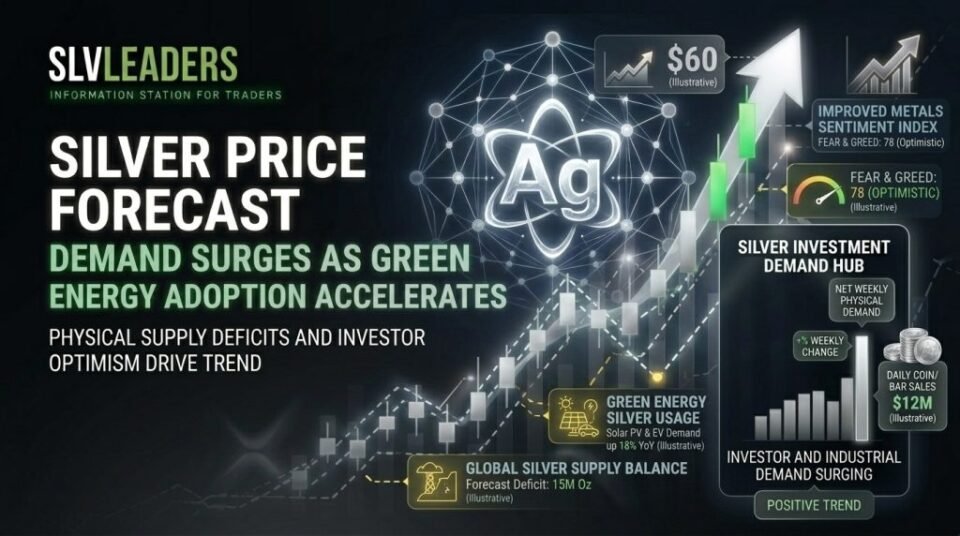
Silver prices hover near $60 in July 2026 amid 6th deficit year & booming solar/EV demand. Explore Fed policy, US-Iran deal impact & technical outlook for smart investing insights.
As of July 7, 2026, prices of silver remain steady around $60 per ounce over a slow-moving weekend. Traders are assessing the metal’s fundamentally sound long-term outlook against near-term factors such as a stronger greenback and softening geopolitical stress.
If you are unfamiliar with this asset class, silver is best described as a hybrid: it serves as an essential industrial metal for solar and electric vehicles, while simultaneously acting as a haven asset for risk-averse investors in volatile markets.
Its two-pronged role makes for dynamic price action: while safe-haven demand wanes as tensions relax, industrial use is supporting prices.
Silver’s Long-Term Bullish Case for Deficits
In 2026, silver will be in its sixth consecutive year of deficits with the Silver Institute anticipating 46 million ounces in shortfall. Mine supply increases only modestly since most silver is produced as a byproduct of base metal mining operations; silver miners cannot simply crank up their production when prices rise.
-
More than half of silver use is for industrial needs; for instance, photovoltaics (solar panels) account for about 20% of global consumption because of the global energy transition.
-
There is sustained growth across technology applications and in electric vehicles.
-
Global stocks remain tight since China is the world’s largest consumer of silver.
These dynamics are consistent with structural themes such as a global energy transition. Though there is some technological breakthrough in efficiency with respect to manufacturing photovoltaic cells, the enormous volume of investment required to deploy solar panels at the current global scale creates a structural demand that is unlikely to abate soon.
So for the ordinary investor, there is more than just a market euphoria at play, as silver is underpinned by real end-use demand in an increasingly electrified and digital world.
Short-Term Pressure From Geopolitics and Federal Reserve Rates
The U.S.-Iran interim nuclear pact known as the Islamabad Memorandum of June helped contain potential spikes in oil prices and lowered geopolitical risks.
That, however, has resulted in a drop in safe-haven demand for silver; but with the current state of the region still fraught with tension, the agreement remains on shaky ground. On a related note, lower oil prices have reduced inflation risks, which, in turn, supports industrial activity.
In mid-June, the Federal Reserve, led by Kevin Warsh, maintained its interest rates unchanged in keeping with its data-centric approach and vigilant stance. The persistence of inflation at 3.8 percent, in headline consumer prices over the past few months, and real rates higher than they have been for a while, has supported the US dollar, exerting pressure on the metal’s price.
Meanwhile, relatively softer-than-expected labor data has continued to support the market expectation of eventual monetary policy easing to maintain the soft-landing scenario. In that environment, silver’s dual nature is useful: a decrease in geopolitical risk is often accompanied by an increase in industrial activity.
Silver Price Analysis: Selling Prevails but Watch $61.55
On the 4-hour timeframe, silver trades at $60.05 after breaking out of an extended downtrending channel. With lower highs and lower lows, $67 (the 200 EMA) presents strong resistance in the immediate future. Should silver reclaim and hold above $61.55, bulls will target $62.72 and higher. On the downside, a break in support targets $59.06 and $57.51.
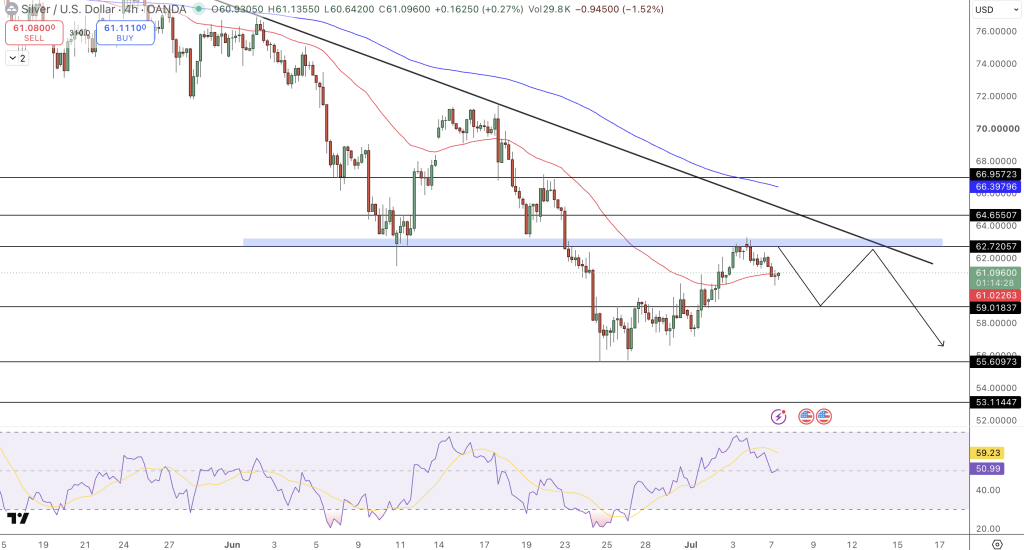
The RSI is trading at 59, suggesting that the metal has plenty of room to move higher or lower. That said, without a clear breakout in price or technical indicators, the overall bias remains neutral.
What Comes Next for Silver
Key catalysts on the horizon:
-
Upcoming inflation reports, retail sales, and PMI data could drive expectations for the Fed.
-
Progress or setbacks in the proposed US-Iran deal could affect safe-haven flows.
-
The US dollar and US Treasury yields remain headwinds in the near-term.
-
Further data on the production outlook in the solar and EV sectors will show industrial strength.
While headlines have caused silver to fluctuate recently, the precious metal’s investment case remains appealing during uncertain times. The underlying supply-demand story, as seen in the strong demand from green energy technologies and other technological applications, provides long-term investors with a compelling case for the energy transition and digital technology sectors.
The metal’s short-term trajectory will be determined by macroeconomic developments and industrial demand, but its long-term fundamentals are strong as it moves into a supply deficit. Investors should monitor macroeconomic trends and industrial demand data to see how silver performs into late 2026.