
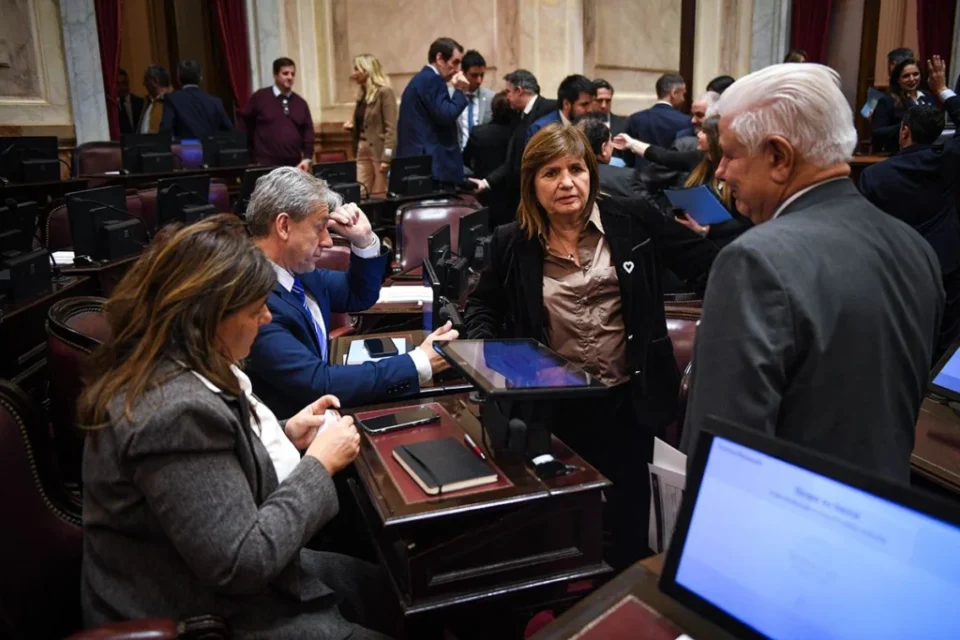
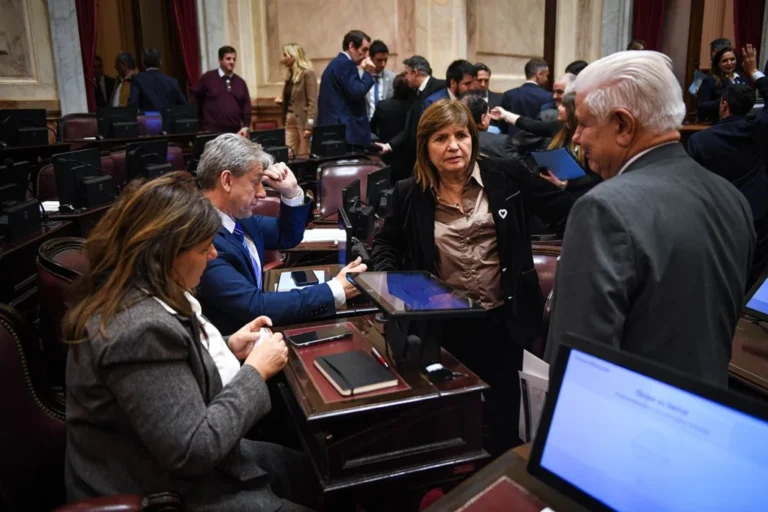
For the fourth time, ruling party failed to gather the votes needed to approve the initiative, even though the text has already been modified 15 times with the aim of reaching consensus among the different parliamentary blocs. Photo: Argentine Senate.
July 16, 2026 Hour: 10:11 pm
-
-
-
-
-
-
PDF
🔗 Comparte este artículo
The Argentina’s Senate this Thursday postponed debating President Javier Milei’s private property bill, which seeks to eliminate limits on foreign land ownership and repeal environmental protections on fire-ravaged lands across the country.
The proposed Inviolability of Private Property Act represents a core element of Javier Milei’s neoliberal reform agenda, which aims to make state nationalization and expropriation processes extremely difficult while simultaneously deregulating foreign land ownership.
After facing fierce resistance from opposition blocks in the Senate, the ruling coalition’s legislative chief, Patricia Bullrich, announced a parliamentary recess until August 6 to seek consensus.
RELATED: Argentina Registers Soaring Labor Informality in 2026, Near 2001 Crisis
The government seeks to alter Land Law 26.737, which was sanctioned in 2011 to restrict foreign ownership of rural land to 15% at federal, provincial and municipal levels. President Milei previously attempted to repeal this law through Article 154 of the Mega DNU 70/23, but a federal judicial injunction suspended those effects.
Under the new legal framework, foreign states would still require special authorization to buy land, but private foreign entities would face no limits. Similar to changes made to the Glaciers Law, the bill delegates the power to establish land-acquisition limits to individual provinces.
Another of the amendments incorporated in the opinion is the so-called “administrative silence”, a mechanism which provides that, if provincial or national authorities do not issue a ruling within the prescribed time limits, the corresponding authorization shall be deemed to have been granted automatically.
Text reads: “With 62 votes in favour, 3 against and 1 abstention, the motion of the senator @PatoBullrich to give way to a fourth intermission for August 6 is adopted.”
Environmental Protection Gutted
The bill also targets Fire Management Law 26.815, specifically proposing the repeal of Article 22 bis. The current law, modified in 2020 to prevent speculative real estate arson, prohibits any changes in land use for 60 years following a fire in native forests, protected natural areas, or wetlands.
Alongside the eviction reform, the legislative package targets Argentina’s Fire Management Law by repealing the article that previously prohibited land-use changes for 30 years on rural properties affected by fires in agricultural zones, grasslands, shrublands and peri-urban areas. Environmental organizations have long documented a pattern of intentional fires in Argentine Patagonia linked to speculative real estate interests seeking to convert protected natural areas into development projects or monoculture plantations.
Milei’s proposal completely eliminates these 60-year and 30-year restrictions, allowing immediate commercial development on burned properties. This move has sparked deep concern in Argentinean Patagonia, where real estate developers have a history of using intentional forest fires to clear land for luxury developments. Environmental organizations have labeled the move as an invitation to eco-destruction, directly rewarding criminal arson.
This legislative push comes amid a systematic defunding of state environmental protection agencies. The Milei administration has slashed the budget of the National Fire Management Service by 69% compared to 2023 levels. Critics point out the blatant contradiction of claiming to strengthen preventive environmental regimes while actively dismantling the financial and physical infrastructure required to fight forest fires.If approved, the law will fundamentally reshape Argentina’s territorial and environmental landscape. By easing expropriation barriers for private companies and allowing unlimited foreign purchases of rural estates, the reform aligns with Milei’s goal of absolute market deregulation.
Environmental defenders argue that removing these temporal protections creates a perverse incentive for arson: charred land can now be repurposed for real estate development, cultivation or pine forestry within a much shorter timeframe.
The Argentinean government justifies the reform by arguing that previous restrictions were overly rigid and prevented productive economic use of degraded land. However, critics contend that the legislation lacks mechanisms to prevent fraudulent fire claims or to monitor environmental consequences, effectively rewarding illegal burning.
The Senate’s upcoming debate be crucial in determining whether the state retains its regulatory power over national territory or surrenders it to speculative markets.
Text reads: “A good one: the treatment of the project that enables the foreignisation of our lands is postponed. The government does not have the votes. Now to continue to inform and raise awareness about the consequences of this law to stop it once and for all. Sovereignty is non-negotiable.”
The land foreignization component of the package, which eliminates restrictions on foreign purchase of rural territory, remains stalled after the Senate postponed debate for the fourth time until August 6.
Meanwhile, the express eviction and fire law reforms continue advancing through committee, exposing deep divisions not only between the opposition and the ruling coalition but also within the government’s own legislative bloc. Senators from Patagonian provinces have expressed particular alarm over the environmental rollback, while tenant advocates are mobilizing nationwide protests ahead of the next congressional session.
Text reads: “Foreign lands in Argentina”
Author: Laura V. Mor
Source: Pagina 12 / Tiempo Argentino