
Cross-Border Payments on Crypto Infrastructure: The $857 Billion Opportunity Behind the Financial Super App
The average cost of sending $200 internationally remains around
Across the
Many firms and individuals routinely lose 6-7% on standard cross-border payments after accounting for bank fees and FX markups as well as middleman processing. The traditional remittance model relies on a fragmented network of correspondent banks that systematically extract value from global capital flows through hidden spreads and delayed settlements.
How Stablecoin Settlement Changes the Economics
Shifting global capital via blockchain rails alters the fundamental cost structure of remittances. A transfer using USDT on the Tron network costs approximately $0.50 regardless of the amount sent. At the same time, it costs between $2 and $20 to send USDC on Ethereum depending on network congestion.
Senders could save
The exact same transfer via stablecoins costs less than $1 in network fees, plus optional 0.1 to 0.5% service fees if an exchange is involved. During
Stablecoins moved roughly
The Super App Advantage Over Standalone Remittance Services
When the recipient’s platform offers investment access, yield products, and localized payment rails, the remittance functions as an onramp to broader financial participation rather than just a simple money transfer.
Binance increasingly positions itself beyond a cryptocurrency exchange as an integrated financial platform. “Binance is the largest crypto ecosystem in the world. We are a financial super app. Beyond crypto, we offer users exposure to a growing suite of products,including, U.S.-listed stocks and ETFs, as well as derivatives providing exposure to commodities, precious metals and pre-IPO opportunities. The product suite keeps expanding, and we see Binance becoming part of the global financial infrastructure,” Teng said.
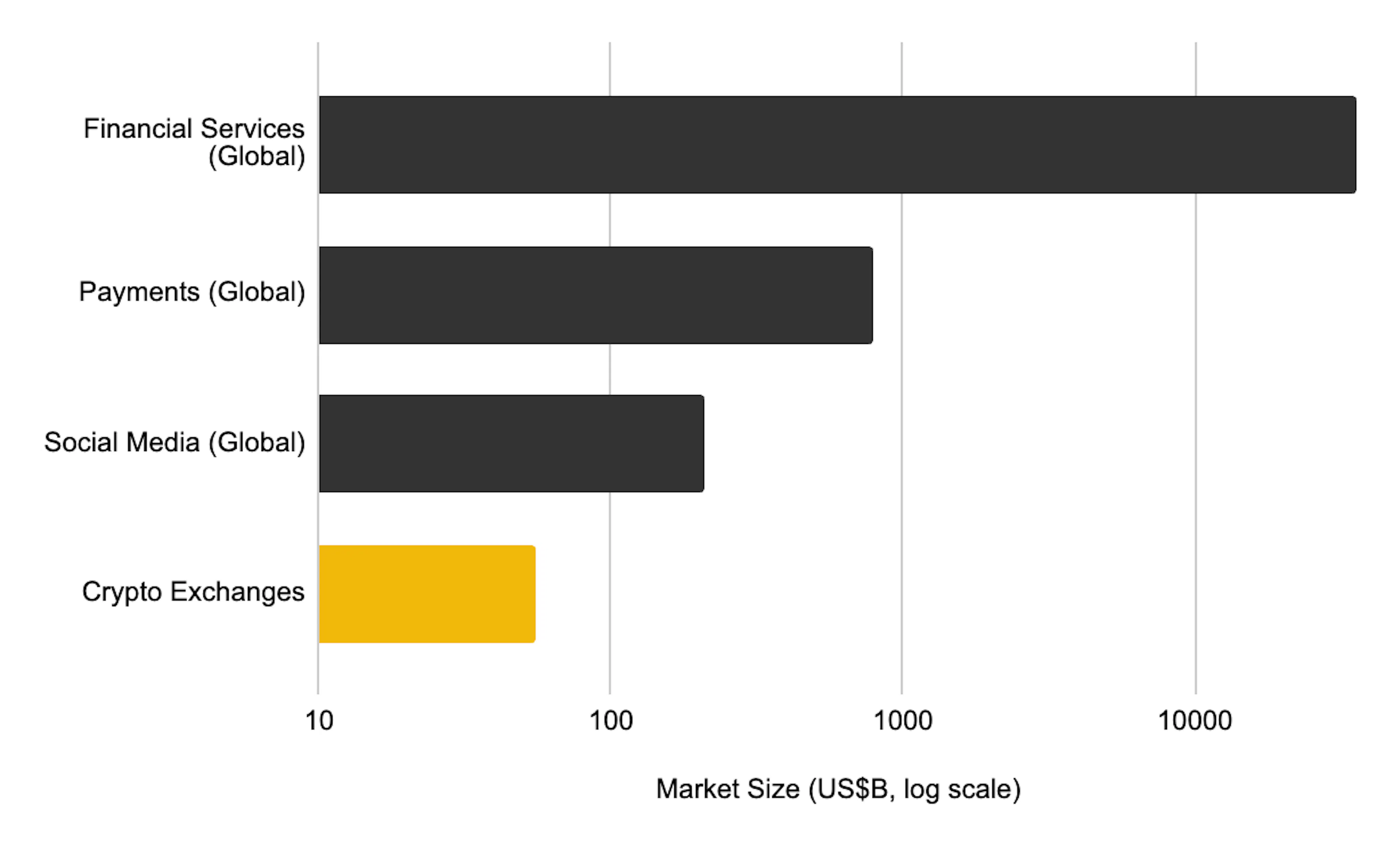
Today, the global financial services market sits at roughly $36 trillion, while crypto exchanges represent only
This convergence is highly visible in Latin America, where Bitso processed $6.5 billion in US-Mexico remittances in 2024, with stablecoins accounting for nearly 40% of crypto purchases in the region. In Nigeria, the largest remittance destination in Africa with a $59 billion market value, stablecoins capture over 40% of the local crypto market.
Users in these regions treat stablecoins as dual-purpose instruments. They rely on them as efficient payment rails for international transfers and as necessary stores of value against high local inflation, proving that integrated financial platforms provide utility far beyond isolated transactions.
Geographic Overlap: Emerging Markets as the Convergence Point
The geographic correlation between financial exclusion and crypto adoption is precise.
By offering stock trading with fractional shares starting from $5 and settling entirely in stablecoins, integrated platforms bypass the foreign exchange fees of legacy brokerages. The Philippines receives $40 billion annually as the world’s fourth-largest remittance market. Routing just 10% of that volume through stablecoin rails would save Filipino workers $56 million every year based on current transfer volumes. In sub-Saharan Africa, 57% of adults remain completely unbanked.
Stablecoins bypass this barrier because they only require a smartphone and internet access, eliminating the need for formal bank accounts or physical money transfer locations. Integrated super apps find their clearest value proposition right where this overlap between high remittance demand and structural financial exclusion occurs, bringing institutional-grade financial capabilities directly to mobile devices.
Teng argues that mobile-first financial infrastructure will increasingly replace traditional banking experiences in these markets. “Through a mobile, through a wallet, you can do everything literally,” he said. “You don’t necessarily need a bank account, but you definitely need a wallet.”
Remittances as the Catalyst for Comprehensive Digital Finance
Remittance users represent an exceptionally high-potential customer acquisition channel for integrated financial platforms. The immediate cost savings provide a logical, mathematically sound reason to switch settlement systems, while the addition of investment access, yield generation, and everyday payments creates lasting retention.
Regulatory tailwinds support this structural shift, highlighted by the GENIUS Act providing clarity in the US and expanding crypto licensing frameworks strengthening key remittance corridors.
The data suggests that when institutional access barriers fall, market demand surfaces globally. Remittances no longer need to be isolated, high-friction events. Through super app infrastructure, they become the secure entry point into a comprehensive digital economy.
This story was distributed as a release by Jon Stojan under HackerNoon’s Business Blogging Program.