
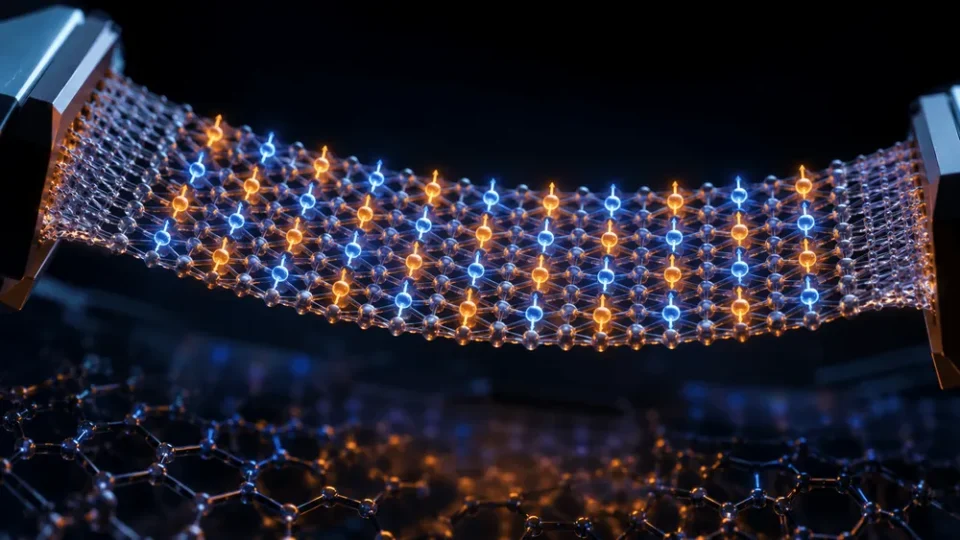
The magnets we encounter in everyday life are made from a limited set of materials such as iron and nickel. It’s an everyday intuition that whether a material exhibits magnetism is innately determined by the properties of the atoms and electrons that make it up. However, in the world of quantum materials, slightly altering physical conditions can suddenly reveal hidden properties.
An international research team centered on Ming Yi and Yichen Zhang of Rice University, and including Bharat Jalan of the University of Minnesota and Milan Radovic of the Paul Scherrer Institute, has revealed that ruthenium dioxide—long concluded to be “non-magnetic”—exhibits a new type of magnetism called “altermagnetism” under specific conditions. This discovery was published in the journal Science Advances and offers insights that open a new path for next-generation computer memory development. The demonstration of a concrete method for controlling altermagnetism, which had previously existed only as a theoretical concept, is sending ripples through the global materials science community.
A Material That Shouldn’t Be Magnetic
Ruthenium dioxide has long been a subject of complex debate among physicists. This compound, formed from the precious metal ruthenium and oxygen, has been valued industrially as an electrode material due to its high conductivity. However, there is a long history of basic research worldwide aimed at understanding the magnetic state of its bulk form. At times, signs of magnetism were reported. This sparked a long-running debate between theorists and experimentalists over whether such signs stemmed from impurities or crystal defects, or were an inherent property of the material itself. After decades of verification, the consensus eventually settled on “pure bulk ruthenium dioxide is non-magnetic.” For many researchers, the quest to understand the magnetism of ruthenium dioxide was considered a closed topic.
Fundamentally, a material’s magnetism arises from the “spin” (a rotation-like property) of electrons. Within the traditional framework of physics, magnetic order has largely been classified into two types. One is “ferromagnetism,” where all electron spins point in the same direction, producing strong magnetic force. Many of the permanent magnets we encounter daily, such as iron and nickel, fall into this category. The other is “antiferromagnetism,” where neighboring spins point in opposite directions and cancel each other out, making the material appear non-magnetic from the outside.
This ferromagnetic/antiferromagnetic dichotomy has formed the foundation of magnetism research for over a century. Ferromagnetic materials respond well to external magnetic fields, making it easy to read and write information. However, they also affect surrounding materials with their own magnetic field. Antiferromagnetic materials, on the other hand, don’t affect their surroundings, but because they don’t respond to external forces, reading and writing their state is extremely difficult. Each has its own trade-offs, presenting a major dilemma in both physics and engineering.
In recent years, a concept that could be called a third type of magnetism—”altermagnetism”—has been theoretically proposed. Altermagnetism has zero net magnetization overall, like antiferromagnetism, while simultaneously exhibiting spin splitting along specific crystallographic directions, similar to ferromagnetism. This originates from a quantum mechanical phenomenon called “Kramers degeneracy breaking,” in which electron energy states differ depending on direction. Normally, in antiferromagnets, electrons with opposite spins occupy the same energy state, but in altermagnets, the breaking of crystal symmetry causes the energy of electrons moving in a particular direction to split depending on spin orientation. This gives altermagnets a combination of properties: the antiferromagnetic advantage of not leaking magnetic field into the surroundings, and the ferromagnetic advantage of easy read/write access to information.
At the stage of theoretical calculations using supercomputers, ruthenium dioxide had been named as a strong candidate material for exhibiting this altermagnetism. However, no matter how precisely bulk-form ruthenium dioxide was measured, decisive evidence of magnetism could not be found. In bulk form, electron spins had no particular order and failed to meet the requirements for altermagnetism.
A Breakthrough Born from Ultrathin Film Form
What the research team focused on to break through this impasse was the “form” of the material. Abandoning analysis of bulk crystals, they took the approach of fabricating ruthenium dioxide as an ultrathin film only a few atomic layers thick. A thickness of a few atomic layers means, in actual dimensions, less than a few nanometers—an extremely thin scale, less than one hundred-thousandth the diameter of a human hair. Since the discovery of graphene, it has been known that reducing a material to near-two-dimensional, extremely thin scales can reveal entirely different physical laws. The research team believed this thin-filming would be the key for ruthenium dioxide as well.
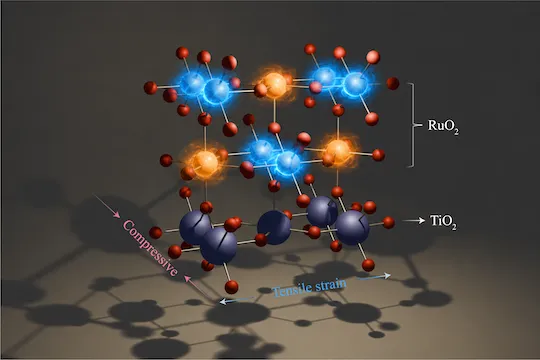
Fabricating the high-quality samples, handled by the University of Minnesota team, required advanced techniques akin to stacking atoms one by one. Rather than simply carving material physically, atoms were irradiated within a vacuum chamber, epitaxially growing crystals on a substrate. During this process, they applied a pressure known as “lattice strain.” This mechanism exploits the mismatch between the regular arrangement of atoms making up the material and the atomic arrangement of a different substrate material serving as the foundation, applying physical force to slightly widen or narrow the spacing. Because the spacing of atoms in the substrate differs from the natural spacing of ruthenium dioxide, the ruthenium dioxide film deposited on top is forcibly stretched or compressed to match the substrate’s pattern. It was this microscopic lattice strain that served as the trigger awakening the dormant magnetism of ruthenium dioxide.
To identify the material’s magnetic state, the research team, with cooperation from the Paul Scherrer Institute, employed an advanced measurement technique called spin-resolved angle-resolved photoemission spectroscopy (ARPES). ARPES is based on the photoelectric effect elucidated by Einstein. It is a technique that precisely measures the energy and momentum of electrons ejected from a material’s surface when high-energy light is shone upon it. By adding spin resolution to this, it becomes possible to capture whether the ejected electrons have upward or downward spin. This enabled direct observation of how electron spins within the material are spatially arranged—the so-called “spin texture.”
Strain Draws Out Spin Alignment
The measurement results confirmed a spin texture that exceeded expectations. The strained ultrathin ruthenium dioxide film clearly exhibited the spin arrangement characteristic of altermagnetism, as theoretically predicted. Rather than pointing in random directions, the electron spins were neatly split along specific crystallographic axes. The research team also carefully compared this against theoretical models based on first-principles calculations, confirming that the behavior matched unconventional magnetism.
Electrons that had remained silent in bulk form began exhibiting an orderly spin arrangement once confined to an ultrathin sheet and subjected to strain. This result demonstrates that a material’s form and physical pressure can fundamentally alter the properties of quantum materials. The spin splitting that was not observed in the bulk state was drawn out by the perturbation of lattice strain.
The core of this discovery lies in the fact that the presence or absence of magnetism switches clearly depending on conditions. According to the research team’s report, when there was no lattice strain, as in the natural bulk form, no sign of altermagnetism whatsoever was observed in the electron spins. The difference in physical pressure—whether strain is present or absent—functions as a switch for magnetism.
Yichen Zhang, the paper’s first author, states: “This strain-dependent property suggests the possibility of using lattice strain as a ‘physical control knob’ to induce or control altermagnetism.” Controlling a material’s magnetism typically requires applying a powerful external magnetic field or passing a large electric current. If magnetism can be controlled through a structural approach like lattice strain, it becomes possible to design highly energy-efficient devices that don’t depend on external magnetic fields.
Toward Next-Generation Memory Architecture
The discovery and control of altermagnetism represents an important step in fundamental physics while also pointing toward a path for practical applications. The main targets are next-generation spintronics and memory architecture.
For decades, the semiconductor industry has improved performance by miniaturizing circuits. Particularly in today’s era of training artificial intelligence models and processing massive amounts of data in parallel, the speed and capacity of memory that temporarily stores data has become a bottleneck determining overall system performance. As silicon-based devices approach atomic-scale limits, conventional methods of recording and processing data based solely on the presence or absence of electron “charge” are hitting a wall of power consumption and heat generation. In response, spintronics is a technology that uses electron “spin” (rotation) in addition to charge to store and process data.
Memory using existing ferromagnetic materials (such as MRAM) has already been put into practical use as non-volatile memory. However, because ferromagnetic materials leak magnetic force outward and interfere with adjacent memory cells, there has been a physical limit to increasing recording density—bringing cells too close together destroys the data. Antiferromagnetic materials, which don’t leak magnetic force, are suited to high density, but because they don’t respond to external magnetic fields, establishing technology to read and write their state has proven difficult.
Altermagnetism has properties that resolve the challenges faced by both. Like antiferromagnetism, it has no external magnetic leakage, enabling higher memory cell density, while like ferromagnetism, it allows information to be read and written using the spin-splitting effect. By utilizing a phenomenon called spin-orbit torque, the direction of spin can be efficiently reversed using a minute electric current. This could lead to further device miniaturization, increased capacity, and significant improvements in processing speed—meeting the requirements for a foundational technology that could dramatically reduce data center power consumption.
Unresolved questions remain toward practical application. Whether the altermagnetism observed in ruthenium dioxide can be stably maintained at room temperature—as required in real device environments—remains a subject for future verification. Since many quantum effects only manifest at extremely low temperatures, the path to industrial application won’t open unless room-temperature operation is demonstrated. Additionally, it remains unclear whether using lattice strain as a control knob for magnetism holds universally true for quantum materials other than ruthenium dioxide.
From bulk to few-atomic-layer thin films, and then to the application of strain—this approach of drawing out hidden properties by adjusting physical conditions is opening up the possibilities of unknown quantum materials.