
Platinum and palladium have participated in the broader precious-metals rally, but beneath the price action, important differences are emerging.
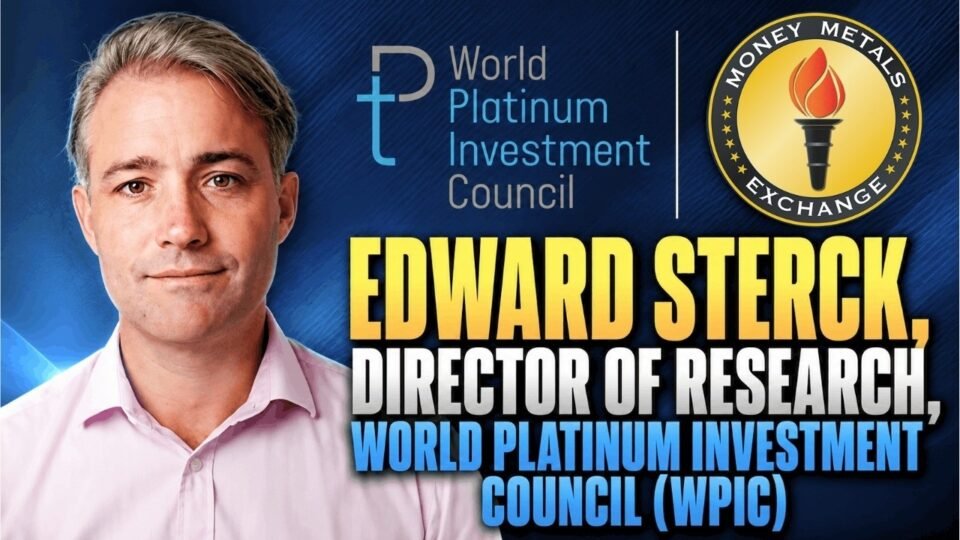
Money Metals host Mike Maharrey recently spoke with Edward Sterck, Director of Research at the World Platinum Investment Council (WPIC), about persistent platinum supply deficits, palladium’s dependence on the auto industry, geopolitical risks, trade policy, and potentially significant new sources of demand from hydrogen and artificial intelligence.
As of August 6, 2026, platinum was trading at around $1,728 per ounce, putting the metal well above the range that confined it for much of the previous decade.
(Interview Starts Around 6:45 Mark)
Platinum Breaks Out After a Decade
For roughly 10 years, platinum remained largely range-bound between about $900 and $1,100 per ounce. That changed in May 2025, when the metal began a sharp rally that continued into January 2026.
Edward Sterck said the initial catalyst was supply and demand.
The platinum market had entered its third consecutive year of significant deficits. Since commodity markets must ultimately balance, those shortfalls were filled by drawing metal from above-ground inventories. Eventually, those stocks fell to what Sterck called “unsustainably low levels,” forcing prices higher to entice holders to sell.
By the middle of the fourth quarter, another force took over. A broad precious-metals rally led by gold reflected growing demand for hard assets with value independent of the U.S. dollar.
Sterck characterized it as a “de-dollarization” or “sell America” trade. As demand spilled beyond gold, investors moved into silver, platinum, palladium and even copper.
After reaching what Sterck described as “frothy” levels in January, platinum corrected. It subsequently traded around $2,000 per ounce for a period before coming under renewed pressure. By August 6, the spot price had retreated to roughly $1,728 per ounce.
Middle East Conflict Changes the Picture
Conflict in the Middle East subsequently altered the macroeconomic environment for precious metals.
Higher oil prices increased inflation expectations and, in turn, expectations for higher Federal Reserve interest rates. That supported the dollar and weighed on dollar-denominated commodity prices.
There has been some direct impact on platinum demand because Middle Eastern oil refineries use platinum-based catalysts. When those facilities go offline, demand for catalysts can decline at the margins.
But Sterck said that effect is relatively small. The bigger influence has come through inflation expectations, anticipated Federal Reserve policy, and the dollar.
Despite those macro pressures, Sterck said the underlying supply-demand fundamentals for platinum remain favorable.
Why Platinum and Palladium Are Diverging
One of the biggest differences between platinum and palladium comes down to who uses the metals.
About 40% of global platinum demand comes from catalytic converters used in vehicles with internal-combustion engines. Vehicle electrification therefore represents a long-term demand headwind, although Sterck believes the transition is taking longer than many analysts previously expected.
Palladium is much more exposed. More than 80% of palladium demand is tied to the automotive sector.
Recycling creates another potential problem for palladium. WPIC expects rising recycling supply, combined with the gradual drag from vehicle electrification, eventually to push the palladium market into surplus.
But that transition keeps getting delayed.
Palladium remains in deficit today. Sterck said the existing shortage could allow the metal to continue trading alongside the broader precious-metals complex over roughly the next 12 months, even as bearish longer-term sentiment hangs over the market.
Russia Adds a Palladium Wild Card
Palladium’s supply profile makes that bearish outlook more complicated.
Russia produces about 40% of global palladium supply. A disruption at a Russian mine or another event restricting Russian supplies could therefore trigger a sharp price spike, particularly with futures positioning already skewed toward the downside.
Platinum has considerably less Russian exposure.
About 70% of global platinum mine supply comes from South Africa, rising to roughly 80% for Southern Africa when Zimbabwe is included. Russia accounts for only about 11%.
Palladium, by comparison, is concentrated between South Africa and Russia, with each producing roughly 40% of global supply.
That geopolitical exposure could also influence how automakers substitute platinum and palladium. In gasoline vehicles, Sterck said the two metals are almost one-for-one substitutes.
But manufacturers cannot simply switch between the metals whenever prices change. Once a vehicle model has completed certification and entered production, automakers generally do not alter the platinum-group-metal mix in its catalytic converter. Substitution therefore tends to occur as future models are designed and certified.
Tariff Fears Send Platinum Into the U.S.
U.S. trade policy has already produced dramatic movements in physical metal.
Sterck traced the shift to November 2024, when it became increasingly clear that tariffs would play a major role in the incoming administration’s trade policy.
U.S. end users and market participants began bringing platinum and palladium into the country ahead of anticipated needs, concerned that future trade barriers could affect metal availability.
Visible platinum inventories associated with U.S. futures exchanges surged from roughly 150,000 ounces to around 750,000 ounces—a fivefold increase. Sterck emphasized that exchange inventories represented only the visible portion of the movement, meaning additional metal could have entered the country without being deposited in those warehouses.
As some trade fears eased during 2026, metal began flowing out of futures exchange warehouses and back into the broader market, helping relieve some of the immediate tightness.
Uncertainty remains, however, including investigations under Sections 232 and 301 of U.S. trade law. Palladium faces an additional risk from a U.S. International Trade Commission case involving allegations of Russian dumping. An earlier ruling found no injury to the United States, but the decision has been appealed.
Expensive Gold Gives Platinum Jewelry an Opening
High gold prices have also created an unusual opportunity for platinum in the jewelry market.
Platinum generally competes in the mid-range and fine-jewelry segments, particularly against white gold. White gold was originally produced as a lower-cost alternative that could visually resemble platinum.
But soaring gold prices turned that relationship upside down.
Sterck said white-gold jewelry was at one point being sold at a premium to platinum jewelry, even at the retail level. That has contributed to relatively consistent growth in platinum jewelry demand in markets such as the United States and Europe.
China remains a notable exception.
Platinum jewelry became fashionable there during the late 2000s and early 2010s, with demand peaking around 2014. Since then, government policies and changing consumer preferences have contributed to a steady decline.
Hopes that soaring gold prices would spark a major revival in Chinese platinum jewelry demand have so far proved disappointing.
The Investment Case for Platinum
For investors accustomed to gold and silver, Sterck said platinum offers something different because of the diversity of its end uses.
Its industrial exposure makes platinum somewhat more pro-cyclical than gold, potentially giving it a different role within a diversified precious-metals portfolio.
Supply remains a major part of the investment case.
Sterck expects platinum deficits to persist for the foreseeable future, although investment demand could determine how tight the market remains this year. ETF outflows and metal leaving exchange warehouses could push the market closer to balance.
Monetary policy could also play an important role. Sterck believes the market may be overestimating the likelihood of Federal Reserve rate hikes. His personal expectation is for a relatively flat rate environment this year, which could provide renewed support for the precious-metals complex.
Hydrogen and AI Could Drive New Demand
Perhaps the most intriguing part of the platinum story involves emerging sources of industrial demand.
Sterck argued that geopolitical instability could encourage countries in Europe and East Asia to place greater emphasis on energy security and accelerate development of the hydrogen economy.
He compared the potential effect to the way the oil crisis of the 1970s helped catalyze North Sea oil and gas development in Europe. Platinum is used within hydrogen technologies, making broader adoption a potentially significant source of future demand.
Artificial intelligence represents an even newer opportunity.
Edward Sterck
said
World Platinum Investment Council – WPIC®
has only become fully aware of some of these applications during the past six months. Semiconductor manufacturing and optical-crystal production for data-center interconnects could represent significant end uses for platinum, palladium and other platinum-group metals.
These applications are still being quantified and may not yet be fully reflected in existing supply-demand forecasts.
Could Platinum Outpace Gold Again?
Maharrey closed by asking whether platinum could ever regain its historic premium over gold.
Sterck noted that from 1980 through today, platinum has averaged roughly twice the gold price, even including recent years when platinum traded at a significant discount.
Platinum is also extraordinarily scarce. According to Sterck, it is about 30 times less available than gold.
But gold possesses an important advantage: it is a monetary asset, while platinum is not.
Gold’s larger and more liquid market has made it the preferred asset for central banks looking for alternatives to the dollar-dominated financial system. Sterck said that dynamic has helped drive central-bank gold buying since roughly 2014.
With the global system moving toward a more multipolar and uncertain geopolitical environment, Sterck sees little reason for that trend to disappear soon.
Platinum nevertheless offers a different investment story. Persistent deficits have depleted inventories, global mine supply is highly concentrated, and traditional automotive and jewelry consumption could increasingly be supplemented by hydrogen, AI infrastructure and other emerging technologies.
For precious-metals investors accustomed to thinking primarily about gold and silver, platinum may be worth watching precisely because the forces driving it are different.
Originally Published on Money Metals.