
The structural and physicochemical properties
The NbOx supports were synthesized via a hydrothermal method followed by calcination at 300–800 °C to tune their surface structure and acidity. Afterwards, the Ru was loaded by incipient-wet-impregnation and reduction. The actual Ru loading ranged between 0.61 and 0.66 wt%, as determined by inductively coupled plasma optical emission spectrometry (ICP-OES, Table S1). As the calcination temperature of Ru/NbOx–T increased from 300 to 800 °C, the specific surface area decreased from 190.2 to 2.8 m2·g−1, accompanied by the reduction of inter-particle pore volume and mesopore structure (Table S1, Fig. S1).
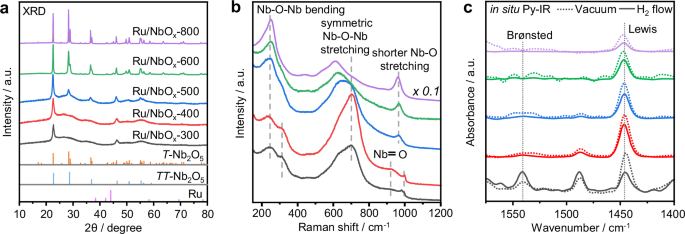
The crystallinity of Ru/NbOx–T (T = 300, 400, 500, 600 and 800 °C) was analyzed by powder X-ray diffraction (XRD, Fig. 1a). The samples calcined at 300 and 400 °C could be characterized as pseudohexagonal TT-Nb2O5 (PDF 28-0317), with the distinct peaks at 2θ = 22.6° and 46.2°, corresponding to the (001) and (002) planes. Nevertheless, when the calcination temperature was elevated to 500 °C and above, the NbOx transformed into an orthorhombic T-Nb2O5 (PDF 30-0873)35. No diffraction peaks related to Ru were detected, suggesting that Ru was well dispersed on the support (Fig. S2).

a XRD patterns; b Raman spectra and c typical and in situ Py-IR profiles. Referential XRD patterns are Ru (PDF 65-7646), TT-Nb2O5 (PDF 28-0317), and T-Nb2O5 (PDF 30-0873). Conditions of in situ Py-IR: after pyridine adsorption and desorption under vacuum at 200 °C, the H2 flow (50 ml·min−1) was introduced into the sample chamber for 20 min.
Raman spectroscopy (Fig. 1b) further confirms the structural evolution of NbOx with increasing calcination temperature. Ru/NbOx-300 and Ru/NbOx-400 exhibit a band at ~318 cm−1 together with high-wavenumber features at ~930 and ~998 cm−1, indicating a more distorted and defect-rich NbOx surface containing terminal Nb=O and NbO4-related species36,37. With increasing calcination temperature, these bands disappear, while the main Nb-O-Nb stretching vibration shifts from ~702 to ~618 cm−1 and a new band at ~965 cm−1 emerges, characteristic of Nb-O stretching vibrations in a more ordered Nb2O5 framework dominated by edge-shared NbO6 octahedra38.
The acidic sites of the catalysts, as determined by NH3 temperature-programmed desorption (NH3-TPD), were predominantly weak and medium-strong acids (<400 °C). Among them, Ru/NbOx-300 with the lowest calcination temperature exhibited the strongest acidity (0.205 mmol·g−1), whereas Ru/NbOx-800 had no acidity (Fig. S3). As the calcination temperature increased, the crystalline transformation of NbOx led to the loss of distorted NbO4 units, and the surface area thus resulted in a decrease in overall acidity31. After Ru was loaded onto NbOx support, the acidity slightly increased (Table S2), which indicates the Ru species contributed to NH3 adsorption.
Typical and in situ pyridine adsorbed infrared spectroscopy (Py-IR) was also employed to examine the acid types and their evolution under H2 atmosphere (Fig. 1c). Under vacuum (dash line), Ru/NbOx–T catalysts exhibited dominant Lewis acidity (1446 cm−1), while Ru/NbOx-300 also possessed minor Brønsted acidity (1540 cm−1), attributable to the presence of Brønsted-acidic hydroxyl groups in NbOx-300. As the calcination temperature rose, both Brønsted and Lewis acidity gradually decreased, which aligns with the NH3-TPD results. Additionally, Lewis acid sites on NbOx were transformed into Brønsted acid sites via a hydrogen spillover process31. Under an H2 atmosphere, Ru facilitates the dissociation of H2 into active hydrogen species (H*) that migrate and react with surface Nb=O bonds to form new hydroxyl groups (Nb-OH), thereby increasing the density of Brønsted acid sites. Therefore, a clear decrease in Lewis acidity and corresponding intensification of Brønsted acidity was observed upon the introduction of H2 flow at 200 °C. This process is most pronounced on Ru/NbOx-300, while catalysts calcined at elevated temperatures show less increase of Brønsted acidity, suggesting such transformation happens more readily over a distorted Ru-NbOx surface39. More than typical acidic zeolites used as support, the NbOx provides a redox-active, metal-interacting oxide where acidity, Ru nuclearity, and electronic structure could be intrinsically coupled.
The morphology of the NbOx and Ru particle size were examined by aberration-corrected high angle annular dark field scanning transmission electron microscopy (AC-HAADF-STEM, Fig. 2a). With increasing calcination temperature, NbOx evolves from thin nanorods (300–400 °C) to thicker, shorter rods (500 °C), and finally to enlarged grains (at 600 and 800 °C), reflecting progressive crystallization and nanoparticle agglomeration. Images of Ru/NbOx-300 reveal the dominant presence of dispersed Ru single atoms on NbOx nanorods, as indicated by the arrows. In addition, a small fraction of sub-nanometer Ru clusters (0.5~0.8 nm) is observed, as highlighted by the circles. Nevertheless, EDX-mapping of the selected regions confirms the presence of Ru, supporting the existence of atomically dispersed Ru species even where direct visual discrimination is limited (Fig. S4). Ru species are also highly dispersed in Ru/NbOx-400, with no observable nanoparticles, while dominant sub-nanometer clusters emerge at 500 °C. Distinct Ru nanoparticles (~1 nm) form uniformly at 600 °C and grow to ~3 nm at 800 °C. Correlation of Ru particle size with BET surface area and EPR-derived defect density reveals that Ru growth is mainly driven by NbOx sintering and surface area loss upon calcination, accompanied by depletion of oxygen vacancy anchoring sites (Fig. S5)40. Furthermore, the presence of Ru in Ru/NbOx-300 and Ru/NbOx-400 is confirmed by ICP-OES and Energy-dispersive X-ray (EDX) mapping, suggesting the atomic Ru dispersion (Table S1, Fig. S4). To decouple the effect of support properties, Ru nanoparticles were pre-synthesized by the sol-gel method and loaded onto NbOx-300 (Ru NP/NbOx-300), in which the average particle size was ~2.0 nm (Figs. 2a and S6). Highly dispersed Ru on non-acidic supports (Ru SA/NbOx-600 and Ru SA/MgAlOx) were also prepared and examined by STEM-EDX, which detected Ru species without any observable particles (Fig. S6).

a HAADF-STEM images and corresponding particle size distribution, b XPS Ru 3p spectra, and c Ru K-edge XANES, d EXAFS spectra in R space, and e CO-adsorbed DRIFT spectra after desorption at R.T. and 200 °C of selected Ru/NbOx-300, Ru/NbOx-600, and referential samples.
The electronic states of Ru/NbOx were analyzed by X-ray photoelectron spectroscopy (XPS), with the Ru 3p, Nb 3d, and O 1s regions examined (Figs. 2b and S7). Although the O 1s spectra of Ru/NbOx–T appear similar, subtle electronic differences are evident in the Nb 3d region, where Ru/NbOx-300 exhibits a ~0.2 eV higher binding energy, consistent with defect-induced distortion of NbOx surface units. The limited variation in O 1s spectra likely reflects the dominance of lattice oxygen and the dynamic redox nature of NbOx surfaces under reaction conditions (Fig. S7). Deconvolution of the Ru 3p1/2 signal revealed three components corresponding to metallic Ru0 (461.8 eV), oxidized Ruδ+ (463.8 eV), and the O KLL Auger peak (470.8 eV)41,42. With increasing Ru particle size over Ru/NbOx–T, dispersed sub-nano Ruδ+ species converted to metallic Ru0, as evidenced by the Ruδ+/Ru0 ratio decreasing from 7.9 for Ru/NbOx-300 to 0.5 for Ru/NbOx-800 (Fig. S8). Moreover, the referential Ru NP/NbOx-300, Ru SA/NbOx-600, and Ru SA/MgAlOx predominantly exhibit metallic and oxidative Ru species, respectively, consistent with their Ru size (Fig. S9, Table S3).
The reducibility of Ru species on Ru/NbOx–T varied markedly with support calcination temperature, as revealed by hydrogen temperature-programmed reduction (H2-TPR, Fig. S10). Hydrogen consumption increased progressively and peaked for Ru/NbOx-800, indicating the presence of more reducible Ru species. Ru/NbOx-300 exhibited the highest reduction temperature (340 °C) but the lowest hydrogen uptake, suggesting few reducible Ru species (mainly Ruδ+), consistent with TEM and XPS results. Upon calcination, two reduction peaks appeared: ~100 °C from surface oxygen reduction on Ru nanoparticles and ~300 °C from strongly coordinated Ru species43. The increased H2 consumption observed for Ru/NbOx-800 in H2-TPR is attributed to enhanced H2 dissociation on larger metallic Ru nanoparticles and subsequent hydrogen spillover to the reducible NbOx surface, resulting in partial support reduction. This behavior is consistent with XPS showing a higher fraction of Ru0 and with previous reports that larger Ru particles exhibit stronger H2 activation capability44,45,46.
X-ray absorption near-edge structure (XANES) and extended X-ray absorption fine structure (EXAFS) spectroscopies were performed to elucidate the Ru coordination environment (Fig. 2c, d). The Ru K-edge XANES of Ru/NbOx-300 closely matches that of RuO2, whereas Ru/NbOx-600 resembles metallic Ru foil, indicating that Ru is predominantly oxidized in the former but metallic in the latter47. EXAFS analysis of Ru/NbOx-300 shows a dominant first-shell feature assignable to an Ru-O scattering path at 1.50 Å; Artemis fitting yields a first-shell Ru-O coordination number (CN) of 4, consistent with atomically dispersed, oxidized Ru sites (Fig. S11, Table S4). By contrast, the EXAFS of Ru/NbOx-600 is dominated by a Ru-Ru scattering path at 2.23 Å, with a fitted first-shell Ru-Ru CN of c.a. 6, indicative of metallic Ru nanoparticles.
CO adsorption experiments were conducted at room temperature, followed by desorption at room temperature and at 200 °C in Ar flow for 30 min (Fig. 2e). The total CO adsorption intensity decreases in the order Ru/NbOx-300 > Ru/NbOx-600 > Ru/NbOx-800, indicating progressively lower Ru dispersion with increasing calcination temperature, consistent with STEM and XANES results. All three catalysts exhibit a band at 2146 cm−1, assigned to CO coordinated to cationic Ru species (Ru3+/Ru2+, e.g., Ru3+(CO)2 or Ru3+ (CO)3). Its intensity decreases from Ru/NbOx-300 to -800, reflecting a gradual decline in oxidized, highly dispersed Ru species48,49,50.
Ru/NbOx-300 displays two major bands at 2105 and 2089 cm−1 after room temperature desorption. The 2105 cm−1 band corresponds to linearly bound CO, while the 2089 cm−1 band is assigned to geminal/multi-carbonyl species on single Ruδ+ sites. After desorption at 200 °C, both bands decrease but remain dominant. A minor band at 2045 cm−1, attributed to atop CO on metallic Ru0 ensembles, appears, suggesting limited redistribution toward small metallic domains upon thermal treatment. Ru/NbOx-600 exhibits bands at 2089 and 1987 cm−1 at room temperature, assigned to multi-coordinated CO on isolated Ru sites and small Ru clusters, respectively. After desorption at 200 °C, the 1987 cm−1 band disappears, and a strong 2045 cm−1 band emerges, indicating a more pronounced metallic Ru0 contribution. Ru/NbOx-800 shows a weak 2089 cm−1 band and a dominant 2059 cm−1 band before heating, attributed to CO on Ruδ+ and Ru0 species, respectively. Both vanish after desorption at 200 °C, consistent with weak CO binding and a low density of stable cationic Ru sites.
The combined results from these characterizations consistently demonstrate a nuclearity-dependent evolution of Ru species across the Ru/NbOx series. All techniques converge on the same trend: Ru/NbOx-300 is dominated by atomically dispersed, oxidized Ru species, whereas increasing calcination temperature progressively leads to more metallic and aggregated Ru ensembles. The strong agreement among these independent characterizations provides a robust structural basis for correlating Ru nuclearity and electronic state with catalytic behavior.
Catalytic performance
The hydroconversion of polyolefins was conducted in a stainless-steel autoclave with mechanic stirrer. The activity of Ru/NbOx–T catalysts exhibited an interesting U-shape trend along with the calcination temperature (Fig. 3a). The PE conversion peaked at Ru/NbOx-300 and Ru/NbOx-600, reaching 100.0% and 91.2%, respectively. Methane was absent for Ru/NbOx–T (T = 300–500 °C), appeared in only 1.8% selectivity for Ru/NbOx-600, but rose sharply to 14.8% for Ru/NbOx-800. Product distribution varied sharply with catalyst acidity (Fig. S12): Ru/NbOx-300 gave iso-alkanes predominantly (iso/n = 4.1), with C5-35 selectivity of 98.2%, reflecting a hydrocracking pathway driven by dispersed and oxidative Ru species and in situ-generated Brønsted-acidic Nb-OH. Whereas Ru/NbOx-600 yielded mainly n-alkanes (iso/n = 0.3), with C5-35 selectivity of 96.4%, consistent with hydrogenolysis over larger Ru nanoparticles on neutral NbOx-600 (Fig. 3b, c). The reduced acidity of NbOx-400/500 suppressed C–C cleavage, while Ru/NbOx-800 with enlarged particles favored methane generation via hydrogenolysis. In contrast, with the Ru nanoparticles (~2 nm) supported on acidic NbOx-300, the Ru NP/NbOx-300 produced n-alkanes and methane, underscoring the predominance of hydrogenolysis over hydrocracking, which will be elaborated in the following mechanistic discussion. Furthermore, oxidative Ru atoms on non-acidic supports, including MgAlOx and NbOx-600, displayed very limited activity (Table S5), with Ru SA/NbOx-600 achieving only 5.7% conversion of PE51. Hydroconversion of C18 was also examined, showing nearly identical conversion and selectivity trends to PE (Fig. S13), confirming the consistency of Ru/NbOx–T catalysts in transforming long-chain linear alkanes. A comprehensive literature comparison (Table S6) shows that although Ru/NbOx catalysts operate at temperatures slightly higher than some reported systems, they achieve a unique combination of high conversion, suppressed methane formation (0–1.8%), and high selectivity (>96%) to valuable hydrocarbons (C5-35) across different polyolefins.

a Catalytic performance and b methane selectivity and c product distribution of PE catalyzed by Ru/NbOx–T and referential catalysts; d hydroconversion of various polyolefins over Ru/NbOx-300 and Ru/NbOx-600 catalysts; e Reusability test of Ru/NbOx-300 and Ru/NbOx-600 for the hydroconversion of PP and HDPE, respectively. Reaction conditions: substrate (PE for a–c, PP and HDPE for f), 4 g; Ru catalyst, 0.3 g; temperature, 280 °C; H2 pressure, 4 MPa; time, 8 h.
A linear correlation is observed between PE conversion and the iso/n ratio of liquid products with the density of in situ-generated Nb-OH Brønsted acid sites for Ru/NbOx-(300–500) at a similar PE conversion level (~60%), indicating that these sites govern carbocation-mediated β-scission and isomerization in hydrocracking (Fig. S14). When PE conversion over Ru/NbOx-300 was further increased to 100%, the iso/n ratio increased slightly to 4.1, suggesting that secondary hydroisomerization of products occurs concurrently with PE hydrocracking but contributes to a much smaller extent (Table S7). In contrast, Ru/NbOx-(600–800) shows negligible Nb-OH formation and no such correlation, consistent with a hydrogenolysis pathway dominated by metallic Ru. These results directly link Nb-OH Brønsted acidity to hydrocracking activity and selectivity.
The hydroconversion of PE over Ru/NbOx catalysts revealed a strong dependence on support and temperature (Fig. S15). Ru/NbOx-300 exhibited a sharp increase in conversion from 23.5% at 260 °C to 95.8% at 280 °C, with 98.2% selectivity for C5-35, indicating that acidic sites are insufficiently activated at lower temperatures. Ru/NbOx-600 outperformed Ru/NbOx-300 below 260 °C and maintained 96.4% C5-35 selectivity at 280 °C. In contrast, Ru/NbOx-800 showed lower PE conversion and much higher methane formation (Fig. S16). Notably, methane generation remained negligible over Ru/NbOx-300 (<0.1%) and Ru/NbOx-600 (<2%), despite their distinct hydrocracking and hydrogenolysis pathways.
The Ru/NbOx–T catalysts were further evaluated for the hydroconversion of various polyolefins, including LDPE (Mw, 100.0 kDa), HDPE (Mw, 141.6 kDa), PP (Mw, 27.2 kDa), and daily waste bottles (Fig. 3d, e). Both Ru/NbOx-300 and Ru/NbOx-600 achieved full HDPE conversion with dominant liquid selectivity. Ru/NbOx-300 achieved 90.5% liquid fuel (C5-20) selectivity rich in iso-alkanes via hydrocracking, suitable as gasoline, jet fuel, and diesel, whereas Ru/NbOx-600 afforded 93.1% selectivity to liquid fuels and wax (C5-35), producing mainly normal alkanes via hydrogenolysis with minimal methane (1.8%), useful as solvents, lubricants, and chemical feedstocks3. Tailoring the Ru nuclearity thus enables selective control over product distribution (Figs. S17 and S18). Both catalysts also converted waste HDPE bottles into short alkanes, though with lower activity, likely due to additives and impurities.
PP, the second most produced polyolefin, is notoriously less active to hydrogenolysis over conventional Ru nanoparticles16,25. Consistent with this limitation, Ru/NbOx-600 achieved only <18% conversion. In sharp contrast, atomically dispersed Ru on NbOx-300 delivered complete PP conversion with >91% selectivity to liquid fuels, underscoring the critical role of Ru nuclearity and support acidity in enabling efficient PP hydrocracking. At 280 °C, Ru/NbOx-300 exhibited an exceptional reaction rate of 1731 gPP·gRu−1·h−1, highlighting its remarkable intrinsic activity for polypropylene hydrocracking. This discrepancy emphasizes the structural sensitivity of Ru catalysts for different substrates, as the methyl substituents in PP hinder hydrogenolysis on Ru nanoparticles but favor tertiary carbocations that are essential for hydrocracking11,52. Accordingly, with proper control of Ru nuclearity on acidic supports, it allows efficient hydrocracking of PP that produces liquid fuels while suppressing methane formation (Table S6).
The stability of Ru/NbOx-300 and Ru/NbOx-600 was evaluated through five consecutive hydroconversion cycles using PP and HDPE as substrates, respectively. Ru/NbOx-300 maintained constant PP conversion with only a slight shift toward heavier products (Figs. 3f and S19), while Ru/NbOx-600 consistently achieved full HDPE conversion with minor selectivity shifts toward heavier alkanes, underscoring its stable hydrogenolysis performance. HAADF-STEM revealed Ru on NbOx-300 grew from sub-nanometer species to ~1.0 nm nanoparticles after repeated calcination-reduction cycles and retained hydrocracking selectivity, whereas Ru nanoparticles on NbOx-600 showed negligible growth (~0.1 nm) (Fig. S20). This indicates that hydrocracking does not strictly require isolated single atoms but is governed by the cooperative effects of Ru nuclearity, oxidation state, and Brønsted acidity. The superior activity of fresh Ru/NbOx-300 further suggests that atomically dispersed Ru species exhibit more efficiency for C–H activation and hydrogen spillover. Compared with previous reports, both catalysts exhibited superior reusability, attributed to stabilized Ru species over NbOx.
Mechanistic insights
The drastically different selectivity patterns of Ru/NbOx-300 and Ru/NbOx-600 highlight two independent reaction pathways, which were further probed by measuring apparent activation energies (Ea) for PE and PP hydroconversion (Figs. 4a, S21, and Table S8). For Ru/NbOx-300, the Ea for PE (172.5 kJ/mol) matches reported hydrocracking values, consistent with Brønsted acid-catalyzed β-scission as the rate-determining step31,53,54; while the lower Ea for PP (91.9 kJ/mol) reflects the ease of forming tertiary carbocations, explaining its higher reactivity. In contrast, Ru/NbOx-600 exhibited a much lower Ea for PE (57.9 kJ/mol), indicative of facile hydrogenolysis over metallic Ru, in line with the lower reaction temperatures typically required (200–260 °C)10. However, the higher Ea for PP (84.6 kJ/mol) suggests steric limitations in PP adsorption and cleavage on Ru nanoparticles. These results demonstrate that rationally designed Ru/NbOx-300 and Ru/NbOx-600 catalysts enable distinct hydrocracking and hydrogenolysis pathways, making them better suited for PP and PE conversion, respectively.

a Apparent activation energy (Ea) in hydroconversion PE and PP over Ru/NbOx-300 and Ru/NbOx-600; b hydrogenation of 1-hexadecene over selected catalysts; c, d operando FT-IR spectra of PE hydroconversion catalyzed by Ru/NbOx-300 and Ru/NbOx-600 at 280 °C. Reaction conditions: a polyolefins, 4 g; Ru catalyst, 0.3 g; H2 pressure, 4 MPa; time, 0.5–9 h; temperature, 240–280 °C; b 1-hexadecene (5%, cyclohexane as solvent), 4 g; Ru catalyst, 0.005 g; H2 pressure, 4 MPa; time, 0.5 h; temperature, 50 °C; c PE, 0.9 g and Ru catalyst, 0.1 g, were mixed and pressed into wafers and monitored at 280 °C under 3 MPa H2.
The hydrogenation activity was evaluated using hexadecene as a model substrate. Catalysts with different Ru sizes—Ru/NbOx-300 (atomically dispersed), Ru/NbOx-600 (~1.0 nm), and Ru NP/NbOx-300 (~2.0 nm) showed distinct performances, with conversions of 54.1%, 91.5%, and 99.4%, respectively. This trend reflects the hydrogenation ability increases with Ru ensemble size, further reflecting the Ru nuclearity as the key determinant of activity and selectivity (Fig. 4b). This limited hydrogenation capacity of highly dispersed Ru in Ru/NbOx-300, together with preferential hydrogen spillover to NbOx to generate Brønsted-acidic Nb-OH sites, explains why carbocation intermediates in the hydrocracking regime can undergo not only β-scission and skeletal rearrangement but also intramolecular cyclization, giving a measurable amount of cyclic alkanes (~13%) in liquid alkanes.
Operando FT-IR spectroscopy was employed to monitor PE hydroconversion over Ru/NbOx-300 and Ru/NbOx-600, providing direct evidence for their distinct pathways (Fig. 4c). Characteristic C–H bands at 1460, 2853, and 2923 cm−1 confirmed PE adsorption, and their progressive decrease indicated PE conversion into short alkanes on both catalysts55. For Ru/NbOx-300, a transient C=O band at 1712 cm−1 followed by a C=C band at 1650 cm−1 revealed the interactions between oxidative Ru atoms and C–C chain and the formation of olefinic intermediates, consistent with a hydrocracking mechanism54,55. Additionally, a sharp O–H vibration at 3738 cm−1 verified in situ-generated Brønsted acid sites Nb-OH for the β-scission of C–C bonds31. In contrast, Ru/NbOx-600 exhibited only weak C–O features without C=C formation but showed a distinct 3014 cm−1 band assignable to methane56,57, directly evidencing a hydrogenolysis pathway (Fig. 4d)58,59.
To further elucidate the distinct catalytic behaviors of oxidative Ru atoms and metallic Ru nanoparticles in activating C–H and C–C bonds, we performed state-of-the-art density functional theory (DFT) calculations based on the reaction pathways of a four-carbon butane. For computational tractability, a single Ru atom anchored on the Nb2O5 (100) surface was used to model oxidative Ru, while the Ru (0001) surface served as a representative model for metallic Ru nanoparticles. The adsorption configurations of butane on these two models are shown in Figs. 5a and S22. Two representative reaction pathways were examined to illustrate the activation of C–H and C–C bonds, as summarized in Figs. 5b, c, S23, and S24. The C–H activation pathway leads to the formation of *CH3CHCHCH3, whereas the C–C activation pathway results in *CH3CH2 via bond scission. On the metallic Ru surface, C–C bond cleavage is energetically favored over dehydrogenation. In contrast, when Ru exists as a single atom covalently bound to an oxygen atom on Nb2O5, C–H activation is more favorable than C–C hydrogenolysis. Oxidative Ru stabilizes the transition state for dehydrogenation through electron transfer with O, while metallic Ru favors bond scission due to metallic bonding. Compared with metallic Ru, single oxidative Ru atoms exhibit lower intrinsic reactivity, as reflected by their higher energy barriers for bond activation. However, in practical catalytic systems, the presence of Brønsted-acidic Nb-OH sites and oxygen vacancies is expected to further reduce the reaction barriers. These findings highlight that the nuclearity of Ru, whether metallic nanoparticles or oxidative single atoms, governs the preferred reaction pathway, thereby dictating product selectivity in hydroconverting polyolefins.

a The configuration of adsorbed butane on metallic Ru (001) and Ru single atoms on Nb2O5 (110); the potential energy corrugation of the hydrogenolysis or dehydrogenation of butane on b Ru (001) nanoparticles and c Ru single atoms on Nb2O5 (110). The energy values are referenced to the sum of the potential energies of the isolated butane and the solid surfaces. d The proposed mechanisms of hydrogenolysis and hydrocracking over metallic Ru particles and single Ru atoms with acidic NbOx, respectively. e Illustration of the design principles of catalytic pathways and activity over Ru catalysts. f Catalytic hydroconversion pathways of PE and PP and corresponding product distribution as a function of the Ru nuclearity and NbOx acidity.
Based on calculations, the distinct C–C cleavage pathways arise from the interplay of Ru nuclearity, electronic state, and NbOx acidity (Fig. 5d). For catalysts with metallic Ru surfaces, hydrogenolysis of –CH2–CH2– units is favored due to the lower activation barrier, as confirmed by both Ea and calculations. The reaction proceeds via initial C–H activation and dehydrogenation, followed by C–C bond cleavage; subsequent hydrogenation of CH2* fragments yields short linear alkanes. On larger Ru nanoparticles, long –(CH2)n– (n > 2) chains adsorb strongly, enabling cleavage of multiple internal C–C bonds and full hydrogenation to CH4 (Fig. S25)14. Introducing heteroatoms (e.g., O, Pt, Fe, Ni) onto Ru disrupts the extended metallic surface, creating isolated Ru-Ru domains that can weaken long-chain adsorption and suppress CH4 formation9,24,26,30. This also explains the lower activity of Ru catalysts in the hydrogenolysis of PP; the branched structure would be unfavored during the initial adsorption step. Moreover, introducing oxygen vacancies to the support may also alter the electronic state of Ru, which further accelerates hydrogenolysis.
In contrast, oxidative Ru atoms form Ru-O-Nb sites that facilitate C–H activation and dehydrogenation, while direct C–C bond cleavage remains energetically unfavored. Instead, C=C intermediates undergo protonation via in situ-generated Brønsted acid sites. Hydrogen spillover from Ru to Nb=O produces Nb-OH groups that protonate alkenes, forming carbonium intermediates, which undergo isomerization and β-scission to complete C–C cleavage. Subsequent hydrogenation yields branched alkanes. Since this acid-catalyzed C–C cleavage is rate-determining, highly dispersed Ru species on non-acidic supports, lacking Brønsted sites, show negligible activity.
The catalytic behavior of Ru/NbOx systems in polyolefin hydroconversion is governed primarily by Ru nuclearity, with Brønsted acidity acting as an essential co-determinant for hydrocracking (Fig. 5d). Metallic Ru nanoparticles can activate both C–H and C–C bonds, making hydrogenolysis intrinsically more accessible, whereas oxidative, highly dispersed Ru species favor only C–H activation and therefore require Brønsted-acidic supports to enable C–C cleavage through hydrocracking. Thus, Ru nuclearity serves as the primary gatekeeper for pathway selection, while Brønsted acidity enables and modulates the hydrocracking regime once extended metallic Ru ensembles are absent. Building on this understanding, Ru nanoparticles with controlled Ru-Ru domains are particularly suited for converting HDPE into linear alkanes for solvents, lubricants, and chemical feedstocks, whereas highly dispersed Ru species on acidic supports are optimal for transforming PP and PE into branched alkanes for gasoline, kerosene, jet fuel, and diesel. This mechanistic insight provides a clear framework for designing next-generation Ru catalysts tailored to specific polyolefin waste streams (Fig. 5e).