

Inside the world’s largest jewelry industry trade fair, Jewellery & Gem World Hong Kong
Jewellery & Gem World Hong Kong
The pulse of the jewelry industry and its relationship with the constantly changing world is reflected each year at Jewellery & Gem World Hong Kong (JGWHK).
This year the annual jewelry trade show attracted more than 3,300 exhibitors, a 5% decline from 2023, according to Informa Markets, which owns and operates the fair. Although final buyer numbers aren’t available, walking the floors on the first four days, it’s easy to see that foot traffic was down as well. Still the show is expected to attract about 50,000 visitors.
Buyers in the Fine Design Pavilion of Jewellery & Gem World Hong Kong
Jewellery & Gem World Hong Kong
More important than the numbers themselves is what they represent. A major typhoon in the Shanghai area a few days before the show began meant many exhibitors and buyers from the area could not immediately make the trip to Hong Kong. Obviously, war in Ukraine and in Gaza has kept people in these regions from attending. After years of exponential growth, the U.S. jewelry market has softened, partly due to the upcoming presidential election. The China market has softened as well, reflecting the country’s overall economic challenges. These are the two largest markets in the world for jewelry. Then for the first time in memory, the fair coincided with the Mid-Autumn Festival on September 18, which further reduced overall attendance, at least temporarily.
For a fair that has been held during trade wars, citywide political protests and a once-in-a-century typhoon, these distractions were mild by comparison. Through it all JGWHK remains, by far, the largest jewelry trade fair in the world, and for good reason.
Buyers examining jewels at Jewellery & Gem World Hong Kong
Jewellery & Gem World Hong Kong
Play Puzzles & Games on Forbes
This is the first time I’ve attended the fair since the COVID pandemic and much of it seems to be the same as prior years. This is a fair where people come to do business and everything else is secondary. There are no celebrities promoting brands. New product releases are far and few. Instead, the marketplace was in full effect.
The trade show is so large it is held at two convention facilities with staggered dates: AWE September 16 – 20 for jewelry-making materials and the Hong Kong Convention and Exhibition Centre (HKCEC), September 18 – 22, in the center of Hong Kong for finished jewelry. I attended the first two days at each facility.
Where the World Comes for Gems, Diamonds, Pearls And More
At the AWE, the colored gem, diamond, and pearl dealers were out in force, making deals with large manufacturers, designers and high jewelry artists. On any given moment, you may see Swiss high jewelers talking sapphires with gem dealers from Sri Lanka, Aussie black opal dealers selling their material to French manufacturers, and Japanese pearl dealers selling to Indian manufacturers.
On the first day of the show, French high jewelry artist, Lydia Courteille, was looking for gemstones for her large elaborate pieces. She is one of several high jewelry artists, such as Christian Hemmerle of German high jewelry house, Hemmerle, and Indian high jeweler, Neha Dani, regularly attend the fair. I later learned that Chinese high jewelry artist, Feng J, and Hong Kong high jewelry, Wallace Chan, were in the AWE looking for material.
One of the many booths that sell bead jewelry at Jewellery & Gem World Hong Kong
Jewellery & Gem World Hong Kong
One change since I last attended were areas dedicated to lab-grown diamonds, which despite the natural diamond industry’s best efforts, has become part of the fabric of a diverse jewelry industry.
Fuli Gemstones was most likely one of the only exhibitors at AWE not selling its material. The company owns a peridot mine in central China. Peridot is a gemstone with a transparent electric green-yellow color. It’s one of the few gems that occur in just one color. It’s well-known in the industry but not highly used. It’s rarer than most gemstones and can be used as a featured gem or to add highlights to jewels.
A 301-carat rough peridot unearthed by Fuli Gems at Jewellery & Gem World Hong Kong
Anthony DeMarco
Fuli Gemstones CEO, Pia Tonna, and her team were showing some of the material from the mine to prospective buyers, including a bright 301-carat rough, useful secondary materials such as olivine that the mine produces, two new proprietary gem shapes the company created, and two jewelry watches with its dials and bezels topped with peridot mele (gems that typically weight less than 0.15 carats). While the mine is in the geological research phase of development, Tonna, a veteran mine executive, has been tirelessly promoting its gems around the world.
“This is the largest deposit of peridot in the world, and when it gets around full capacity it will account to around 64% of the market share, which is huge,” Tonna says. “It’s distinctive. It’s got this amazing green color, it’s clean, (so) it doesn’t need any treatment (a rarity among gems). It’s an interesting gemstone. It’s been in history for over 1,000 years but people forgot about it.”
A multi-colored pearl necklace at Jewellery & Gem World Hong Kong
Jewellery & Gem World Hong Kong
She says based on the geological surveys about 10% will result in rough stones of hundreds of carats each, about 30% will be three to five carats, another 30% of five to ten carats. The remainder are smaller pieces of less than a carat. Several are even smaller and can be cut for mele. Because of its bright green sparkle, it can be used as an affordable alternative to diamond mele.
“This mine produces literally a pyramid of production, so we can supply all the high jewelry brands if we want. We can supply the bit market, we can support the young designers, and we can do calibrated goods,” she said. “It’s really versatile.”
Yellow Gold Is Hot, Diamonds Are Not
At the HKCEC, exhibitors of finished jewels range from inexpensive mass-produced fashion items to some of the most impressive high jewels you will see at any trade fair of this scale. Buyers are retailers (large and small) from all over the world looking to stock their stores with pieces that will appeal to their customers.
The most crowded area of the fair for the first two days was the section for vintage and antique jewels, and according to exhibitors, retailers from China and other countries were buying, except for diamonds, which is being hit by mine overproduction and competition from less expensive lab-grown diamonds.
Fruits of the sea, loose coral beads being offered at Jewellery & Gem World Hong Kong
Jewellery & Gem World Hong Kong
Ioannis Alexandris, owner of Gemolithos, which specializes in antique and period jewels, had a crowded booth throughout the first two days. On the second day he said he made a few big sales to some of his important Asian clients. The more common merchandise is a more difficult sell and there’s no demand for loose diamonds, no matter the quality, he added. He showed me an approximate 9.99-carat Asscher-cut diamond with high quality color and clarity that he can’t sell. On the other hand, 18-to-22-karat yellow gold is in demand.
“For the private VIP customers, if you find something that they like, they will buy it. The money is there. With the shops in the middle price segment, it’s very difficult,” he said.
“Antique Jewelry from 1800 to 1939: Appreciating the Dreams.” by Ioannis Alexandris, owner of Gemolithos
Gemolithos
“The people who have the money, they’re here. They’re very demanding. They know the market. They’re buying from everywhere. But if you bring them what they want, they will buy.”
In addition to his exhaustive collection of important gems, and antique and vintage jewels, Alexandris was promoting his book, “Antique Jewelry from 1800 to 1939: Appreciating the Dreams.” Seven years in the making, the self-published book is for professionals and enthusiasts. It combines scholarly research with personal stories behind many of the gems. It contains all the design periods in the 139 years that the book represents, including Victorian, Art Nouveau and Belle Epoque and Art Deco. In the book, he discusses the jewel’s relationship with the style of the times. The book also demonstrates how to determine authentic period pieces.
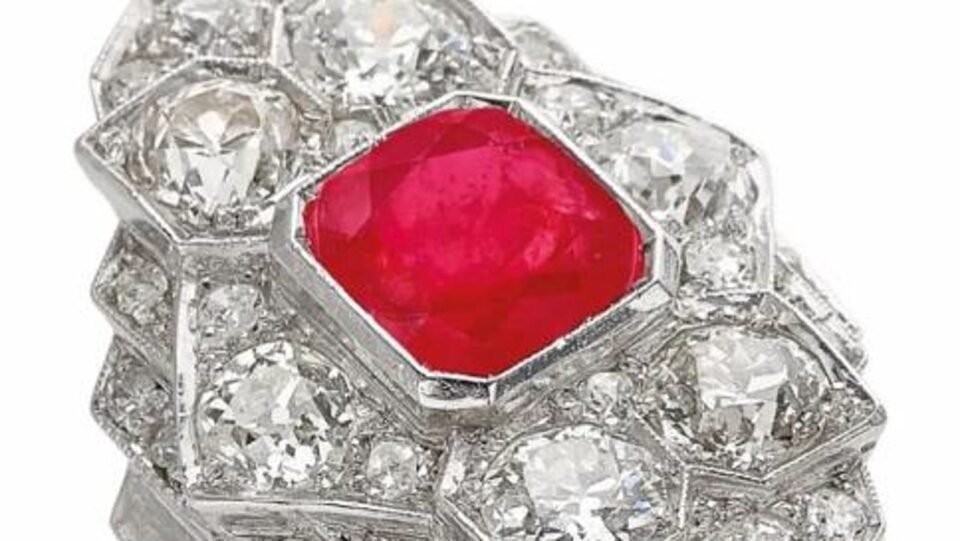
A rare pigeon blood ruby on offer by Gemolithos at Jewellery & Gem World Hong Kong
Gemolithos
For U.S. vintage and antique dealer, Steve Neckman, if it’s wearable, it is selling, particularly yellow gold and signed pieces.
“Platinum and diamond, what we used to call cocktail jewelry, is very slow,” he said. He pointed to a yellow gold Bulgari necklace and a diamond and platinum Harry Winston necklace side-by-side in his case. “I would sell the Bulgari necklace before I would sell this diamond Harry Winston. The first one you can wear anywhere, the second one you won’t wear on a Thursday night. That’s just wearability.”
He continued, “Are hanging earrings better than buttons? Yes. Are hoops still hot? Yes. Are big rings in? Yes. Are wood and natural materials hot? Yes.”
A ring featuring a Paraiba tourmaline from the original mine in Brazil by Alexander Laut
Anthony DeMarco
The Fine Design Pavilion is where the high jewelry companies are located. Unlike the antique and estate jewelry section, foot traffic was slow during the first two days.
Ephraim Zion, founder of the House of Dehres, one of the premier high jewelry firms in Hong Kong, said the first two days are what he expected.
“It’s too early to tell but generally speaking, based on the one and a half days, it’s a little quiet,” he said. “We didn’t come here with great expectations but we still have another three days.”
A suite of jewels featuring rare emeralds and diamond by Dehres at Jewellery & Gem World Hong Kong
Anthony DeMarco
Dehres specializes in creating jewels with exceptional diamonds and colored gems; and for selling loose diamonds and colored gems of exceptional quality. He lamented about the difficult state of the diamond industry and the difficult economy for dealers.
“We have the negative economic environment. We have very high interest rates. That’s all over the world, especially in the Western world. Since Hong Kong is tied up to the U.S. dollar, (local) rates are also high.”
He continued, “The market is very, very quiet right now with this environment of falling prices, especially in, white diamonds,” he said. “People are extremely careful, and they really don’t want to buy anything, which is understandable.”
As far as white diamonds go, he says interest is limited to 15-to-30 carat gems with exceptional color and clarity.
Jewellery & Gem World Hong Kong
Jewellery & Gem World Hong Kong
He said there’s more interest in colored gems, particularly the “big three” as they are known: rubies, emeralds and sapphires, as well as rare Paraiba tourmaline from the original mine in Brazil. But again, he says people want the best and there isn’t that much of the best material available. He also noted that colored diamonds are still strong.
“Colored diamonds are not as bad as the white diamonds. There’s a little bit of softening but prices are quite stable, I’m happy to say.”
Alexander Laut, based in Portugal, was once again in the Fine Design Pavilion showing his unique high jewelry creations made with a variety of high-quality colored gems, including a ring created with an important Paraiba tourmaline from the original mine in Brazil, the rarest and most valuable of this type of gem.
Buyers inspecting jewels at Jewellery & Gem World Hong Kong
Jewellery & Gem World Hong Kong
“My observation is there are fewer people than before. It may have something to do with the Full Moon Festival, but yesterday, it was quite slow,” Laut said on the second day. “But let’s see. It always helps when the airport side (AWE) closes and people move here.”
Laut has been exhibiting at fair for about a dozen years, and he says those who come to his both know his creations. “People appreciate that everything is one of a kind, and are rare, collectible pieces,” he said. “This fair is important for us because we can meet with auction houses who come here.”
He added, “We’re optimistic, and we always believe that there are no gray days.”