
“The stock market is filled with individuals who know the price of everything, but the value of nothing.” Phillip Fisher
The same analogy could apply to the precious metals market.
With each passing day, investors are presented with explanations for why gold or silver prices have moved higher or lower. “Gold fell because Treasury yields rose.” “Silver rallied because inflation increased.” “Gold surged because geopolitical tensions intensified.” While each of these explanations contains a grain of truth, they are often incomplete.
One of the greatest errors investors make is trying to explain gold and silver prices with a single economic indicator. Precious metals are not priced in isolation. Instead, they reflect the equilibrium of numerous competing forces, each varying in importance over time. Sometimes inflation expectations take precedence. At other times, during periods of financial stress, safe-haven forces may overwhelm traditional interest-rate relationships. More recently, record purchases by global central banks (discussed in one of our prior Substack articles) have also affected the long-term supply-and-demand balance in the gold market. Finally, the rapidly growing investment appetite among Chinese and Indian households has become an increasingly important underlying driver of demand for precious metals.
As a result, investors sometimes see gold and silver behave in ways that challenge common assumptions. Gold can rise even as Treasury yields increase, or both can fall together. Silver and gold alternate between outperforming and underperforming each other, despite both being precious metals. These apparent contradictions do not signal market irrationality; instead, they show that multiple, dynamic forces influence precious metals at the same time. Additionally, unlike gold, 58% of silver demand comes from industrial applications.
To track these relationships, we focus on movements in gold and silver prices over our 2003 to 2026 sample period and review factors that may explain their price volatility.
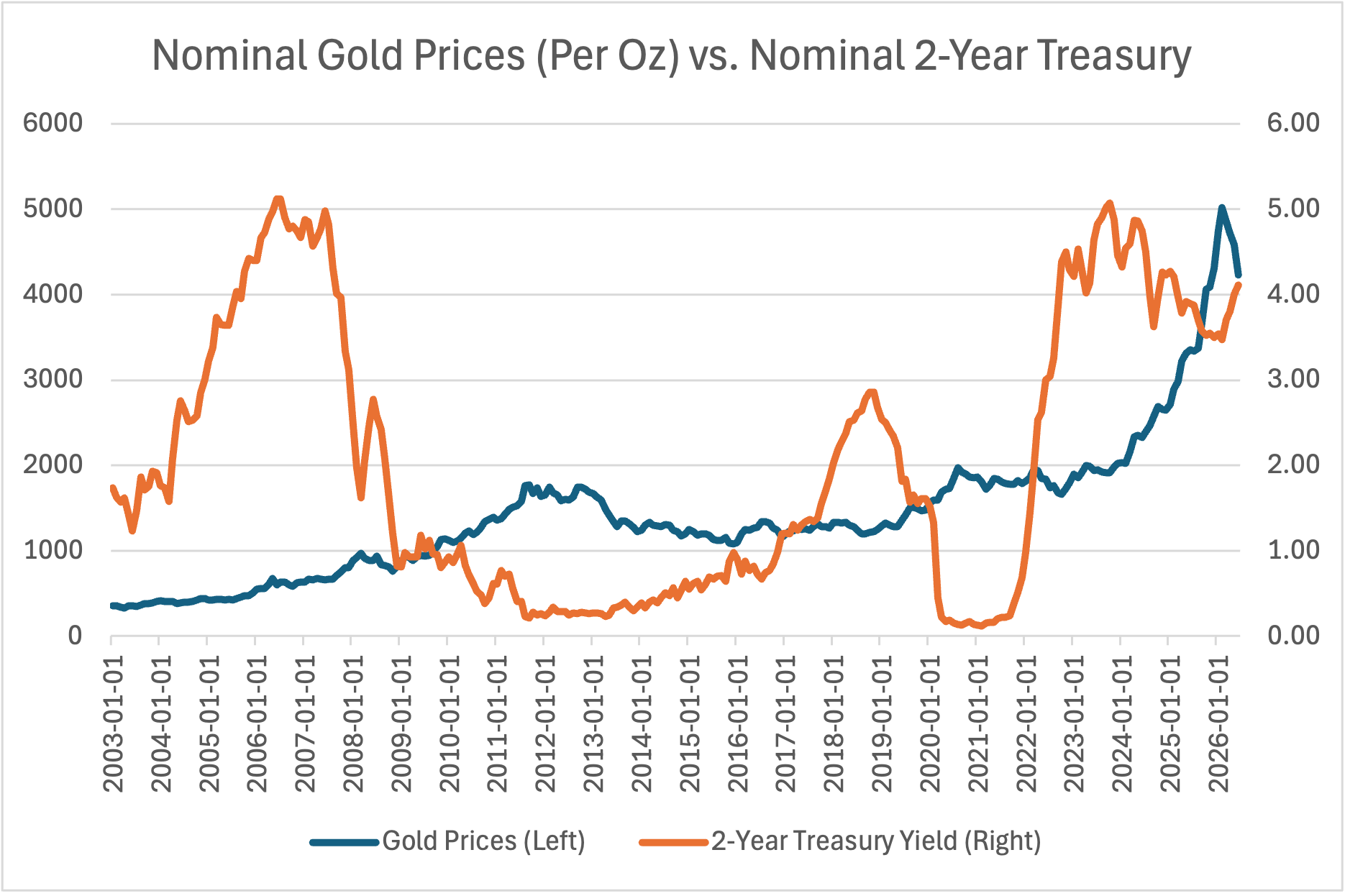
From an investment perspective, few things have influenced gold and silver prices as consistently as shifting expectations about future Federal Reserve policy. Investors constantly reassess where they expect monetary policy to be in six months, a year, or even two years. Not surprisingly, precious metals often begin moving long before the Federal Reserve changes interest rates.
To capture this policy impact, we use the two-year Treasury yield, which reflects investors’ collective expectations for inflation and economic growth and, according to conventional wisdom, captures the Federal Reserve’s reaction function. Unlike inflation data, which describe past price levels, the two-year Treasury yield continuously updates as investors process new information.
Source: World Gold Council and Board of Governors of the Federal Reserve System
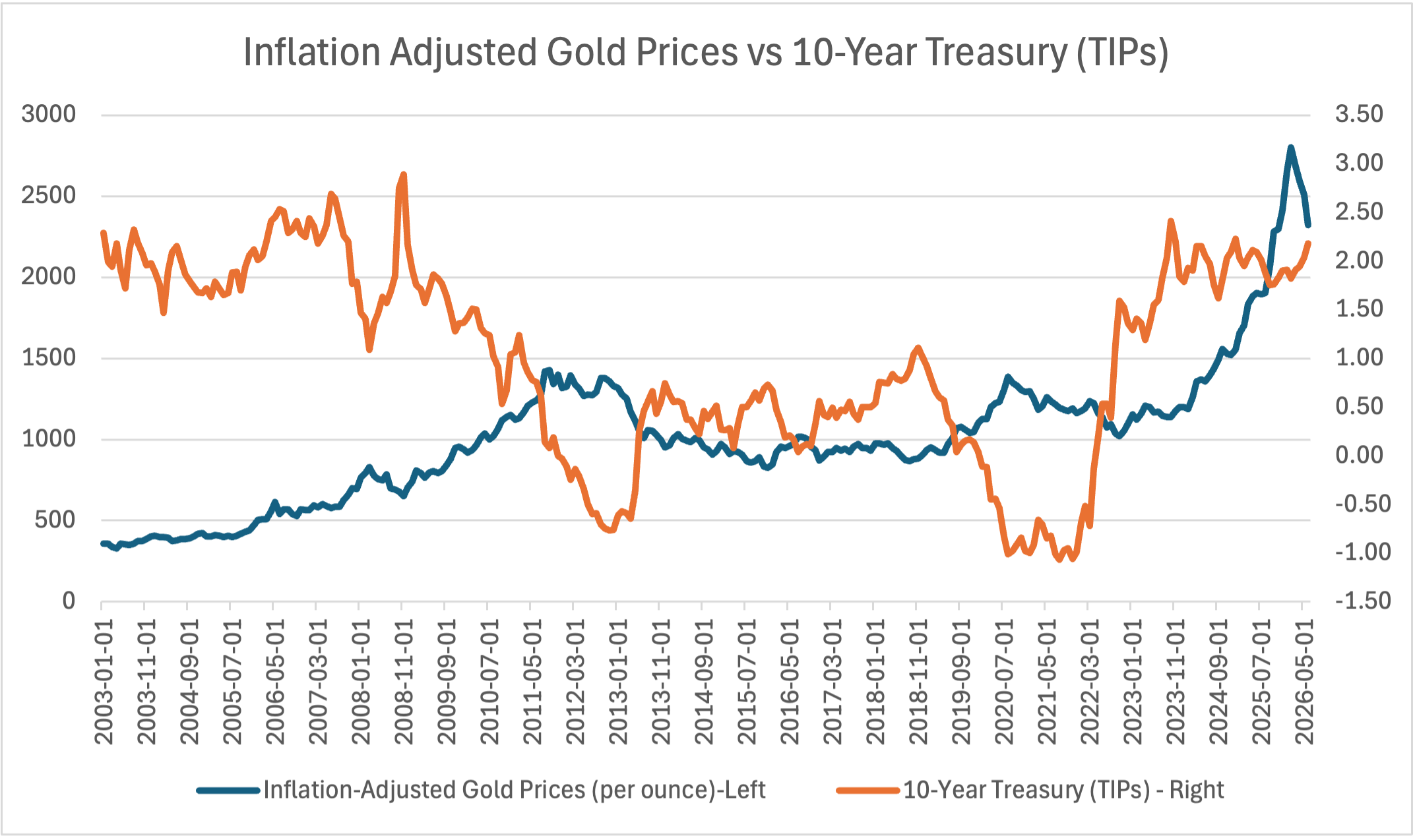
However, academic research further refines this concept, suggesting that long-term real interest rates offer the strongest theoretical explanation for fluctuations in inflation-adjusted gold prices. To capture this relationship, we tracked movements in inflation-adjusted Treasury yields (TIPs) and in the inflation-adjusted price of gold.
While Federal Reserve policy-rate expectations remain a critical determinant of precious-metals prices, investors cannot ignore the importance of long-term real interest rates, which are even more strongly correlated with gold prices.
The intuition is straightforward. Gold pays neither interest or dividends. Higher or lower real yields tend to increase or decrease the opportunity cost of holding gold, thereby reducing or increasing the demand for gold. Interestingly, our analysis shows that the correlation between real gold prices and the real 10-year Treasury yield is -26%.
Source: World Gold Council and Board of Governors of the Federal Reserve System
Safety Haven Effects
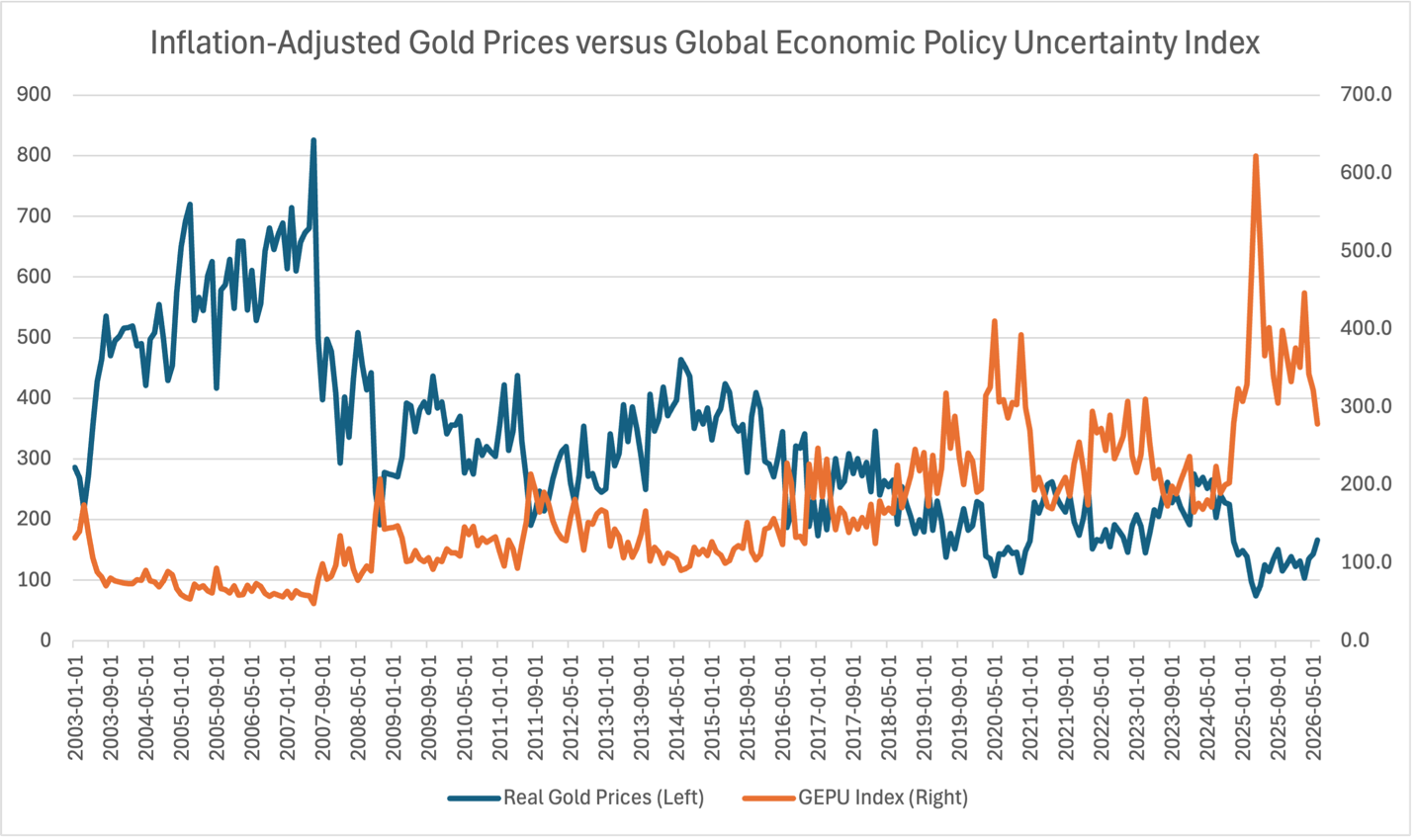
Another important factor in the precious-metals financial relationship is reflected in movements in global economic policy uncertainty. When uncertainty is low or stable, it has a muted impact on precious-metal prices, but when uncertainty surges, it generates safe-haven demand for gold.
Whether driven by a financial crisis, military conflicts, trade disputes, or political instability, these factors can often boost demand for precious metals. During these periods, investors often prioritize capital preservation over income generation. Consequently, gold may appreciate even as Treasury yields rise when geopolitical risk concerns become significant, which explains why simple pairwise correlations occasionally “break down.”
Source: Scott R. Baker, Nicholas Bloom, and Steven J. Davis, World Gold Council and Bureau of Labor Statistics
Silver Catalysts
Silver adds complexity because it is both a precious metal and an industrial commodity. About 58 percent of annual silver demand comes from industrial uses, including solar panels, semiconductors, medical technologies, electric vehicles, and advanced electronics. As a result, silver prices reflect not only monetary conditions and investor sentiment but also expectations for global manufacturing activity and technological investment. When industrial and investment demand both strengthen, silver often outperforms gold. Conversely, slowing global growth often causes silver to underperform, even when gold remains relatively resilient.
Historical Catalysts
After the dot-com bubble burst and the 2001 U.S. recession, monetary policy remained accommodative even as global economic growth accelerated. As confidence in emerging markets rose, commodity and precious metal prices broadly strengthened as investors sought portfolio diversification.
Two important structural developments boosted the global gold market.
The first was the opening of the Shanghai Gold Exchange in 2002, which effectively liberalized the country’s retail gold market and enabled Chinese households to accumulate gold as a financial asset. What began as a relatively small investment market grew into one of the world’s largest sources of physical gold demand.
The second was the introduction of gold-backed exchange-traded funds (ETFs) in 2004. For the first time, investors could gain direct exposure to gold through a simple brokerage account without buying and storing physical bullion. ETFs transformed gold from a niche investment into a readily available financial asset, enabling broader participation by institutional and retail investors alike.
Meanwhile, India’s long-standing cultural affinity for gold jewelry continued to provide a reliable structural foundation for global demand. Together, Chinese investment and household demand (mostly from Asian women), Indian household demand, and rapidly growing ETF ownership generally supported the gold bull market that unfolded over the following decade.
The Global Financial Crisis (2007-09) also reinforced these trends. As central banks worldwide cut interest rates toward zero and launched unprecedented quantitative easing, investors increasingly questioned the long-term purchasing power of paper currencies. Gold became a preferred store of value, while silver benefited from both investment demand and expectations of eventual economic recovery. Naturally, both gold and silver prices rose sharply.
In contrast, the “Taper Tantrum” in 2013 led investors to expect the Federal Reserve to withdraw liquidity, pushing Treasury yields higher and triggering substantial outflows from gold ETFs. This led some observers to conclude that gold’s bull market had ended.
However, this conjecture proved premature!
While Western financial investors were selling, Asian households were buying. Lower prices encouraged Chinese consumers to increase their purchases, and despite a 10% import duty, Indian households continued to accumulate gold. Rather than eliminating demand, India’s tax increases shifted activity into unofficial channels. In essence, gold ownership shifted rather than collapsed.
This evolution became even more apparent after the COVID-19 pandemic.
One of the most underappreciated developments in today’s gold market is the emergence of global central banks as dominant long-term buyers. As I discussed in a previous Substack article, “Global EM-Central Banks Are Continuing to Build a Fortress Gold-Based Safety Net,” emerging-market central banks began viewing gold as a strategic reserve asset to reduce dependence on traditional reserve currencies and strengthen national financial resilience.
From a broader perspective, the World Gold Council reports that global central banks have accumulated 1,000 metric tons of gold over the past four years, compared with an average of 500 metric tons over the past decade! This shift went beyond reserve diversification and reflected a structural change in how sovereign institutions perceived geopolitical risk amid potential U.S. financial sanctions against certain countries.
Remarkably, central bank purchases have continued even as many Western ETF investors reduced their holdings. Under prior market conditions, sustained ETF selling would likely have led to price declines, but in this new era, official-sector purchases and strong Asian physical demand have largely absorbed the selling pressure, fundamentally altering the market’s supply-and-demand dynamics.
China also deserves particular attention because it occupies a unique position in the global gold market. It is both the world’s largest gold producer and one of the world’s largest gold consumers. It is also among the world’s most aggressive sovereign buyers of gold reserves. Few countries influence both the supply and demand sides of a commodity market as profoundly as China does.
India has also undergone a transformation. Historically, Indian gold demand was overwhelmingly tied to weddings, religious celebrations, and jewelry purchases. Today, investment demand for bars, coins, and ETFs has become an increasingly important part of household portfolios. By 2025, investment demand surpassed jewelry demand for the first time in India’s history, reflecting the country’s growing financial sophistication and evolving household asset-allocation preferences.
Multiple Factors Impacted Precious Metals in 2026
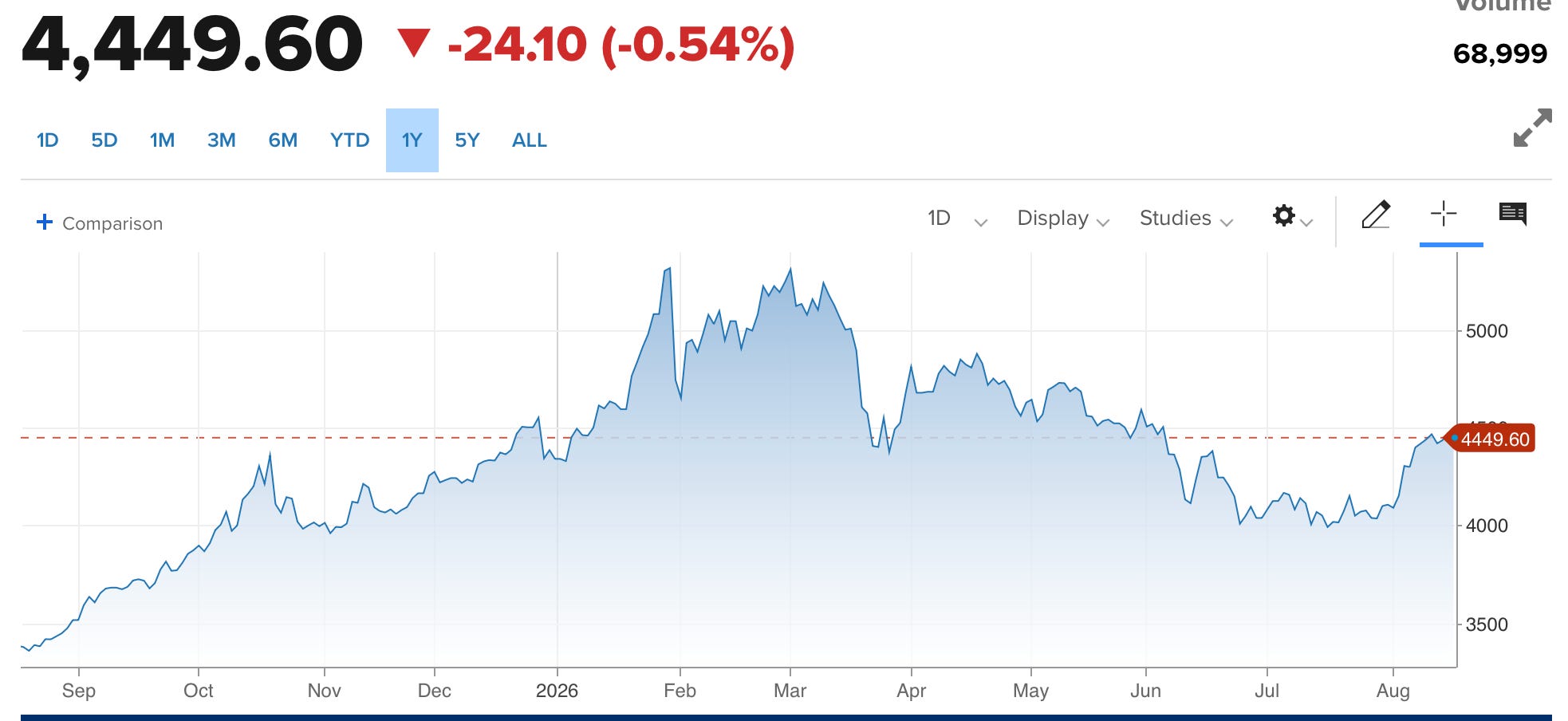
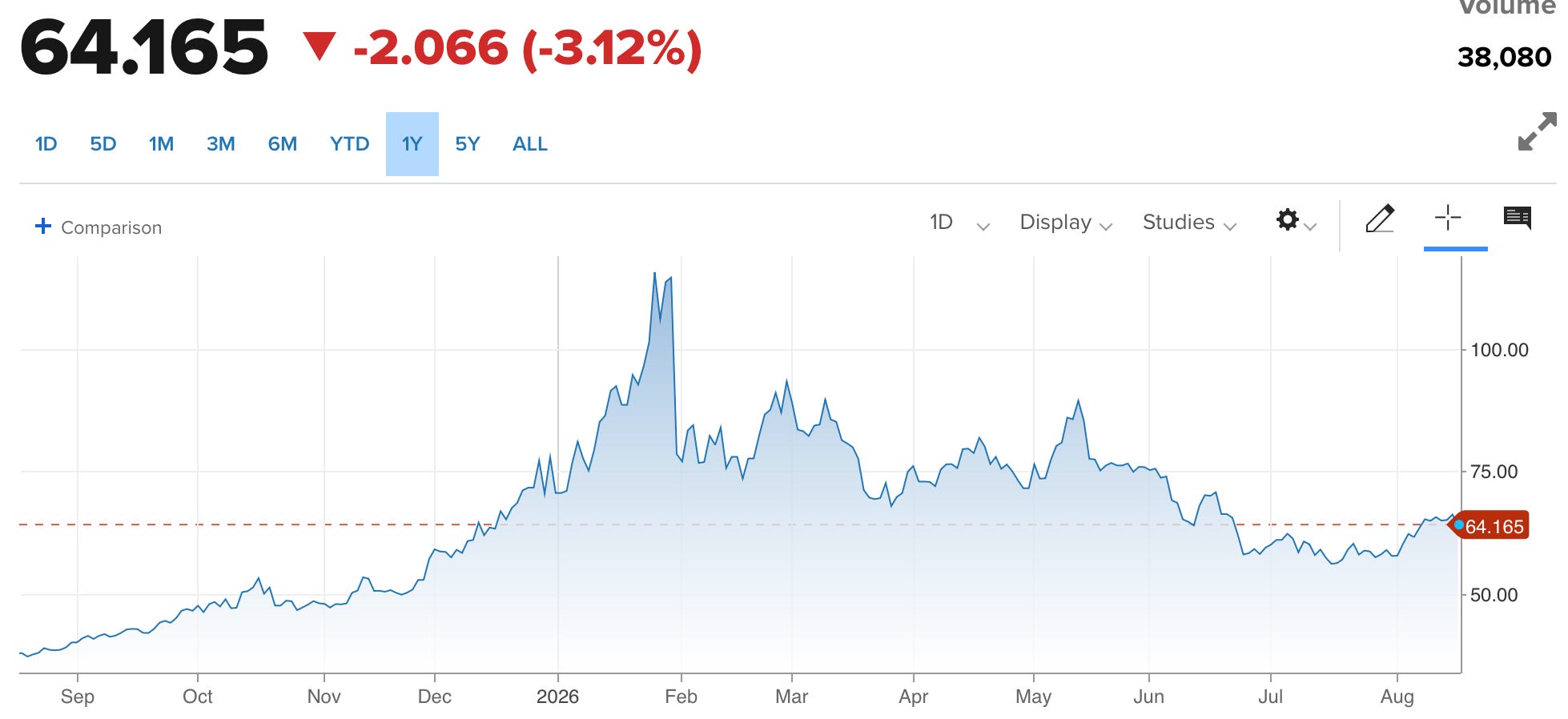
This year has seen every catalyst we have relied on to explain precious-metal price movements. In January 2026, gold and silver prices surged to $5,419 and $120.00, respectively, in response to escalating geopolitical uncertainty. Although the U.S.-Iran conflict did not begin until February 2026, widespread news reports indicated that markets were pricing in a higher risk of military conflict in the Middle East, based on the movement of military equipment in the region.
Source: CNBC
But as the U.S.-Iran conflict unfolded and pushed oil prices and inflation higher, fears of Federal Reserve tightening moved to the forefront, triggering a sell-off in precious metals with gold and silver prices dropping to $3,976 and $55.00, respectively.
Offsetting these concerns, however, was a view that in August 2026, the new Fed Chair Walsh talked tough on inflation but would not raise interest rates so close to the U.S. midterm elections. Risks of higher inflation, along with the Federal Reserve’s reluctance to raise interest rates, are undoubtedly bullish for precious metals, especially against a backdrop of continued geopolitical uncertainty associated with a war that has exceeded its expected 4- to 6-week timeline and has no immediate end in sight. This would trigger safe-haven effects and boost precious metal prices. At the time of this writing, gold and silver prices had recovered to 4,449.60 and $64.17 per ounce, respectively.
Source: CNBC
Summary and Concluding Thoughts
An important historical lesson is that precious metal prices are determined by numerous interacting economic forces rather than any single variable.
Viewing gold and silver through a broad macroeconomic lens that incorporates expectations for monetary policy, real interest rates, inflation, global uncertainty, central-bank accumulation, ETF flows, Asian household demand, and industrial fundamentals will better equip investors to understand fluctuations in gold and silver prices.
As investors look ahead, the question is not whether a single factor will determine the direction of precious metals. Instead, the relevant question is which factor will become the dominant force at the margin. The answer will almost certainly vary over time.
For this reason, investors should closely monitor all the factors we discussed to fully understand the day-to-day fluctuations in gold and silver prices!