
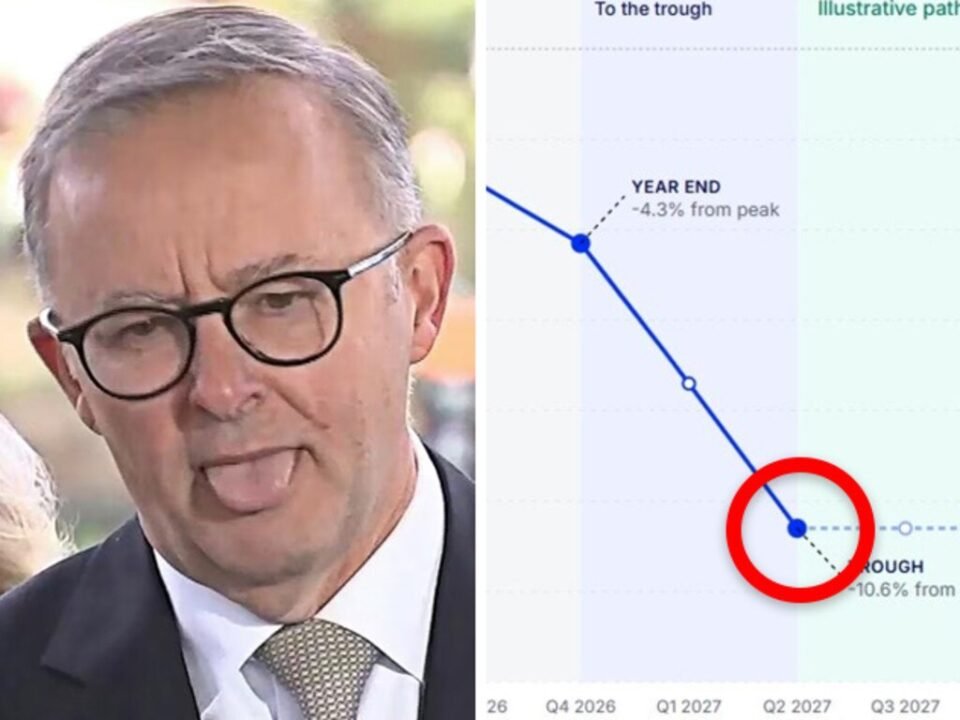
Falling home prices fuelled by Albanese government property tax reforms and higher interest rates will strip an expected $1.3 trillion from Australia’s total wealth, new forecasts have revealed.
The modelling by Primara Research measured what recent ANZ predictions of a 10.6 per cent fall in national property prices over the next two years would cost the economy, indicating it would make the country poorer.
Australian households were forecast to lose a total $527.5 billion in 2026 alone.
It was noted that close to 57 per cent of the country’s household wealth was tied up in residential property, making housing market downturns a significant strain on the economy.
MORE: ANZ reveals when home prices will start growing again
ANZ projected a 10 per cent downturn in property prices on Tuesday. Picture: NewsWire / Gaye Gerard
MORE: ‘Worst time’ to be a first-home buyer in 56yrs
Australia’s residential housing market is currently valued at about $12.7 trillion across roughly 11.5 million dwellings.
NSW represents about 40 per cent of the nation’s housing market and is expected to have the largest falls in prices, with ANZ forecasting a 14.5 per cent average drop in Sydney values over the next two years.
This would result in a $653.2 billion reduction in NSW household property wealth, from $4.5 trillion at the start of 2026 to $3.85 trillion by the end of 2027, the Primara modelling done for HomeLoanRates.com.au showed.
ANZ forecast Melbourne prices would fall by an average of 12.8 per cent over the two years, which would erode Victorian households’ wealth by $357.6 billion.
Victoria and NSW together would account for about 78 per cent of the total lost wealth.
MORE: 1.4m Aussies making their homes ‘poorer’
Property values will fall until mid-2027 before rebounding by around 4 per cent in 2028. Picture: ANZ Bank / ABS Dwelling Values. Analysis: Primara Research for homeloanrates.com.au
McGrath Estate Agents partner and agent Trent Tarbey said the current downturn was being mostly driven by government-led tax changes. “The market was weakening before the budget, because of interest rate rises, but the budget changes were what really pulled down sentiment,” he said.
Shadow Minister for Housing Andrew Bragg said Labor’s tax changes had “destroyed” confidence in the housing market and broken supply fundamentals in the long run.
“Labor has smashed housing,” Senator Bragg said, noting that more effort should have been put into promoting housing supply, rather than the increasing taxes on investors.
“Back in May, the Prime Minister assured Australia that Labor’s Budget was about giving younger Australians a leg-up in the housing market. It has done the opposite,” he said.
The Treasury was contacted for comment but didn’t reply before deadline.
AMP senior economist Shane Oliver said Aussies would feel the drop in wealth and spend less but a silver lining was that it may strengthen the case for a rate cut later on.
“You get that $1.3 trillion hit to wealth, that can mean at an individual level, people feel less well off,” Mr Oliver said.
MORE: 30pc rent increase warning echoes Labor’s 1980s hikes
Shadow Minister for Housing and Environment Senator Andrew Bragg said confidence and the market are “shot” in the short term and broken in the long run. Picture: NewsWire / Martin Ollman.
“And then that leads to less spending in the economy, and that can take pressure off inflation, which ultimately takes pressure off interest rates.
“This is why the reserve bank says, ‘well, we probably need lower house prices, we need lower employment, we need less consumer spending’,” he said, noting it would be a “paper loss” unless homeowners refinanced or sold.
ANZ economists, Madeline Dunk and Adam Boyton said the forecast drop in property prices would be comparable to the 1983 recession.
“We are forecasting the worst downturn in Sydney housing prices since 1983 and I think it’s really a combination of factors: affordability, something that’s been weighing on the Sydney market for a while,” Ms Dunk told The Nightly.
“Our view is that the RBA is done (hiking rates) but nonetheless, we do think the cash rate is slowing down the economy and clearly slowing down the housing market,” she said.
MORE: ‘Low’: Report today to force RBA to cut rates
ANZ economist Madeline Dunk said conditions should improve in 2028.
ANZ’s estimates are for capital cities but head of research at Primara Research, Peter Drennan said it doesn’t mean the regions would expect a different outcome.
“For most Australian households, home equity is the single largest asset on their balance sheet, so a fall of this scale isn’t an abstract number, it changes borrowing capacity, refinancing options and how comfortable people feel taking on new debt,” Mr Drennan said.
“ANZ’s forecast is built on the capital cities, but regional Australia has grown just as fast, if not faster, over the past year.
“If that pattern holds, there’s no reason to assume regional property is shielded from this correction, a similar or even larger pullback would be consistent with how strongly those markets have run,” he said.
MORE: Unions demand 1980s solution to rent crisis
ANZ’s said their estimate was based on clearance rates and less investor loans. Picture: Gaye Gerard / NewsWire
ANZ said key drivers of the downturn are fewer houses selling at auctions and a pullback from investors in response to negative gearing and capital gains tax reforms.
ANZ economists said they expect conditions to improve in early 2028 but won’t return to the levels seen earlier this year.
“Given the broader supply backdrop, and the capacity constraints in the construction sector, we think it is hard to see housing prices falling for an extended period,” Ms Dunk and Mr Boyton said.
“Through the second half of 2027, we expect dwelling prices to start recovering, supported by 50 basis points of rate cuts from the Reserve Bank of Australia.
“This should see capital city housing prices rise by 4.3 per cent in 2028,” they said.
MORE: Sydney locals outraged over $1.4bn data centre ‘sidestep’
— With additional reporting by Aidan Devine