
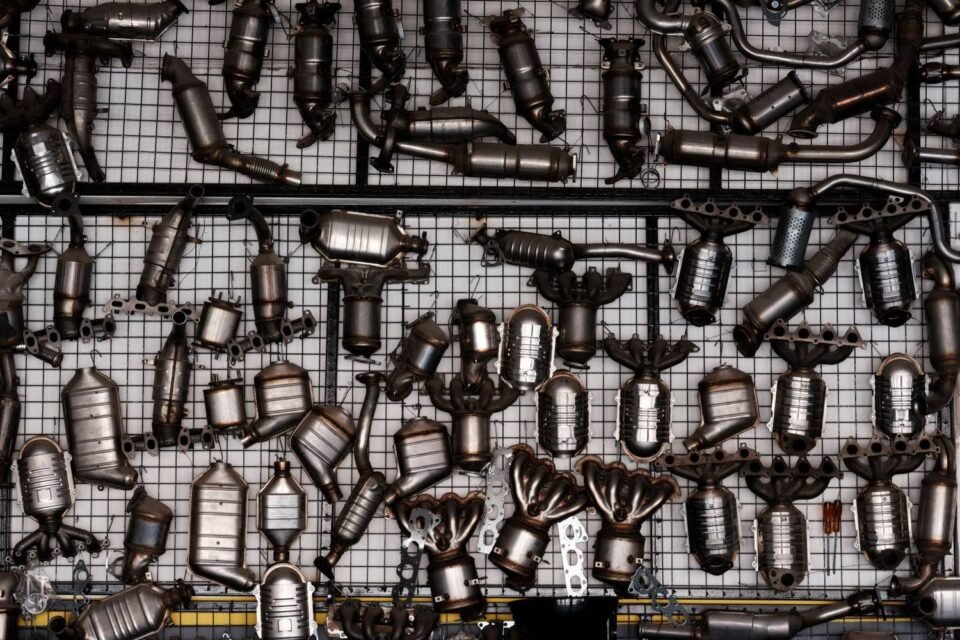
The catalytic converter recycling industry has become an essential part of the circular economy. As demand for platinum, palladium, and rhodium—collectively known as platinum group metals (PGMs)—continues to grow, recycling these valuable components helps reduce the need for primary mining while supporting more sustainable manufacturing. The global catalytic converter recycling market was valued at approximately $22.5 billion in 2025 and is projected to reach nearly $39 billion by 2032, growing at a compound annual rate of around 8%. Secondary recovery from spent autocatalysts already supplies a substantial share of annual PGM availability, with recycling accounting for roughly 30% or more of total supply in recent years.
Yet despite the industry’s growth, one challenge continues to affect both individuals and businesses: pricing transparency. Whether you’re selling a single catalytic converter or managing inventory from an auto dismantling business, understanding what a converter is actually worth isn’t always straightforward. Prices can vary based on the converter model, the amount of recoverable precious metals, current market conditions, and even the condition of the internal ceramic or metallic substrate, making it difficult for sellers to know if they’re receiving a fair offer.
Why Transparency Is So Important
Unlike many automotive parts, catalytic converters don’t have a fixed market value. Two converters that look nearly identical can have completely different prices because of the materials inside them. Value is determined almost entirely by the concentration of platinum, palladium, and rhodium in the washcoat on the honeycomb substrate. As of late July 2026, spot prices hovered around $1,500–$1,600 per ounce for platinum, $1,200–$1,270 for palladium, and $7,750–$8,850 for rhodium—levels that make even modest differences in loading highly consequential.
National average scrap prices for catalytic converters currently sit near $94 each, but the range is extreme: aftermarket units may fetch only $5–$30, while high-grade domestic, hybrid, or “torpedo” converters from large trucks and SUVs can command $100 to over $1,000. Serial numbers (stamped or etched on the shell) have become the primary identifier linking a unit to known PGM loadings. Without accurate identification—often requiring reference to extensive databases or laboratory assay via methods such as ICP-OES—sellers have little confidence they are making the right decision.
This lack of transparency can slow down transactions, reduce trust between buyers and sellers, and discourage responsible recycling. Historical surges in converter theft (which peaked above 64,000 reported claims in 2022 before declining with tighter regulations) further complicated the market by introducing stolen material and prompting many jurisdictions to require proof of ownership, seller identification, and serial-number recording. Opacity also allows low-grade or contaminated material to be mixed into loads, eroding margins for legitimate participants. As the industry grows, there is an increasing need for solutions that make the process simpler, faster, and more predictable.
How AutoCatalystMarket Is Improving the Process
One platform helping address these challenges is AutoCatalystMarket. Designed specifically for the catalytic converter recycling industry, it provides a centralized marketplace and the world’s largest catalog of catalyst data—more than 30,000–35,000 items with tens of thousands of photographs and detailed specifications. Users can search by serial number, vehicle make/model, or even photo recognition to identify a converter and receive pricing based on precise precious-metal content derived from spectral analysis, updated against current market rates for platinum, palladium, and rhodium.
Instead of relying solely on local buyers or limited pricing information, individual vehicle owners, scrap yards, and auto dismantlers can compare offers, create custom price lists, monitor historical trends, and connect with professional buyers across regions. The platform supports both piece-price transactions and bulk recycling calculations for shredded monolith material. By combining industry expertise with digital technology, AutoCatalystMarket aims not simply to facilitate sales but to make the entire recycling process more accessible, efficient, and trustworthy—reducing the information asymmetry that has long characterized this fragmented market.
Supporting Sustainable Automotive Recycling
Better recycling practices benefit more than just buyers and sellers. Every catalytic converter that enters the legitimate recycling stream helps recover valuable PGMs that can be refined and reused in new products. Recovery rates often exceed 90%, and secondary production of these metals typically generates 60–80% less CO₂ than primary mining and refining. This is particularly important given that primary PGM supply remains concentrated in a few regions (notably South Africa) and has faced production constraints, while automotive demand continues under tightening global emissions standards.
Digital platforms also play an important role by making responsible recycling easier to access. When sellers have better information and a straightforward way to connect with qualified buyers who follow documentation requirements, more catalytic converters stay within the formal recycling ecosystem instead of ending up as waste or entering illicit channels. Transparent pricing and verified serial-number databases further support compliance with evolving regulations that aim to curb theft while protecting legitimate trade.
Looking Ahead
As the automotive recycling industry continues to evolve—with rising volumes of end-of-life vehicles, fluctuating PGM prices, and stronger circular-economy mandates—transparency and efficiency will become even more important. Digital solutions are helping modernize a traditionally opaque and fragmented market, giving both businesses and individual sellers greater confidence throughout the selling process. Accurate identification, real-time metal pricing, and accessible marketplaces reduce risk, improve recovery rates, and strengthen trust across the supply chain.
By combining technology, industry knowledge, and a commitment to responsible recycling, AutoCatalystMarket is helping shape a marketplace where pricing is clearer, transactions are simpler, and valuable materials remain part of a sustainable circular economy. In an industry where the difference between a fair deal and a poor one can amount to hundreds of dollars per unit—and where environmental stakes are high—transparency is no longer optional. It is the foundation for growth that benefits everyone involved.