
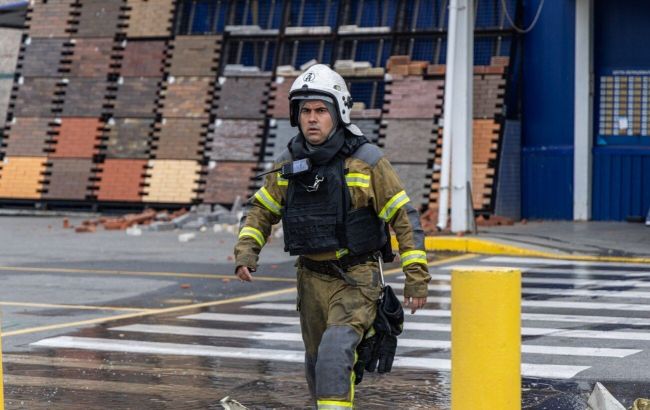
Kyiv and several other parts of Ukraine have faced waves of Russian air attacks since the night of August 27, with warehouses, logistics facilities and other economic infrastructure increasingly among the targets.
The attacks have hit Kyiv and the surrounding region as well as areas including Kryvyi Rih, Odesa, Kharkiv, Zaporizhia, Sumy, Poltava and Cherkasy, RBC Ukraine reported.
In Kyiv, successive waves of jet-powered drones continued through the day and into the evening. Debris fell near schools and kindergartens, while one drone crashed onto a roadway in the central part of the capital, injuring four people.
In Kharkiv, Russian forces struck the Epicentr shopping centre, killing one person and injuring five others.
The attack also damaged logistics facilities belonging to several major Ukrainian retailers and businesses, including Budynok Igrashok, Fora and Comfy. A Roshen warehouse was destroyed.
Residential buildings were damaged in the Kyiv region, while energy facilities in Poltava and Kherson regions were also hit. Russian forces additionally shelled Nikopol and attacked Kramatorsk with guided aerial bombs.
Ukrainian military and political expert Oleksandr Musiienko said the growing focus on businesses and economic infrastructure was part of a broader Russian strategy.
“The enemy is focusing on weakening the overall economic potential of Ukraine and the capital,” Musiienko told RBC-Ukraine.
He said Russia had previously concentrated heavily on energy, gas and water infrastructure but was now increasingly striking industrial facilities, civilian production sites, warehouses, logistics hubs and ports.
The expert said Kyiv would remain a major target for Russian attacks and warned that the frequency of strikes was unlikely to decline.
According to Musiienko, the objective is to weaken Ukraine’s economy and inflict damage far from the battlefield by disrupting supply chains, logistics, retail operations and businesses.
The shift comes as Russian forces continue to face difficulties making significant advances on the ground, making attacks on Ukraine’s rear infrastructure an increasingly important part of the campaign.
Russia is also expanding its use of jet-powered drones, according to the expert.
Musiienko said production of the drones was increasing and that Russia was establishing more launch sites. He estimated that the aircraft could currently travel between 500 and 600km, putting much of northern, eastern, southern and central Ukraine, including Kyiv, within range.
Some of the drones have also been detected heading towards western Ukraine. Musiienko said this could indicate that Russia is working to extend their range.
He also suggested that some long-range UAVs could be carrying reduced warheads in order to accommodate additional fuel, potentially allowing them to be used for reconnaissance missions ahead of missile attacks.
“Russia is increasing the number of these drones. The war is increasingly moving into the air domain,” he said.
The possibility of regular jet-powered drone attacks on Kyiv cannot be ruled out, Musiienko said. Russia could launch individual drones or groups of as many as 20 towards the capital.
Ukraine is developing ways to counter the threat, including the use of air defence systems, aircraft, air-defence artillery and interceptor drones.
However, the expert said interceptor drones were not yet available in sufficient numbers for large-scale deployment because manufacturers were still completing testing.
The latest attacks suggest that Russia’s air campaign is evolving beyond strikes on critical infrastructure, with Ukrainian businesses, warehouses, logistics networks and other parts of the economy increasingly exposed to attack.