

Environmental Week
Cornish clay was first discovered at Tregonning Hill 280 years ago by local Quaker and chemist William Cookworthy.
By the early 20th century, the clay was in global demand. A prized ingredient – essential for making porcelain – it was known as ‘white gold’ due to its rarity. It was so desperately coveted when first introduced from China, that it was traded for its literal weight in gold.
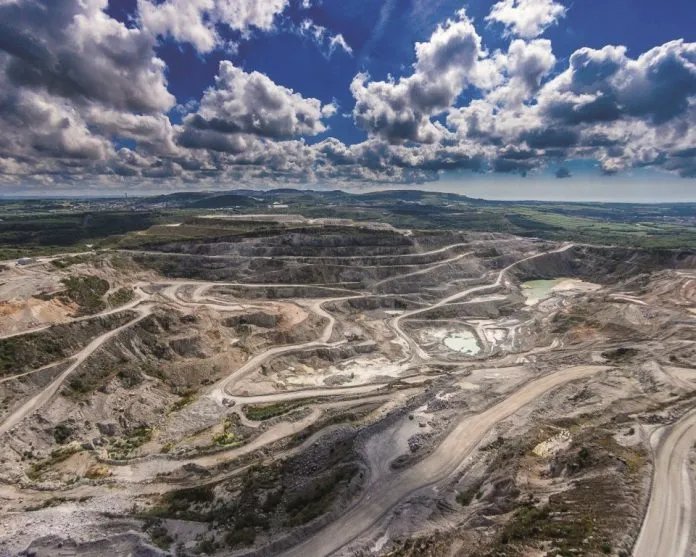
Today in Cornwall, china clay Sustainability is at the heart of customer demands. is extracted and processed primarily by Imerys, and continues to be a mainstay of the local economy – worth around £40 million per year. Around 800 people are employed at over 20 mining and processing facilities in mid-Cornwall and beyond.
It takes an impressive range of specialists to get the clay from ‘pit to port’ – geologists, scientists, engineers, mobile plant operators, plus extensive support functions from IT to logistics – and many of the UK teams actually support Imerys operations around the world.
Hundreds of thousands of tonnes of kaolin is extracted and processed annually – and 80% of this is exported via the deep water Port of Fowey. Clay trains move around 1,000 tonnes of kaolin every week up to Stoke-on-Trent, to feed the ceramics industry clustered in that region.
With hundreds of applications from high-end ceramics to paints, adhesives, plastics, rubber, cosmetics, paper and cardboard – sustainability is at the heart of customer demands.

Imerys’ state-of-the-art research and development centre in Par is focused on finding clever new ways to use minerals and finding sustainable solutions to anticipate and meet customers’ changing needs. Polwhite™ LOOP, which was launched last year, is the most recent example of this.
Mike Bird, science and technology development manager explains: “It has been developed for tyre inner liners, and it offers a low-carbon footprint alternative to some existing minerals already used in the automotive industry*.
“What’s clever is that it uses material from our own process that would otherwise go to waste. By giving it a new life we have turned a byproduct into a high-performance material. This extends the life of our mine, reduces natural resource depletion and provides financial and sustainable value to both Imerys and our customers.
It’s a perfect example of the circular economy principles in action, and it has opened the door for future collaborations.” Alongside this is Imerys ongoing commitment to renewable energy.
Some restored mining land cannot be used for building or given over to public access, and these areas are being utilised for solar farms and wind turbines. The wind turbines on Imerys land are owned by Wadebridge-based Clean Earth Energy. One of the existing turbines is widely recognised as one of the most efficient of its kind in the UK due to its exposed position and consistent coastal winds! When the current round of turbines in construction are fully functioning, they will be providing an impressive 10% of Cornwall’s electricity needs.
* Polwhite LOOP is used to partially replace carbon black (N660) – quotevalue is is 2321 g CO2 eq. as stated by Ecoinvent. Polwhite LOOP is 165 g CO2 eq. as calculated and stated by IMERYS.
