
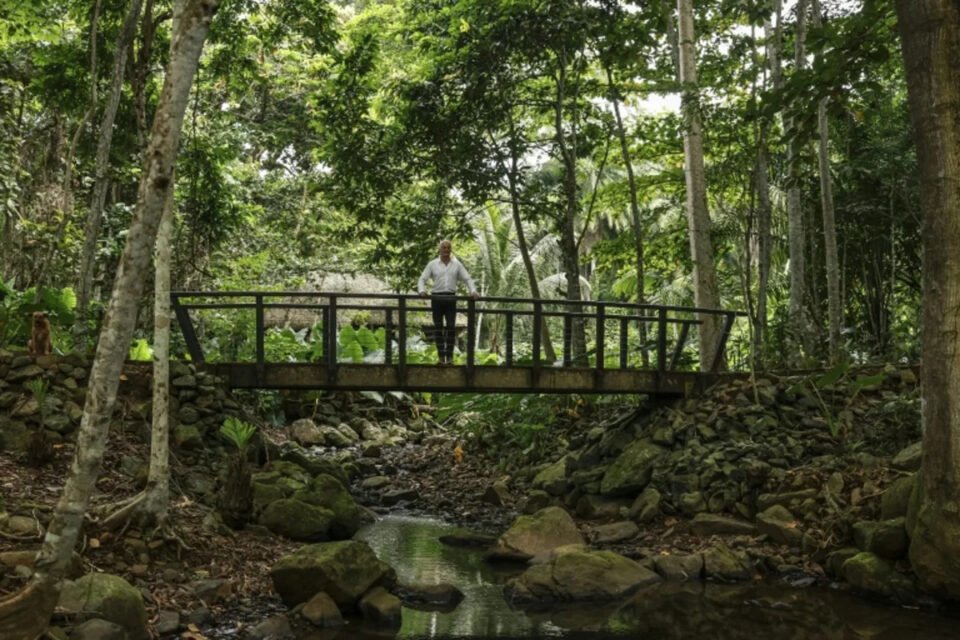

On the paradise island of Principe, a lush jungle haven in the turquoise waters of the Gulf of Guinea, a South African multimillionaire is offering locals a financial dividend to preserve the natural beauty on which his luxury tourism business depends.
The initiative is the brainchild of tech entrepreneur Mark Shuttleworth, who for over a decade has been promoting a model of exclusive ecotourism aimed at an ultra-wealthy foreign clientele.
The dividend scheme, which Shuttleworth’s charitable organisation pays out individually to locals, aims to encourage them to preserve their natural environment — a mountainous volcanic island, bordered by pristine beaches and whose tropical forest is home to a wealth of endemic species.
In return for agreeing in writing not to engage in environmentally damaging activities like sand extraction or unregulated logging, adults can receive up to 6,250 dobras ($290) per quarter — the equivalent of around $3.20 a day.
It represents a bonus in a tiny country where 45 percent of the population lives on less than $3.60 a day, according to the latest World Bank data from 2017.
But some critics say the initiative is a missed opportunity to work with the government to address the island’s economic and social needs.
“I’ve just received the first quarterly payment. At 900 dobras it’s definitely not a salary but it’ll help,” grinned 23-year-old technician Ermelindo Mendes, talking to AFP from his village of Monte Alegre in the lush hills.
The whole of Principe, part of the archipelago of Sao Tome and Principe, is an internationally recognised UNESCO biosphere reserve.
Staying in one of Shuttleworth’s four hotels on the archipelago can cost up to $1,700 a night.
The hotelier promises his guests — most of whom are European -– a luxury experience discovering a “hidden west African paradise”.
– Nature’s guardians –
His business model depends on preserving Principe’s pristine natural environment.
So in February, to enlist the support of the island’s 10,000 inhabitants, Shuttleworth began offering them a small nature dividend via his charitable organisation, the Faya Foundation.
The locals are “nature’s principal guardians. We need them on our side”, said Vik Michau, a sociologist with the Foundation.
None have yet earned the maximum dividend of $290 per quarter.
“Data monitoring shows the natural environment isn’t in an optimal state yet,” Michau said.
To earn more, locals need to reforest the island and make what she described as “better choices regarding the natural environment”.