
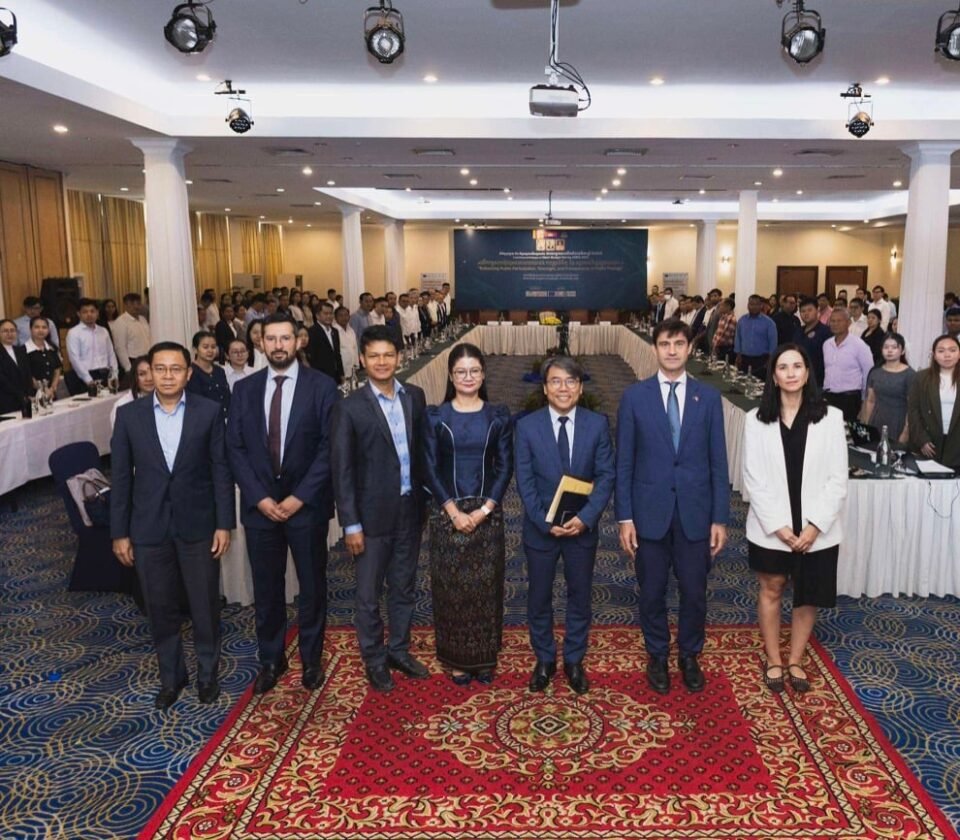
Participants pose for a group photo during the Launch and Dialogue on Open Budget Survey (OBS) 2025 on September 22. Photo: The NGO Forum on Cambodia
PHNOM PENH – Cambodia’s Open Budget Survey (OBS) 2025 has demonstrated noticeable progress in public finance transparency.
However, oversight and public participation continue to lag behind.
The findings, which highlighted the need to broaden public and civil society participation, prompted the relevant stakeholders to gather on Sept. 22 for the launch and dialogue on the OBS 2025 during which were presented the progress made and were discussed ways to further strengthen budget transparency and accountability.
Cambodia’s transparency score increased from 43 in 2023 to 54 in 2025, positioning the country above the global average of 45 and the Asia-Pacific regional average of 49.
The gain was driven by richer content on macroeconomic forecasts and revenue data in the Pre-Budget Statement as well as expenditure, debt and revenue data in the Enacted Budget.
According to Soeung Saroeun, executive director of the NGO Forum on Cambodia and Secretariat of the Budget Working Group, the 11-point rise in budget transparency reflected more timely public disclosure of budget information and civil society efforts to promote public transparency.
However, the score for budget oversight rose by only two points, from 41 in 2023 to 43 in 2025.
Public participation score remained unchanged at 2, prompting Saroeun to stress the need for all stakeholders—particularly the executive and legislative branches—to step up efforts and foster stronger ties with civil society organizations and development partners.
Saroeun also urged the Ministry of Economy and Finance to increase opportunities for citizen participation in national and sub-national budget processes, conduct broader consultations with the National Assembly, and recognize civil society as a full member of the Public Financial Management Reform Steering Committee.
Meas Soksensan, secretary of state at the Ministry of Economy and Finance, said that the ministry has continuously disseminated key budget documents and reports to keep the public informed as part of its efforts to enhance transparency and budget openness.
These include the publication of the Medium-Term Fiscal Framework (MTFF) on the ministry’s website and the creation of a simplified version of the MTFF for the general public.
Soksensan added that the ministry is planning to propose further activities to the relevant units to strengthen budget transparency, and pledged to monitor the dissemination of budget information.
In 2026, a total of 10 ministries and institutions have produced Citizens’ Budget books, while seven ministries have organized public forums on their annual budget packages, he said.
Budget Transparency Alone Is Not Enough for Accountability
Produced by the International Budget Partnership and first launched in 2006, the OBS assesses each country across three dimensions: budget transparency, public participation, and legislative and audit oversight. The 2025 edition covers 82 countries and is conducted by independent civil society researchers in each country.
However, making budget information public is not enough, OBS says. Accountability also requires the capacity and space for the public and oversight bodies to engage with and act on it.
In the survey, Cambodia scored just 2 out of 100 for public participation, well below the global average of 17 and the regional average of 18, with no formal opportunities recorded during budget formulation, implementation or audit.
Bryan Fornari, head of Cooperation at the Delegation of the European Union to Cambodia, said that budget transparency should go beyond publishing allocations and involve showing how public funds are used.
“Citizens should be able not only to see where public money is allocated but also what results it delivers,” he said. “Publishing the budget is important; showing what happened afterwards is equally important.”
As Public Financial Management (PFM) reform advances, Fornari said the priority is to ensure that ministries and budget institutions effectively use PFM systems to strengthen public service delivery and achieve better results.
Mar Sophal, program manager at the NGO Forum on Cambodia and an independent Open Budget Survey researcher, proposed key measures to strengthen public participation.
He said that although there is not yet a formal legal framework, the government has already taken several steps to encourage public input and participation.
“In the coming years, ministries and institutions that have previously published their budget information could make it publicly available through their social media platforms,” Sophal said. “If possible, they could also establish public forums to gather input and feedback from the public.”