
AI attracted $258.7 billion in venture capital in 2025, 61 per cent of all venture investment worldwide, according to the OECD, yet less than 1 per cent of AI investment is directed towards social impact and the capabilities that determine who benefits remain concentrated in a small number of markets. The Gates Foundation’s Goalkeepers 2026 report, published last week, found that more than 90 per cent of the data used to train early large language models came from English-language sources, and that leading speech-recognition systems make errors less than 6 per cent of the time in English and more than 60 per cent of the time in Yoruba.
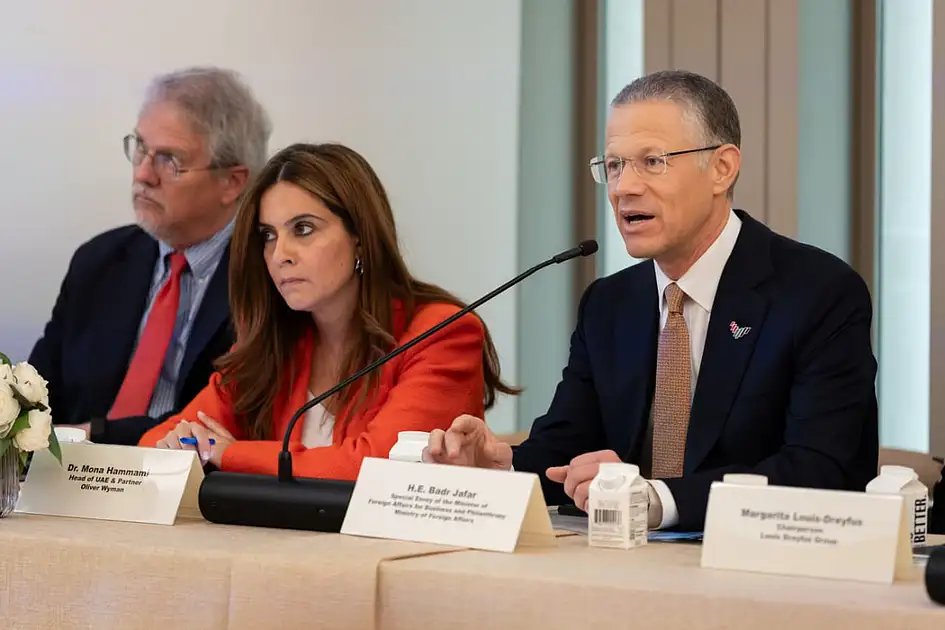
More than 60 leaders from government, business, philanthropy and technology met at the Permanent Mission of the United Arab Emirates to the United Nations today to examine how artificial intelligence can be shaped by, and not only delivered to, the countries and communities of the Global South, at a private roundtable held during the 81st session of the UN General Assembly.
The roundtable, ‘AI, Philanthropy and Inclusive Growth’, was co-hosted by Emirates Foundation and Badr Jafar, Special Envoy of the UAE Minister of Foreign Affairs for Business and Philanthropy. It marked the launch of a white paper, ‘From Access to Agency: How philanthropy can support AI development in the Global South’, developed by Emirates Foundation and the Office of the Special Envoy with Oliver Wyman, and continued a conversation begun at the World Economic Forum in Davos in January around the ‘AI impact flywheel’, in which public policy sets direction, philanthropy de-risks experimentation and business scales solutions.
Opening the roundtable, Badr Jafar said: “Philanthropy’s job is to fund what others will not: local-language data, independent evaluation, the missing middle of people who keep a system working after the pilot ends, and the institutions that take a decade to build. An AI model can cross a border in seconds. Trust, skills and institutions cannot. They are built with people, over years, on terms communities can sustain. This is the UAE way.”
The white paper describes a ladder from access to adoption, adaptation, creation and governance, and identifies where philanthropy can fund what is too early, too shared, too local or too long-term for commercial investors and governments: local-language data, independent evaluation, shared infrastructure, the technicians and local firms who sustain systems after pilots end, and institutions that take a decade to build while most grants last one to three years.
Ahmed Talib Al Shamsi, Secretary General of Emirates Foundation, said: “Technology creates meaningful social impact when it strengthens the capabilities of people and institutions serving their communities. At Emirates Foundation, our focus is on connecting innovation with real community priorities, building the skills and partnerships needed to translate promising ideas into practical solutions, and ensuring that those solutions can grow, sustain their impact and create long-term value for society.”
Discussion focused on capability across the full AI talent stack, from frontline users to frontier researchers and the practitioners between them; on building locally led AI capability in the Global South; on philanthropy’s distinctive role and appetite for early risk; and on the institutions, shared infrastructure and communities of practice that turn access into agency. Participants also considered how the UAE’s assets in compute, research institutions, capital and convening can be put behind locally led capability, including through the UAE’s AI for Development initiative for Africa and the AIM for Scale partnership with the Gates Foundation, which delivered AI-based monsoon forecasts to 38 million Indian farmers in 2025.
At the conclusion of the roundtable, Emirates Foundation and the Responsible AI Future Foundation signed a Memorandum of Understanding. The agreement was signed by Ahmed Taleb Al Shamsi, Secretary General of Emirates Foundation, and Dr. Mark Latonero, Chief Global Affairs Officer of the Responsible AI Future Foundation.
The collaboration will explore practical approaches that enable communities and institutions to responsibly adopt, shape and sustain AI solutions, while supporting knowledge exchange and the development of scalable models with relevance across the Middle East and the Global South.
The Responsible AI Future Foundation was launched by G42 and Microsoft, with Mohamed bin Zayed University of Artificial Intelligence as a research partner, to advance responsible AI standards and implementation across the Middle East and the Global South.
