
Financial strategies can advance sustainability goals, but only if environmental trade-offs can be measured, trusted and incorporated into decisions.
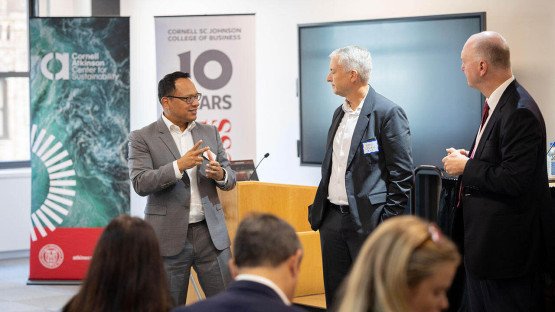
A panel of experts showcased practical efforts to do just that at a Climate Week NYC 2026 event co-hosted by the Cornell SC Johnson College of Business, the Cornell Atkinson Center for Sustainability and Accounting for Sustainability (A4S), a global nonprofit that aims to incorporate sustainability into financial and business decisions.
The event, held Sept. 21 in New York City, featured global leaders in sustainable finance.
First, winners of the 2026 Finance for the Future award, an honor founded by A4S that recognizes organizations and people who incorporate sustainability into financial decisions, gave two rounds of brief talks on their companies’ tangible climate-related efforts. Those include financing early-stage climate projects, calculating numerical costs of natural impacts and improving corporate reporting.
Other speakers were then welcomed to the stage in a panel, “The Challenges of Systems Change,” moderated by Andrew Karolyi, the Charles Field Knight Dean of the SC Johnson College.
“If measuring your environmental impacts is that important, it should be embedded into financial accounting,” said Kathy Mulvany, global head of sustainability and head of sustainable investment at Everpure. Nikita Asthana, global head of sustainability at Olam Agri, reiterated the importance of considering environmental risks alongside financial performance.
Speakers acknowledged that companies require reliable and comparable data sources in order to incorporate environmental impacts into investments and business strategy. This evolving need has led to a change in the purpose and content of sustainability reporting, they said.
According to Asthana, sustainability reporting used to contain narratives geared towards civil societies, like nonprofits, but is now very data heavy so investors can understand climate and nature risk exposure.
“The process of getting all of this data and ensuring that it is auditable, ensuring that the quality and integrity of all of this information is able to meet a certain benchmark … all of that is a humongous burden,” she said.
Holly Turner, head of sustainable investment at Schroders, and Valentin Jahn, deputy director of research and operation at the Transition Pathway Initiative (TPI), discussed ways their companies have reimagined sustainability data for better comparative purposes.
“We recognize nature loss is not only an environmental issue, but one that could impact us financially,” said Turner. Schroders created a single nature value relative to sales percentage for each company that can then be compared, she explained.
TPI’s framework makes multidimensional corporate climate action accessible to large and small firms alike, Jahn said. Using the framework, created from public information, investors can look past companies’ climate-related claims, assess their actions and compare that with peers. The practicality and transparency of the free-to-access framework creates a leveling effect for climate-informed investing, he said.
Maryam Farboodi, associate professor of finance (SC Johnson) moderated the second of two rounds of lightning talks, and said she was “really delighted to see three different awardees who are looking at three facades of the same big question.”
Karolyi moderated the closing panel of the event, folding AI into the reporting and data conversation. Panelists said they were aligned in thinking of AI as a useful tool for distilling data for easier comparison, inferencing and making the investment process more efficient. However, from a corporate perspective, Asthana was cautious.
“If you do not have good data, then what are we even going to input into this model or into this platform?” she said.
David Ng, professor of finance (SC Johnson) and a Cornell Atkinson Faculty Fellow, and Yin Luo, a member of the Charles H. Dyson School of Applied Economics and Management’s Advisory Council member and vice chairman at Wolfe Research, had a more optimistic view.
Investors have access to enormous amounts of sustainability information, but traditionally it has been expensive and time consuming to collect and analyze, Luo said. With the use of AI, investors and regulators can process more information than would have been previously possible, he said.
Ng sees AI as a connector of the disparate data already available. The data may already exist, but researchers and investors haven’t had an efficient way to connect all of it. “In this day and age, AI could potentially open doors for us to assess risk better,” Ng said.
Karolyi closed by asking panelists what the topic of conversation would be five years in the future and then summed up their predictions.
“That’s what we’ll be talking about in five years: What other incremental information could help integrate high‑quality, decision‑useful data to directly inform climate policy, business strategy, investors and public action?” he said.
Vanessa Cronk is a digital content strategist at the Cornell SC Johnson College of Business.