
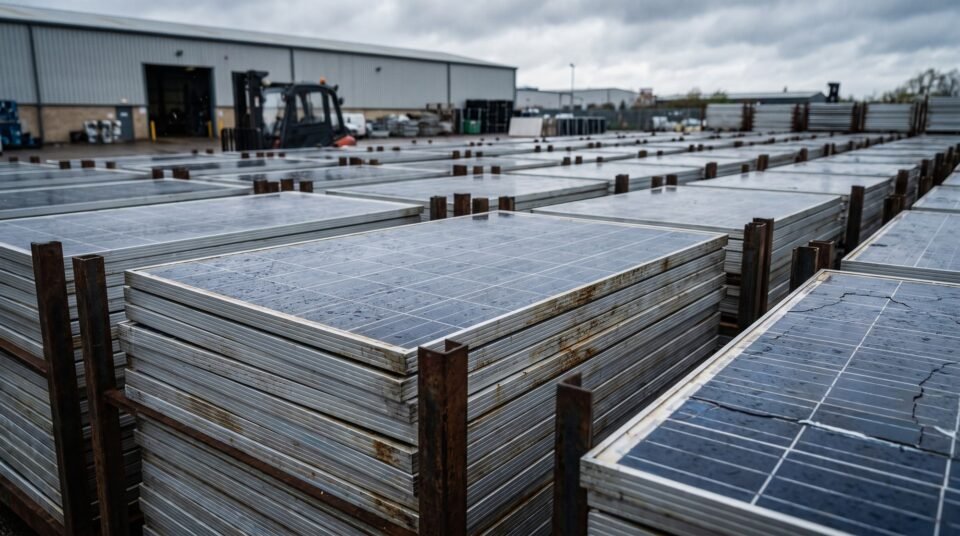
A typical solar panel weighs about 11.6 kilograms. Roughly two-thirds of that is glass, and the aluminum frame accounts for another eighth. By weight, those two materials are most of the module.
By value, they are nearly beside the point.
Almost all of the money locked inside a crystalline silicon panel sits in a thin metallic contact layer that makes up about 0.03 percent of its mass. That layer is silver, and it is the reason solar panel recycling has become one of the most closely scrutinized problems in clean energy. It is also the reason so little of it is currently happening.
The most valuable part of a solar panel is almost invisible
A solar cell generates electricity when light knocks electrons loose inside a silicon wafer. To collect that current, manufacturers print a fine grid of silver paste onto the front and back of every cell, then fire it into the surface. The finished grid is measured in micrometers.
Because it is so thin, it is easy to treat as a rounding error. Researchers at Germany’s Fraunhofer Center for Silicon Photovoltaics have published per-module value estimates that suggest the opposite. Presented in 2026, their figures break down a standard 11.6-kilogram crystalline silicon module like this:
| Material | Share of module weight | Approximate value per module |
|---|---|---|
| Glass | 67.5% | €34 |
| Aluminum frame | 12.7% | €229 |
| Silicon cells | 2.7% | €38 |
| Silver contacts | 0.03% | €600 |
Source: per-module estimates from Fraunhofer CSP presented by Dr. Andreas Obst, 2026. Silver loadings vary with cell design and module vintage, and some analyses put the mass share higher.
Silver is the smallest line in the table and the largest number. It is worth more than the glass, the frame, and the silicon cells combined, even though those three account for roughly 83 percent of the module’s weight between them.
That inversion is the whole story. A panel is a heavy object whose economics depend on a trace material, and trace materials are the hardest things to recover from a bonded laminate.

Why recycling a panel costs more than dumping it
The gap is not subtle. Recycling a utility-scale module in the United States costs between $15 and $45. Sending that same module to the landfill costs between $1 and $5.
Philip Kwong of the University of Adelaide, whose review of photovoltaic recycling technologies appeared in the journal Waste Management, describes the trap plainly: recovered materials are generally worth less than the cost of collecting, transporting, dismantling, and processing the modules, and for most mainstream crystalline silicon recycling, commercial viability without extended producer responsibility mandates, landfill restrictions, or public subsidies remains difficult.
The materials are not worthless. Recovering them at usable purity is what costs money. Most commercial lines today do what First Solar calls bulk recycling: they detach the aluminum frame and separate the glass, then stop. Silver and high-purity silicon, the two materials that carry the value, largely end up in mixed residue.
Recovering silver is not a mechanical problem. It is finely dispersed through the cell metallization and sealed inside the laminate, so it takes either a hydrometallurgical process, which leaches it out chemically, or a pyrometallurgical one, which burns off the encapsulant at high temperature. Neither is cheap. Fraunhofer CSP’s own process development work suggests a dedicated hydrometallurgical line needs to process several thousand tonnes of solar cells a year before its capital cost makes sense.
Kwong’s timeline for that changing is measured in years, not quarters. Under current policy settings and waste growth, he projects silver recovery becoming commercially viable in the early to mid-2030s and high-purity silicon in the mid-2030s. Even then, the numbers work only in specific niches where labor, reagent, and energy costs stay low.
Researchers have separately been working on recovery routes for the silicon itself, including methods that aim to return wafers close to their original quality.
The stakes go beyond waste disposal. Obst estimates the solar industry consumed roughly 6,000 tonnes of silver in 2023, against global mine production of about 30,000 tonnes that year. Silver use per gigawatt of installed capacity has fallen steeply, from around 200 tonnes per gigawatt-peak in 2006 to under 30 today, but deployment has grown faster than that thrifting. Yansong Shen, who directs the ARC Research Hub for Photovoltaic Reliability and Sustainability at the University of New South Wales, has said that without continued silver-thrifting, copper substitution, and large-scale recycling, most currently known silver reserves could be consumed within 25 years.
The waste wave is arriving faster than the industry
Panels installed during the boom years of the 2010s were sold with 25- to 30-year performance warranties. Those warranties now function as the industry’s calendar.
In a 2026 update to its end-of-life analysis, IRENA projects that the cumulative weight of retired solar panels will pass 12 million tonnes by 2035 and exceed 200 million tonnes by 2050 under a 1.5°C pathway, a roughly sixteen-fold increase between those two dates. Annual volumes are expected to top 3 million tonnes by 2035 and 25 million tonnes by 2050.
The projection assumes panels last 25 to 30 years, and it accounts for the fact that many will be replaced early by newer, more efficient models rather than simply failing.
What makes the trend unusual is its share. Solar panel waste is less than 1 percent of global electronic waste by weight today. By 2050, IRENA expects it to exceed 21 percent.
Europe offers an early look at what collection looks like in practice. Eurostat figures compiled for the IEA-PVPS Task 12 report on module recycling show that 18 European countries collected 48,395 tonnes of photovoltaic module waste in 2022. That infrastructure exists largely because the European Union has regulated panels under its Waste Electrical and Electronic Equipment Directive since 2012.
There is one anomaly in all of this that nobody has explained. German facilities ought to be crowded with subsidy-era panels, yet Fraunhofer CSP has found that the volume of waste arriving at them actually fell in recent years, and attempts to trace the shortfall through customs statistics did not close the gap. “Where are those modules?” Obst said. “I have no idea.” For anyone trying to finance a recycling plant, that uncertainty is the real obstacle: capacity has to be built for a 2030s peak whose size and timing are still unknown.

What actually happens inside a recycling line
Recycling a module is a sequence of separations, and each step exists because the previous one left something mixed together.
- The aluminum frame and junction box come off first, because they detach cleanly and resell easily.
- The glass is separated from the laminate, usually by crushing, milling, or controlled heating.
- Delamination follows. This is the difficult stage: the encapsulant, backsheet, and cells are bonded into a single sheet, and prying them apart takes heat, chemicals, mechanical force, or some combination of all three.
- Metals are recovered from what remains, often through chemical leaching or electrochemical processing.
- Whatever survives at sufficient purity is refined and sold back into manufacturing.
Every step costs energy, reagents, or both, and each one eats into a margin that is already thin. It also explains a gap that confuses a lot of coverage. Mass recovery rates of 85 to 95 percent are routinely quoted, and some operators claim more than 99 percent, yet a line can hit those numbers while still losing nearly all of the module’s monetary value, because the materials that are easiest to recover in bulk are also the cheapest. Weight and worth are different measurements.
One manufacturer has built the opposite model. First Solar, which makes thin-film cadmium telluride modules rather than silicon ones, has run a closed-loop process since 2005 and says it recovers more than 90 percent of module materials for reuse. The company states that a single kilogram of its semiconductor material can be recycled 41 times, which it equates to more than 1,200 years of use. The difference is that its process targets the semiconductor, not just the bulk.

The policy switch that decides whether any of this works
Almost every serious analysis of photovoltaic recycling reaches the same conclusion: the technology is not the bottleneck. The economics are.
IRENA’s 2026 report identifies extended producer responsibility as the proven mechanism for resolving them. Under EPR rules, companies that place panels on the market carry the financial and practical responsibility for taking them back and treating them at end of life. That turns recycling from an optional cost into a designed-in one, and it gives recyclers the predictable, high-volume, single-chemistry feedstock that makes building a dedicated line worthwhile.
Europe’s rules are the clearest working example, because they create collection volumes rather than leaving recovery to chance. The United States is further behind. Washington State passed the only solar-specific EPR law in 2017 and updated its implementation requirements in 2025. New Jersey passed mandatory recycling legislation in January 2026 but deliberately stopped short of EPR, leaving the cost with consumers rather than manufacturers. There is no federal framework, and the EPA’s effort to reclassify end-of-life panels as universal waste has slipped past its original target date.
Landfill bans push from the other direction. When disposal is cheap and legal, recovered material struggles to compete with it. For a sense of how far the logic already extends, Australia’s first dedicated solar panel recycling facility began operating back in 2021, well before the bulk of the waste wave arrived.
Kwong’s conclusion mirrors the same point from the opposite side: without EPR mandates, landfill restrictions or public subsidies, mainstream crystalline silicon recycling stays hard to justify. The panel is not the problem. The price of throwing it away is.
What an old solar panel is actually worth to you
For a household with a few decommissioned panels, the honest answer is less than the advertising suggests.
The value concentrated in silver and silicon is real, but it only exists at industrial scale. A single panel handed to a recycler is a logistics cost rather than a commodity. Most owners should expect to pay a fee, not receive one, and that fee swings widely depending on where they live and how far the nearest specialist facility is.
Before you decide what to do with a panel, it helps to work out which situation you are actually in:
- It still produces close to its rated output, which makes resale or donation the highest-value option.
- It runs noticeably below spec but still works, which suits off-grid, farm or hobby use where peak efficiency matters less.
- It is cracked, water-damaged or electrically failed, which makes it a recycling job rather than a resale one.
- It is a thin-film module, which some manufacturers take back directly through their own end-of-life programmes.
- It is still inside its performance warranty, which may oblige the manufacturer or installer to handle replacement and take-back.

Landfilling a repairable panel is still rarely the best outcome. Modules still performing within their warranted output, which for most panels means at least 80 percent of rated power after 25 years, often retain resale value for off-grid, agricultural or hobby use, which delays the disposal problem and keeps working hardware in service. When a panel is genuinely finished, a dedicated recycler remains preferable to a general waste stream, because the glass, aluminium and remaining metals can at least be captured. Recovering precious metals from electronic waste is a maturing field, and panels are starting to be treated as part of it rather than as construction debris.
The next problem: panels are changing faster than recyclers can adapt
Crystalline silicon accounts for roughly 95 percent of the global installed base, which has allowed recyclers to design around a single dominant chemistry. That advantage is temporary.
Tandem and perovskite-containing designs are moving toward commercial production, and they stack different materials together in pursuit of higher efficiency. A line built to separate silicon, silver, glass and aluminium will not automatically know what to do with a stack that includes new absorber layers. Whether the industry standardises recovery processes early enough to avoid a second, more complicated waste stream is an open question. It will be settled by how the next generation of modules is designed, not by how today’s are dismantled.

Frequently Asked Questions
Are solar panels worth anything in scrap?
Barely, as individual units. A panel’s scrap value comes from its silver, silicon, aluminium and glass, but recovering those profitably depends on volume, purity and low processing costs. Many scrap dealers will not accept panels at all, and those that do tend to treat them as a handling cost rather than a commodity.
Can you get money for old solar panels?
Sometimes, but usually by selling them for reuse rather than recycling. Panels still producing close to their rated output have resale value for off-grid and agricultural applications. Panels that no longer work generally cost money to dispose of rather than generating any.
Is there money in recycling solar panels?
Not much yet, on materials alone. Recycling a utility-scale module costs $15 to $45 in the United States, while landfilling it costs $1 to $5. Recovering silver and high-purity silicon changes that arithmetic, but researchers project those routes reaching commercial viability only in the 2030s, and only where policy support exists.
What is the 33% rule in solar panels?
It is an installation rule, not a recycling one. In many jurisdictions, rooftop arrays covering more than about a third of a roof’s plan-view area must meet extra fire-safety requirements, such as wider firefighter pathways and larger setbacks from the ridge. The rule exists to keep roofs accessible and ventilated in an emergency, and it is enforced locally rather than federally. The same phrase also circulates informally in the trade for a rough guideline about mixing panels of different wattages, which is a separate idea.
How much does it cost to recycle solar panels?
For a utility-scale module in the United States, processing runs about $15 to $45, against $1 to $5 to landfill the same unit. Households usually face a per-panel fee plus transport, and the figure varies sharply by region because it depends on how far the nearest specialist facility is and whether local rules restrict disposal.
Where can I recycle solar panels near me?
Start with the company that installed the system, since many installers and manufacturers run take-back programmes, particularly for panels still under warranty. National and state recycling directories list specialist photovoltaic processors, and a growing number of general e-waste facilities now accept modules alongside other electronic equipment.
Conclusion: a policy problem wearing an engineering costume
The paradox of solar panel recycling is that the industry already knows how to do it. Delamination works. Silver can be recovered. Silicon can be purified back to wafer quality. What has not happened is the alignment of incentives that would make any of it pay at the scale the coming waste wave demands.
Until disposal costs more than recovery, or until producers are required to take back what they sold, the most valuable 0.03 percent of every retired panel will keep going to landfill along with the glass around it. The fix is a price signal, not a breakthrough.