
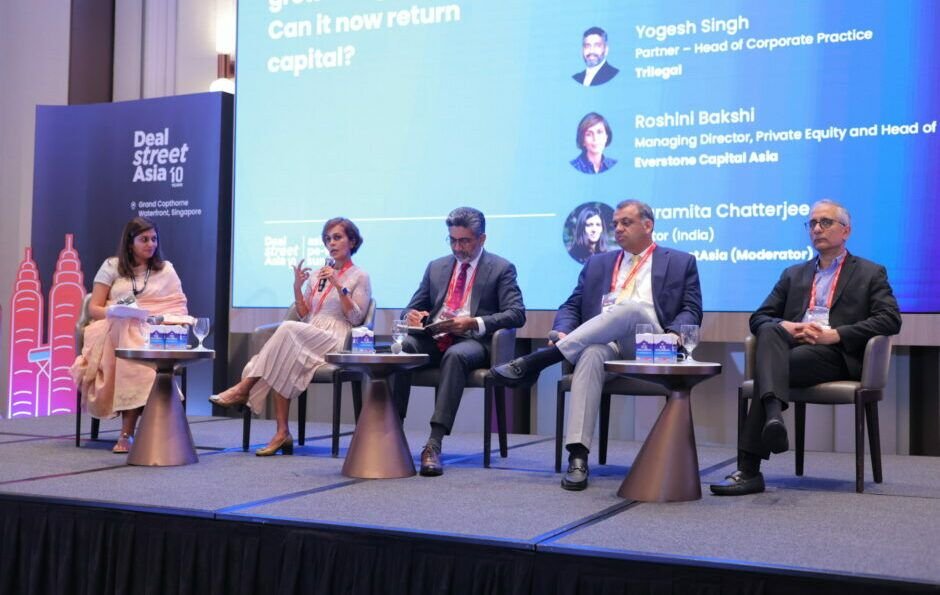
India’s private equity market is increasingly focused on turning growth into exits and returns for limited partners (LPs), as fund managers face slower large exits and greater pressure to distribute capital, panellists said at the 11th edition of the Asia PE-VC Summit in Singapore last week.
In a discussion titled ‘India PE has won the growth argument. Can it now return capital?‘ speakers said distributions to paid-in capital (DPI) remain a key concern in the country. They pointed to public markets, private sales and continuation funds as increasingly important routes for returning capital.
“DPI is always a concern; it can always be better. It’s one of those things that can certainly be improved,” said Abhishek Sharman, Founder & Managing Director, Carpediem Capital at the panel.
“Indian managers, as they become more experienced, also recognise that going to LPs and seeking capital without having DPI is a moot conversation. And therefore, today you see a variety of solutions coming to the fore with the view that DPI should be increased,” added Sharman.
“…going to LPs and seeking capital without having DPI is a moot conversation.”
India-focused PE and VC firms have recorded $13.5 billion in exits so far in 2026, compared with $21.4 billion in 2025 and $26.3 billion in 2024, according to Venture Intelligence data cited during the discussion.
Over the last two years, Indian public markets have largely been flat, which may have postponed some of the bigger exits, according to Sharman. “Once market conditions improve, we could see exit numbers rise, because public markets remain the largest source of exits.”
Asked whether continuation funds are being used to retain high-performing companies or to return capital, Ritesh Chandra, Managing Partner, Avendus Future Leaders Fund said there is always a need to return capital. “When market conditions are unfavourable, or funds are running out of time, a continuation vehicle can provide an alternative to a distressed exit. He said the growing acceptance of such vehicles is also a sign of maturity in the market.”
Sharman added that differences in fund vintages and market conditions can influence exit timing, while giving private companies more time and scale can potentially change their range of outcomes and create a path towards a future IPO.
Asked why large IPOs such as NSE and Reliance Jio have been planned or launched at smaller sizes than initially expected, Sharman said these are mega issuances, and it can be challenging for the market to absorb multiple large offerings.
He said issuers have chosen to preserve pricing rather than maximising the quantum of shares sold. Reliance Jio, for instance, changed the issue mix towards primary capital, while NSE reduced the issue size.
Chandra added that NSE’s case was different, with pricing leading some selling shareholders to back out rather than a lack of demand. He said there is no dearth of capital for high-quality issuances, pointing to NSE’s roughly $2.5 billion issue being oversubscribed six times. “There is demand. There is liquidity in the market,” he said, adding that the key is finding high-quality assets.
Asked what types of deals are dominating the market, including a mix of PE-backed M&As, IPOs, secondary transactions and continuation funds, Yogesh Singh, Partner–Head of Corporate Practice, Trilegal said the market is seeing a combination of deal types, with stake sales remaining dominant.
IPO activity has also increased significantly in the last two months. However, an IPO does not necessarily mean a full exit and can involve partial exits and deferred payouts, said Singh.
He added that investors are increasingly selective about companies and promoters, with governance and promoter quality becoming more important alongside growth.
On how investors manage founder transitions in buyouts while keeping promoters aligned, Roshini Bakshi, Managing Director, Private Equity and Head of Impact, Everstone Capital Asia said the approach is case-specific.
“We focus on defining the promoter’s strengths, aligning the promoter with those strengths, and showing a pathway to exit. For us, it’s very important to work through where we are taking the company from today to the next four years and put that plan in place where the promoter sees the value at the end of it,” she added.
Bakshi said strategic sales and IPOs can provide promoters with a pathway to continued participation, while investors bring capital and additional value-creation capabilities.
India’s strengths
Asked what global LPs consider when comparing India with other emerging markets, Sharman said investors look at multiple factors, with the weightage changing depending on market conditions.
“The growth is undeniable,” he said, adding that currency has recently become a key concern. LPs are also looking at whether India can create employment for the roughly 15 million young people entering the workforce every year.
Despite these concerns, Sharman said India remains one of the few markets capable of delivering strong compounded growth over the next 15–20 years. He pointed to the expected transition of around 1.5 billion people from a per-capita GDP of about $2,500 to $14,000–16,000 over the next 22–23 years as a key part of the investment opportunity.
Adding to the above, Chandra said that scale and diversity are other advantages for India. “No other market can offer you the scale that India does, other than China in the region. The value creation in India is spread across multiple industries, unlike markets where growth is more concentrated in a few sectors.”
“The value creation in India is spread across multiple industries, unlike markets where growth is more concentrated in a few sectors.”
Asked how investors drive value creation between investment and exit, Bakshi said the firm prefers control investments and generally takes majority stakes. Most of its investments are in companies where it is the first financial investor, with the promoter retaining a minority stake or in carve-out situations.
She said the investment thesis is developed from the pre-IC diligence stage, with the firm focusing on five areas: organisation, sales and growth, operations, digital transformation and the promoter construct. Most of the companies are already EBITDA-positive, she said, meaning the focus is on growth rather than turnaround. The firm brings in external partners for operational, sales and digital transformation, while handling organisation transformation internally.
Bakshi said the firm has also become more structured in defining the promoter’s role, responsibilities and rights through shareholder agreements, including incentives and areas where the promoter has veto or non-veto rights.
Elaborating on key lessons from past mistakes, Bakshi said the firm’s early funds had taken some minority positions without clearly defining the promoter construct. She said this led to disagreements over promoter responsibilities, investor support, and eventually the timing, buyer and value of an exit.
Asked how geopolitical uncertainty and the West Asia crisis are affecting investment and exit activity, and whether founders and investors are seeking to renegotiate terms, Singh said investors today are very focused on value protection, tight corporate governance norms and clear thinking around exit avenues. There is also greater focus on diligence to understand the full roadmap for an exit. There are also sophisticated conversations around risk transfer, with mechanisms such as W&I insurance being used where investors do not want to take on particular risks.
“On the founder side, we typically see requests for proper upside sharing, management incentives, protection against down rounds, anti-dilution mechanisms, operational control and flexibility around liquidity. Overall, there are much more disciplined conversations around multiple aspects of deal-making, shaped by past crises, including the 2008 bond defaults, the 2014 policy paralysis, the COVID-19 pandemic and the current geopolitical uncertainty,” Singh said.
On the question of whether governance concerns or GDP data affect returns, Chandra said concerns around corruption have receded significantly, particularly as younger founders increasingly focus on company-level value creation rather than extracting money from businesses. He said incidences of corruption and accounting irregularities are now “extremely rare”.
On concerns around India’s GDP data, Chandra said investors should instead look at leading indicators such as indirect tax collections, passenger vehicle sales, housing registrations and power consumption. He cited 15% year-on-year growth in indirect tax collections, 30% growth in passenger vehicle sales and 15–18% growth in housing registrations.
“We are seeing, given the fact that we invest in late-stage companies, 20% growth; 25% growth is given,” he said, adding that the broader trend in the domestic economy matters more than debates over whether GDP growth is 7%, 7.5% or 7.8%.
On whether mergers between Indian and Southeast Asian companies could create multiple arbitrage opportunities, Chandra said consolidation could make sense where there are strategic similarities, particularly in technology, but multiple arbitrage should not be the starting point.
To this, Singh added India has a regulatory route that allows certain Southeast Asian companies to merge with Indian entities without going through a court or tribunal, with the process potentially completed in less than three months. He said his firm had seen at least 20 such transactions in the past 12 months.
Bakshi said her firm, meanwhile, has pursued such combinations where there are operational synergies, including in medtech and QSRs, rather than simply to capture valuation arbitrage.
On valuations, Sharman said they are “reasonable”, noting that public-market earnings have increased while multiples have remained broadly stable over the past 18–24 months. He added that private-market valuations have also become more reasonable.
Chandra, meanwhile, said India has never been a cheap market, but there are pockets of opportunity that investors find attractive.