
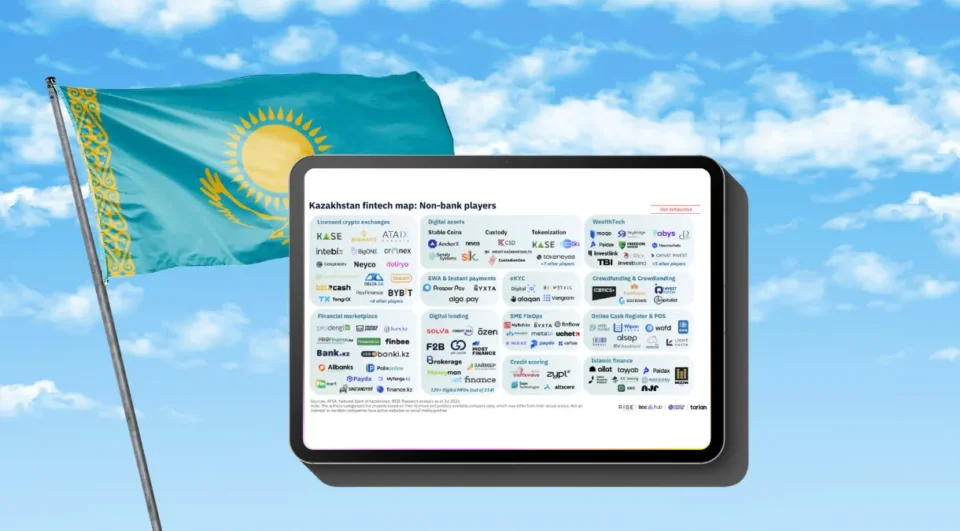
Kazakhstan’s first wave of fintech innovation was driven by banks and incumbents, which now lead consumer fintech through broad super-apps and digital ecosystems.
This sector is now moving towards infrastructure, especially banking-as-a-service (BaaS), artificial intelligence (AI), and digital assets, according to a new report by RISE Research and Advisory in partnership with Tarlan Payments, BCC Hub, and Fintech Center, supported by the National Bank of Kazakhstan.
Incumbent financial institutions now dominate the digital consumer finance market, with five banks accounting for 69% of banking-sector assets. Banks also cover nearly the entire small and medium-sized enterprise (SME) journey, allowing firms open accounts, pay, and obtain financing via sophisticated digital platforms.

SME services coverage by banks and fintech companies in Kazakhstan, Source: Fintech in Kazakhstan: Annual national study 2026, RISE Research and Advisory, Tarlan Payments, BCC Hub, Fintech Center, and the National Bank of Kazakhstan, 2026

Meanwhile, three super-apps now lead everyday financial services in Kazakhstan. Kaspi.kz heads this space. This super-app combines digital banking, an e-commerce marketplace, and a peer-to-peer (P2P) payments system into a single platform, claiming around 27.5 million users, including 15.7 million users in Kazakhstan and 11.8 million users in Türkiye. Kaspi.kz is publicly traded on Nasdaq, but control remains concentrated among its founders and Baring Funds, a major investment fund.

Another leading super-app in Kazakhstan is the Halyk SuperApp by Halyk Bank. This app combines mobile banking with lifestyle and public services, such as banking, investment, insurance, e-grocery, education, taxes, and fines. The platform, which evolved from the Homebank platform back in 2022-2023, reports 8.5 million monthly active users (MAU) for its consumer app, while the Onlinebank business platform serves 343,800 MAU.
Halyk Bank is a commercial savings bank in Kazakhstan and the largest in the country with a 35% market share. It also ranks among the major financial institutions in Eastern and Central Europe.

Another prominent super-app in Kazakhstan is the Freedom SuperApp. This front end for Freedom Bank integrates retail banking, payments, insurance, and lifestyle services, claiming 5.2 million users and 2.59 million MAU.
Freedom Bank Kazakhstan is a prominent commercial bank in Kazakhstan, known for pioneering fully digital and automated banking services in Central Asia.

A new wave of fintech innovation in Kazakhstan
This landscape is leaving limited room for standalone business-to-consumer (B2C) models, prompting a shift towards a new phase of fintech development centered on infrastructure, business-to-business (B2B) categories, and technology providers.
In particular, BaaS is emerging as a major growth area as banks explore ways to monetize their infrastructure. In this ecosystem, Bank RBK, Bank CenterCredit (BCC), Halyk Bank, and Freedom Bank dominate, positioning themselves as fintech partners, white-label enablers, and infrastructure suppliers for startups, digital ecosystems, and regulated institutions aiming to digitize their services.

Digital assets represent another fintech vertical poised for growth, supported by growing regulatory clarity. In May 2026, Kazakhstan introduced a broader national framework, distinguishing between unsecured digital assets, such as cryptocurrencies like Bitcoin and Ethereum, and digital financial services, including fiat-backed stablecoins, tokenized real-world assets, and digital forms of traditional financial instruments.
The framework also introduces digital asset service providers, requiring formal licensing for operators of digital financial asset platforms, digital asset trading platforms, and exchanges of unbacked digital assets.
It builds on the Law “On Digital Assets in the Republic of Kazakhstan”, dated February 2023. This regulation set the basis for legal oversights of digital asset activities, formulating clear infrastructure, capital, risk management, compliance control, and anti-money laundering, countering the financing of terrorism, and countering proliferation financing (AML/CFT/CPF) requirements.
According to the RISE Research and Advisory report, there are currently more than 50 regulated digital asset providers operating across Kazakhstan and the Astana International Financial Centre (AIFC), a special financial and business hub in the country’s capital city of Astana. Under the new federal regulation, this ecosystem expected to expand further.

Another key trend emerging in the Kazakh fintech sector is AI. This technology is now shifting from research and experimentation towards implementation in the domestic financial sector.
A February survey by NBK polled 95 market participants and found that 20% reached implementation stage in 2025, rising 4 points from 2024. Another 13% entered the pilot stage in 2025, up 9 points from 2024, while early research dropped 9 points, showing how institutions are advancing in their AI journey.
AI adoption is also increasingly shifting towards operational processes. The NBK survey identified operational activity as the leading application of AI in Kazakhstan in 2025, increasing 10 points from 2024 to 21%. Software development and information systems support held second place at 18%, while risk management and compliance ranked third at 16% in 2025, up 2 points from 2024.

Kazakhstan fintech map 2026

Featured image: Edited by Fintech News Singapore, based on image by asylab and travelstock86 via Magnific