


Gold has spent most of the day in the $4,180s, primarily due to the Fed recently decreasing the likelihood of an October rate hike with the recent U.S. inflation data. Fed Funds Futures are now pricing in an October rate hike at about a 12% probability. However, the jobs report will most likely be the main factor that determines the Fed’s next move. Gold will still likely be impacted by the U.S. Dollar as the greenback may still be trending upward due to elevated Treasury yields.
Softer Inflation Gives Gold Some Monetary Relief
For now, I’ll say that my bias is neutral with slightly bullish risks as long as Gold trades above $4,173. A move above $4,191 would continue the short term improvement in Gold, while a move below $4,173 would continue to put $4,123 under pressure.
Recent inflation data has lowered somewhat, taking some of the recent stress off of gold. The latest PCE data came in under expectations and previous data has been revised lower taking some of the recent stress off of Gold. The Fed is still expected to hike interest rates at some point in 2022 and the investing community is expecting the Fed to keep rates elevated through the end of the year, which will continue to restrain the economy. This should also help the price of gold.
NFP Is Now the Main Catalyst
While other fundamental catalysts have recently been positive for gold, the main focus has been on U.S. Non-Farm Payrolls data. Consensus estimates have the report showing the U.S. creating 90,000 jobs in September, down from 162,000 jobs created in August. The U.S. unemployment rate is expected to hold steady at 4.1%.
If the Non-Farm Payrolls report misses expectations, it could solidify the belief the Fed can wait to raise rates. Lower rates would decrease U.S. dollar strength and allow gold to strengthen. If the report surprises to the upside, it could increase expectations for an October rate hike, and gold could see renewed selling pressure.
Treasury Yields Remain the Bigger Headwind
Treasury yields remain the larger headwind for precious metals. Following the rebound in the third quarter, Treasury yields remain at historically high levels, reflecting continuing concerns regarding inflation and elevated government borrowing.
Gold produces no income, and high bond yields give investors the opportunity to earn an attractive income. Unless the Fed’s long-term bond yields begin to move lower, it is possible that bullion could remain range-bound.
Dollar Strength Still Limits the Recovery
The U.S. dollar also remains relatively firm, which continues to cap gold’s upside. A strong dollar makes bullion more expensive for international buyers and usually weakens demand outside the U.S.
For a cleaner bullish setup, gold would benefit from both lower Treasury yields and a weaker dollar at the same time. The Fed repricing has improved, but the currency market has not yet delivered that full confirmation, which is why the current recovery still looks measured rather than explosive.
Central-Bank Demand Remains a Strong Structural Support
A firm U.S. dollar continues to limit the upside potential of gold. A strong U.S. dollar makes bullion more expensive for international investors, thereby reducing its demand outside the U.S.
For a cleaner bullish set up, gold would benefit from lower Treasury yields and a weaker dollar simultaneously. The Fed repricing has been improving, but the currency market has not delivered full confirmation yet, which is why the current recovery looks measured rather than explosive.
Geopolitical Risk Still Supports Bullion
The longer term gold story is considerably stronger than the short term rates story. Emerging market central banks, including China and Poland, have continued to diversify their reserves with bullion, and further reinforces the notion that gold is being used to stockpile strategic reserves rather than a short term inflation hedge.
This demand matters because central banks operate on a longer time frame than macro traders. Purchases by central banks help to structure a floor to the market and reduce the sensitivity of gold to real yields, and help explain why gold has been less correlated to real yields in this cycle as compared to previous cycles.
Gold Technical Analysis: $4,191 Is the First Recovery Test
Currently, gold is trading at roughly $4,180 on the 1-hour chart, bouncing from the $4,123 support area. What is interesting is that price has been consolidating above the $4,173 area, and the RSI has also recovered above the mid-line, indicating that the short-term momentum has improved from the oversold condition.
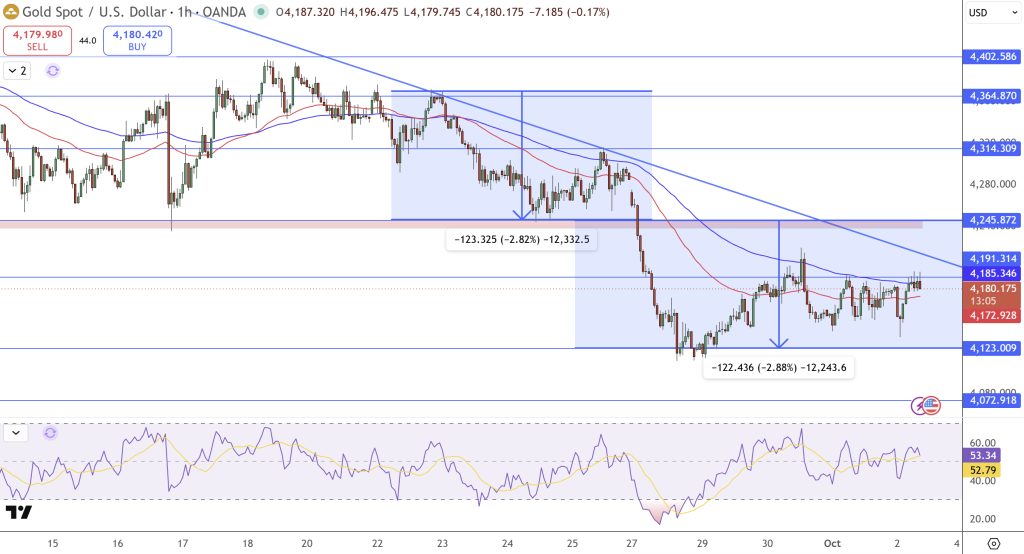
The first resistance is at $4,191. A breakout above that level would open up the next resistance at $4,246, and the level above that at $4,314. The first important support is at $4,173, and $4,123 and $4,073 come into play if the sellers take control.
RSI is currently at 53, indicating a recovery with no overbought conditions. Overall, I am a little bullish with neutral bias, with a focus on the $4,173 area. A clear break above $4,191 would bring a more bullish bias, while a move below $4,173 would bring the $4,123 area back in focus.
Resistance: $4,191, $4,246, $4,314
Support: $4,173, $4,123, $4,073
Frequently Asked Questions
Why is gold stabilizing today?
Gold is benefitting from lower U.S. inflation and expectations for a more dovish Fed in October. However, higher U.S. bond yields and a firming U.S. dollar are capping the upside for gold.
What is the biggest catalyst for gold now?
The Non-Farm Payrolls report on Friday is the biggest catalyst for gold this week. A worse-than-expected report would raise expectations for a more dovish Fed, and a better-than-expected report would take the wind out of gold’s sails.
What is the key XAU/USD breakout level?
The key resistance level is $4,191, and above that is $4,246 and $4,314.

Arslan Ali Butt
Lead Markets Analyst – Multi-Asset (FX, Commodities, Crypto)
Arslan Ali Butt serves as the Lead Commodities and Indices Analyst, bringing a wealth of expertise to the field. With an MBA in Behavioral Finance and active progress towards a Ph.D., Arslan possesses a deep understanding of market dynamics.
His professional journey includes a significant role as a senior analyst at a leading brokerage firm, complementing his extensive experience as a market analyst and day trader. Adept in educating others, Arslan has a commendable track record as an instructor and public speaker.
His incisive analyses, particularly within the realms of cryptocurrency and forex markets, are showcased across esteemed financial publications such as ForexCrunch, InsideBitcoins, and EconomyWatch, solidifying his reputation in the financial community.