
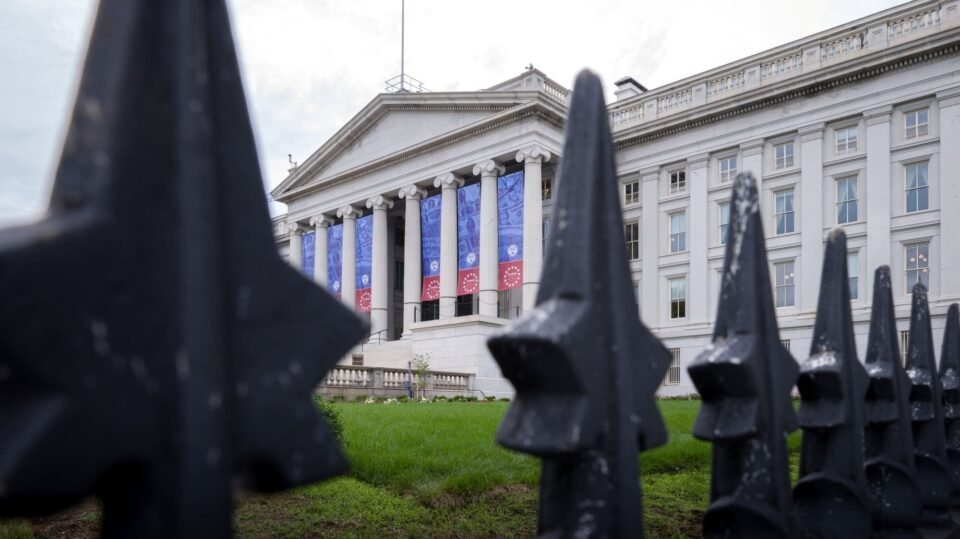
The U.S. Department of the Treasury will auction off a round of new government debt this week. Three-year notes will sell on Tuesday, 10-year notes on Wednesday, and 30-year bonds on Thursday.
A couple of weeks ago, the Treasury Department held an auction for two-, five-, and seven-year Treasurys.
“Those auctions did not go particularly well,” said Winnie Cisar, global head of credit strategy at CreditSights.
Cisar said that demand for Treasurys was much weaker than expected, and it’s hard to pinpoint one reason why.
“I think that this year, for the rates market in the U.S., has been death by a thousand paper cuts,” she said.
Those paper cuts include concerns about long-term government debt, higher energy prices (which cause inflation more broadly), and recent economic data that has been stronger than anticipated.
“It really is all that happening at the same time, and then investors wondering what the right level of yields should be,” said Alex Wolf, global head of macro and fixed income strategy at J.P. Morgan.
Wolf said that investors are also unsure how the Federal Reserve will react to all of this.
“And that’s occurring amid all the noise and volatility that we’re seeing both in oil prices and macro data,” he said. “And it’s creating a difficulty for those participating in markets to know where yields should be.”
All of that uncertainty is pushing rates higher. Investors have those same concerns ahead of this week’s 10- and 30-year Treasury auctions.
Chris Low, chief economist with FHN Financial, said that today, rates are higher across the board “on effectively no new information,” he said. “And that’s simply jitters about the upcoming auctions.”
Low said those jitters aren’t just about the auctions themselves.
“What traders are telling you is that their primary concerns — inflation, excessive government spending, excessive government debt — all of those risks are going to remain in place,” he said.
Which means that investors think interest rates are going to keep rising.