
Authorities must first identify precisely what constitutes “critical infrastructure”
Understand channels through which disruptions can spread and ensure business continuity of critical service providers
The International Monetary Fund (IMF) has warned that the risk of a systemic crisis in global finance could rise if AI-powered cyberattacks target critical infrastructure across financial markets, including tokenization markets. The IMF said financial authorities must act far more proactively than in the past, when they responded only after a crisis had erupted. It stressed that authorities should first identify precisely what constitutes “systemically critical infrastructure” and understand the channels through which shocks can spread.

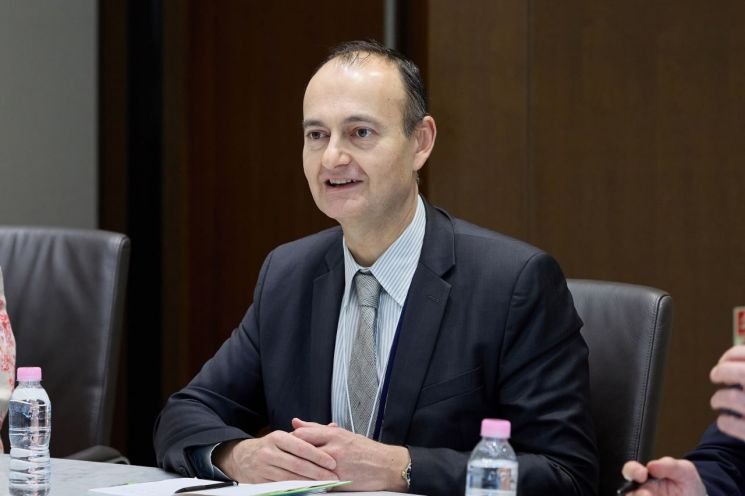
Athanasios Vamvakidis, deputy director of the IMF’s Monetary and Capital Markets Department, answers questions during an interview with local media on the 8th, following an event unveiling the tokenization chapter of the Global Financial Stability Report (GFSR) at the Bank of Korea in Jung-gu, Seoul. Bank of Korea
Athanasios Vamvakidis, deputy director of the IMF’s Monetary and Capital Markets Department, said in an interview with local media on October 8, following an event at the Bank of Korea in Jung-gu, Seoul, to unveil the “Scaling Up Tokenization: New Efficiencies and Vulnerabilities” chapter of the Global Financial Stability Report (GFSR), “New technologies always bring both benefits and risks, but AI is different in scale.” He stressed, “In the past, regulators and supervisors stepped in to contain a crisis after it had erupted. Now they need to respond far more proactively.” In other words, authorities must adopt new approaches to address new risks.
Caio Fonseca Ferreira, IMF Deputy Division Chief for Financial Supervision and Regulation, and Gonzalo Fernandez Dionis, a senior financial expert, who also took part in the interview, likewise said authorities must respond to AI-powered cyberattacks differently than they have in the past. “As tokenization markets expand, critical infrastructure for the financial system as a whole will emerge. The mere existence of this critical infrastructure means that cyberattacks or operational problems could have a much greater impact on the entire system,” Ferreira said. “Authorities need to identify precisely what constitutes ‘systemically critical infrastructure.’” He said this includes heavy reliance on a very small number of cloud providers and the use of the same software. “A flaw in a particular piece of software could affect the entire system, so authorities need to understand the channels through which problems can spread and focus on ensuring the business continuity of critical service providers,” he said.
Dionis said, “With blockchain technology, every node has a shared ledger of transaction history, so even if one node is attacked, the other nodes can maintain the ledger and transaction records intact.” He noted that “while risks increase, the potential to mitigate them through the design of the technology’s architecture also grows.”

Caio Fonseca Ferreira, IMF Deputy Division Chief for Financial Supervision and Regulation, answers questions during an interview with local media following an event unveiling the tokenization chapter of the Global Financial Stability Report (GFSR) at the Bank of Korea in Jung-gu, Seoul, on the 8th. Bank of Korea
Vamvakidis described the acceleration of market responses enabled by financial asset tokenization as a “double-edged sword.” It could boost efficiency across markets, for example by greatly speeding up cross-border payments and dramatically lowering fees, but risks could also emerge more quickly. “A situation could deteriorate very rapidly, but, on the other hand, market discipline could work more effectively,” he said. “When a bank run occurs, regulators need to distinguish whether it was triggered by technology or by other underlying causes, and respond accordingly. There is no time to delay adapting to the new environment.”
However, he said tokenization itself is not the primary cause of bank runs. The issue, he said, is not unique to tokenization but concerns technology as a whole. The project also noted, “AI could detect rumors about the soundness of a particular financial institution and proactively suggest transferring funds, in addition to the risks mentioned above.” It added that authorities must change their approach by detecting and preventing potential risks, such as bank runs, in advance and adjusting the run-off rate assumptions embedded in prudential frameworks.
Commenting on the Bank of Korea’s digital currency projects, including Project Hangang and Agora, he said, “In a world where payments are becoming digital, building trust is paramount, so it is a welcome move for central banks to be at the center of this process.” He also said the projects align well with two key points emphasized in the IMF report: “regulatory clarity on the status of tokenization” and “the availability of safe and scalable settlement assets backed by central bank money.”
He said concerns about privacy infringements involving tokenized assets could be addressed through appropriate regulatory frameworks and system design choices. “Tokenized assets are fundamentally securities, and the same broad regulatory framework that applies to traditional securities should apply to them,” Ferreira said. “This alone can address most regulatory concerns.” He added, “Many countries are considering how to govern permissionless blockchains. Traditional securities regulations designate a clear entity, such as a company, as responsible, but that is difficult to do with public blockchains.” He said institutional adjustments were therefore needed for consumer protection, anti-money laundering, and the management of various digital wallets. One approach, he said, would be to test the limits of regulation together with the market through regulatory sandboxes.

Gonzalo Fernandez Dionis, a senior financial expert, answers questions during an interview with local media following an event unveiling the tokenization chapter of the Global Financial Stability Report (GFSR) at the Bank of Korea in Jung-gu, Seoul, on the 8th. Bank of Korea
He said foreign exchange markets would also be affected by financial asset tokenization, although the impact would be limited. “Retail investors may be exposed to greater foreign exchange risk, and exchange rate volatility could increase temporarily,” Vamvakidis said. “But the global foreign exchange market is enormous, with daily trading volume of about $7 trillion, so tokenization itself will not become a key driver of volatility across the foreign exchange market as a whole.” He explained that access to overseas assets through tokenization would still be subject to regulatory oversight, allowing authorities to act if inflows or outflows became excessive.
He stressed, however, that monetary authorities must take into account the possibility that tokenization could amplify foreign exchange market volatility. “Exchange rate overshooting caused by capital outflows and inflows affects the monetary policy stance, and dollarization risks could rise in some emerging markets,” Vamvakidis said. “In the era of digital currencies, strengthening the health of domestic economies will become even more important to preserve the effectiveness of monetary policy.”
The tokenized real-world asset (RWA) market had grown to $65 billion as of July. However, the IMF’s analysis found that the market is concentrated in the United States and that a large share of issuers do not disclose their locations, creating the potential for regulatory arbitrage and reduced transparency.
Hot Picks Today

The IMF devoted a separate chapter of the GFSR to this analysis, reflecting its focus on the expansion of tokenization markets. The IMF’s Global Financial Stability Report is published every April and October.
This content was produced with the assistance of AI translation services.
© The Asia Business Daily. All rights reserved. Unauthorized AI training and use prohibited.