
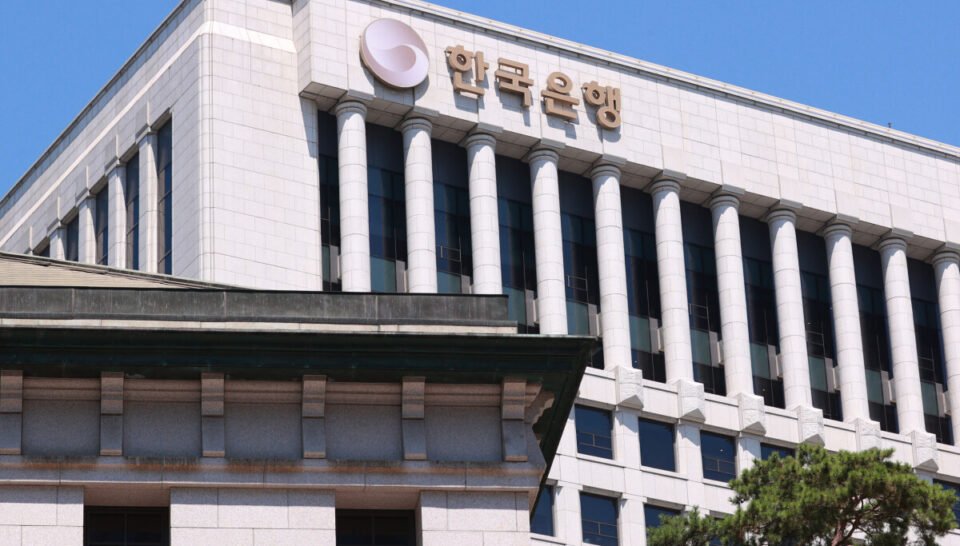
Korea’s long-term bond yields have fallen against a global surge, but its stock market has suffered one of the steepest declines among major economies.
Long-term government bond yields in the United States, Britain and other major economies have remained elevated since last month, but Korea’s yields are bucking the global trend and have declined instead.
Bond yields in several other countries, including Japan, Germany and Australia, also posted relatively modest increases. Analysts say the differences reflect whether central banks raised their benchmark interest rates preemptively to combat inflation.
Korea’s 10-year government bond yield stood at 4.26 percent as of Wednesday, down 0.05 percentage points from 4.31 percent at the end of August, according to a Bank of Korea (BOK) report on international financial and foreign exchange market trends since September, released on Friday.
Over the same period, yields on U.S. and British 10-year government bonds rose by 0.44 and 0.36 percentage points, respectively.
Generally, when bond yields rise in countries or companies with higher credit ratings, yields on lower-rated debt tend to rise as well. That puts Korea’s declining bond yields in an unusual spot, given that yields on U.S. government bonds have risen despite the United States having a higher sovereign credit rating of AA+ than Korea’s AA, according to S&P Global Ratings.
U.S., Britain paying the price for hesitation
Experts say countries whose central banks raised benchmark interest rates preemptively have been better able to withstand upward pressure on government bond yields.
The European Central Bank (ECB) raised its benchmark interest rates twice between June and September, while Germany’s 10-year government bond yield increased by just 0.15 percentage points. The Bank of Japan also raised rates twice during the same period, while its long-term government bond yield rose only 0.04 percentage points.
By contrast, countries that hesitated to raise benchmark rates are now seeing their long-term government bond yields reach their highest levels in more than two decades.
In the United States, President Donald Trump has personally pressured the Federal Reserve to lower interest rates, while the Fed raised rates only once last month. The United Kingdom has not raised its benchmark rate at all this year.
“Because the United States and Britain have been reluctant to raise their benchmark rates, concerns that they may have to raise rates much more aggressively to tackle high inflation are being reflected in long-term government bond yields,” said Bae Moon-sung, head of the credit team at Life Asset Management.
“Korea’s pre-emptive rate hikes helped contain the rise in long-term government bond yields. As BOK Gov. Shin Hyun-song put it, the country used a small hoe to prevent a problem that would otherwise have required a large shovel,” Bae said, citing a Korean proverb about addressing problems early before they become more costly.
When Shin delivered the second benchmark rate increase of the year on Aug. 27, he said, “Because the cost of responding belatedly would be greater, we implemented policy with a ‘small hoe.'”
Kospi sharper fall among major global stock indexes
Despite the relative stability of Korea’s long-term government bond yields, its stock market has suffered a steeper decline than those of other major economies.
The Kospi fell 11.9 percent between the end of August and Wednesday, compared to declines of 0.4 percent for the U.S. S&P 500, 2.2 percent for Japan’s Nikkei 225 and 5.4 percent for Taiwan’s Taiex.
Stock indexes typically face downward pressure when long-term government bond yields rise. Korea, however, has experienced a particularly sharp stock market decline despite its bond yields moving in the opposite direction.
“In the United States, 62 percent of S&P 500 companies have a positive outlook for net profits in the third quarter of this year, while Japanese companies are becoming more attractive to investors through improvements in corporate governance and shareholder returns,” a BOK official said. “By contrast, investors in the Korean stock market have interpreted rising global long-term government bond yields and concerns about slowing AI investment as negative factors for the domestic market.”
“Investor sentiment has weakened, and foreign investment flows turned to net outflows last month,” the official added.
BY KIM DO-NYUN [yoon.soyeon@joongang.co.kr]