
Tay Ninh has many favorable conditions for developing border gate logistics.
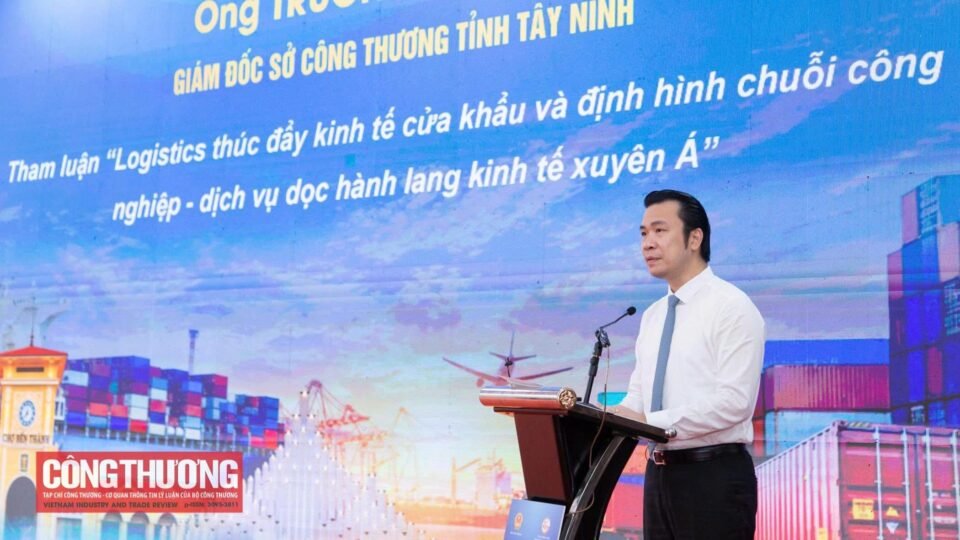
Speaking at the 12th Conference of Industry and Trade Sectors of Southern Provinces and Cities – 2026, Mr. Truong Tan Son, Director of the Department of Industry and Trade of Tay Ninh province, said that with its important geo-economic position on the Trans-Asian Economic Corridor, connecting Ho Chi Minh City with Cambodia, Thailand and the Greater Mekong Subregion, Tay Ninh has many favorable conditions to develop Tay Ninh border gate logistics , promote border economy and form a regional and cross-border industrial and service chain.
The province has 369 km of border, 21 border gates, including 4 international border gates. According to the plan, Tay Ninh will have 17 logistics centers with a total area of over 1,200 hectares, including 4 centers in the border area, with a key concentration in the Moc Bai area.

Mr. Truong Tan Son, Director of the Department of Industry and Trade of Tay Ninh province, emphasized the development orientation of border gate logistics linked to infrastructure connectivity and the formation of industrial and service chains along the Trans-Asian Economic Corridor.
According to Mr. Truong Tan Son, logistics is no longer simply a transportation support service but has become an important part of the economic infrastructure, contributing to connecting production, circulation, and distribution of goods. For Tay Ninh, developing logistics is a solution to effectively exploit the advantages of its border gate, while enhancing its ability to participate in regional and global supply chains.
In the first nine months of 2026, Tay Ninh’s total import and export turnover reached approximately 27 billion USD, an increase of 17.5% compared to the same period. Of this, exports reached 15.5 billion USD, imports reached 11.5 billion USD, resulting in a trade surplus of 4 billion USD.
However, the development of logistics at the Tay Ninh border gate still faces difficulties, especially the high proportion of logistics costs in product prices. Customs clearance, warehousing, and transshipment times are also heavily dependent on the availability of connecting infrastructure.
Based on this reality, Tay Ninh has determined that optimizing logistics infrastructure aims not only to reduce transportation costs and enhance the competitiveness of goods, but also to create conditions for the formation of a sustainable industrial and service chain along the Trans-Asian Economic Corridor.
Developing border gate logistics in conjunction with inter-regional connectivity and digital transformation .
To realize this orientation, Tay Ninh focuses on implementing groups of solutions related to transportation infrastructure, developing logistics centers, administrative reform, digital transformation, and reorganizing industrial and service spaces.
To improve the efficiency of logistics at Tay Ninh border gate, the province is coordinating with ministries, sectors, and Ho Chi Minh City to accelerate investment in the Ho Chi Minh City – Moc Bai expressway, connecting routes to Ring Road 3 and Ring Road 4, and simultaneously upgrade National Highway 22 and National Highway 22B.
According to the province’s plan, completing these transportation routes will help shorten the time for transporting goods from Moc Bai to the ports of Cat Lai, Hiep Phuoc, and Cai Mep – Thi Vai, thereby enhancing connectivity between the border gate area and the seaport system and economic centers in the region.

In its development plan for border gate logistics in Tay Ninh province, the province prioritizes the construction of regional logistics centers in the Moc Bai area, attracting investment in inland ports along the Vam Co Dong River, developing bonded warehouses, cold storage for agricultural products, and high value-added logistics services.
This orientation aims to enhance the capacity for storing, transshipping, and distributing goods, while also enabling localities to participate more deeply in the various stages of the value chain, instead of merely engaging in border transit activities.
Another important issue mentioned by the Director of the Department of Industry and Trade of Tay Ninh province is administrative reform linked to digital transformation in border gate logistics operations.
Accordingly, Tay Ninh is implementing a smart border gate model, optimizing electronic customs clearance operations, applying smart warehouse management systems, transportation coordination platforms, and goods traceability. The province also focuses on connecting data between businesses and customs and quarantine agencies to improve the efficiency of processing procedures and organizing the flow of goods.
Alongside digital transformation, the province encourages the use of energy-efficient transportation, the development of environmentally friendly warehousing systems, and aims to meet international commitments on emission reduction.
Tay Ninh province has identified the combination of infrastructure development, procedural reforms, and technology application as the direction to improve the efficiency of border gate logistics, facilitating businesses in the process of transporting and importing/exporting goods.
Shaping the industrial and service chain along the Trans-Asian Economic Corridor
In addition to focusing on developing infrastructure and logistics services, Tay Ninh also aims to link these activities with the formation of an industrial-service chain along the Trans-Asian Economic Corridor.
According to Mr. Truong Tan Son, Director of the Department of Industry and Trade of Tay Ninh province, with the advantage of being a bridge to the Southern key economic region, a gateway for trade with the Mekong Delta, and the ability to connect with Ho Chi Minh City and Dong Nai , Tay Ninh has the conditions to organize the development space of industry, trade, and logistics according to functional areas.
Based on that, the province is orienting towards forming a dynamic axis connecting Ho Chi Minh City – Trang Bang – Go Dau – Moc Bai, with each area assuming a specific role in the industrial and service chain.
Trang Bang is oriented towards developing processing and supporting industries; Go Dau focuses on developing industrial logistics; while Moc Bai plays the role of a border gate logistics and international trade center.

In particular, Tay Ninh aims to develop the Moc Bai Border Economic Zone into a modern border logistics center capable of serving cross-border e-commerce activities.
Identifying the functions of each area along the development axis aims to strengthen the connection between industrial production activities and the transportation, transshipment, and import/export of goods, creating a basis for the formation of an industrial-service chain linked to the locality’s international trade advantages.
This is also the direction of development for Tay Ninh to gradually transform its gateway location advantage into logistics service provision capacity, expanding its ability to participate in regional supply chains.
Strengthening inter-regional coordination
To effectively implement the logistics development orientations along the Trans-Asian Economic Corridor, Tay Ninh province requests the Government and central ministries and agencies to soon finalize specific mechanisms and policies for border gate economics and border logistics.
At the same time, the province proposed prioritizing investment resources in infrastructure connecting the Trans-Asian Economic Corridor, supporting the development of the Moc Bai logistics center into a regional logistics hub with a connecting role in the region.
For localities in the Southeast and Mekong Delta regions, Tay Ninh proposes strengthening coordination in planning inter-regional logistics networks, connecting inland ports, seaports, distribution centers, and logistics data centers, while also coordinating investment promotion and business networking.
From the perspective of the business community, Tay Ninh province recommends proactively investing in technology, improving service quality, strengthening supply chain linkages, developing high value-added logistics services, and logistics services for e-commerce.
Affirming that developing logistics is a long-term strategy to promote border gate economics and shape new value chains along the Trans-Asian Economic Corridor, Mr. Truong Tan Son believes that Tay Ninh has the conditions to become an important border gate logistics center of the Southeast region, and at the same time a connecting point between Vietnam and Cambodia and the Greater Mekong Subregion.
However, developing logistics at the Tay Ninh border gate depends not only on local efforts but also requires close coordination among provinces and cities in the Southeast and Mekong Delta regions, ministries, and the business community.
Tay Ninh is committed to continuing to work alongside agencies, localities, and businesses in building a modern, smart, green, and integrated logistics ecosystem, contributing to the role of the Trans-Asian Economic Corridor in the growth of the Southern region and the whole country.
