
Chemists have fabricated a hierarchical three-dimensional palladium catalyst in which CoAl-LDH nanosheets are grown on Ti3C2 MXene surfaces, and the composite achieved a 99.2 percent yield in a model Heck coupling of iodobenzene with methyl acrylate within 50 minutes under optimized conditions, corresponding to a turnover frequency of 772.5 per hour. The work is reported in the Journal of Materials Science.
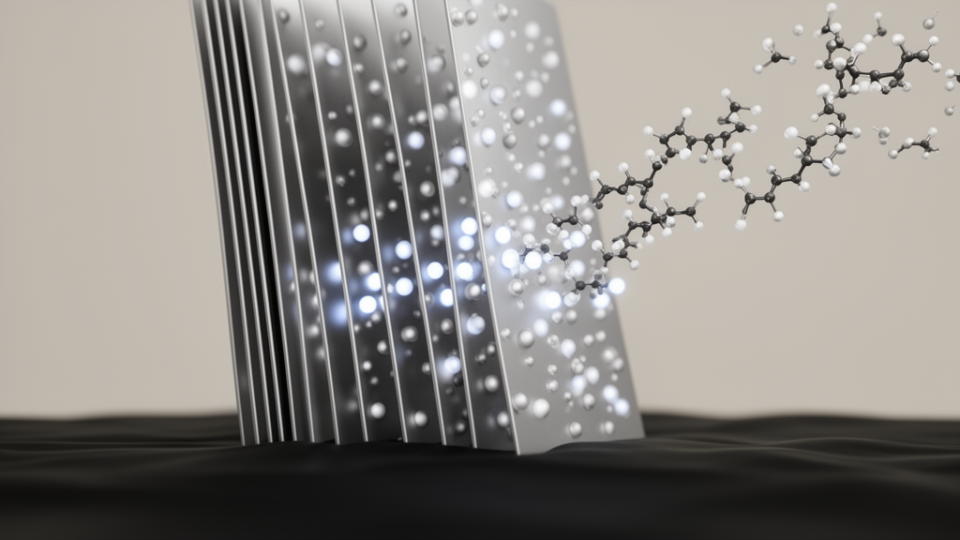
The synthesis proceeded in stages: CoAl-LDH nanosheets were grown in situ on the Ti3C2 surface, then [Pd(NH3)4]2+ precursors were adsorbed and reduced with sodium borohydride. Structural characterization showed the LDH nanosheets standing vertically aligned on the MXene, forming an open, array-like architecture with enlarged surface area and accessible mesoporous channels. The resulting palladium nanoparticles averaged approximately 10.2 nanometers and were well dispersed across the hybrid support.
In the model reaction, the composite reached its high yield and turnover frequency under the optimized conditions reported by the authors. Beyond the model substrates, the catalyst demonstrated a broad substrate scope, coupling various aryl iodides with olefin derivatives. It was also reused five times without significant loss of catalytic activity, a recyclability result the authors highlight for this heterogeneous system.
Palladium-based catalysts have long served as the core catalytic system for the Heck reaction, a key process for constructing carbon–carbon bonds. The authors present this work as a feasible structural design strategy for constructing efficient and recyclable LDH/MXene-supported palladium catalysts for C–C coupling reactions more broadly.
The study, authored by Deke Wang, Ye Liu, Jingwen Yu, Yu Dong, Baoyu Zou, Xingkang Yu, Juanjuan Ma and Lin Liu, was published in the Journal of Materials Science in October 2026. Its central contribution is the demonstration that a vertically aligned nanosheet array assembled from a layered double hydroxide and an MXene can support well-dispersed palladium nanoparticles that deliver high yield, broad substrate tolerance and repeated-run performance in Heck coupling.
Subject of Research: A hierarchical palladium catalyst on CoAl-LDH/Ti3C2 MXene nanosheet arrays for Heck carbon–carbon coupling reactions
Article Title: Hierarchical 3D Pd@CoAl-LDH/Ti3C2 nanosheet arrays: a robust heterogeneous catalyst for efficient Heck coupling
Article References: Wang, D., Liu, Y., Yu, J., Dong, Y., Zou, B., Yu, X., Ma, J., & Liu, L. (2026). Hierarchical 3D Pd@CoAl-LDH/Ti3C2 nanosheet arrays: a robust heterogeneous catalyst for efficient Heck coupling. Journal of Materials Science. https://doi.org/10.1007/s10853-026-13979-z
Image Credits: AI Generated
DOI: 10.1007/s10853-026-13979-z
Keywords: Heck reaction, palladium catalyst, layered double hydroxide, MXene, Ti3C2, CoAl-LDH, carbon-carbon coupling, heterogeneous catalysis, nanosheet arrays, turnover frequency, catalyst recyclability, Hierarchical