
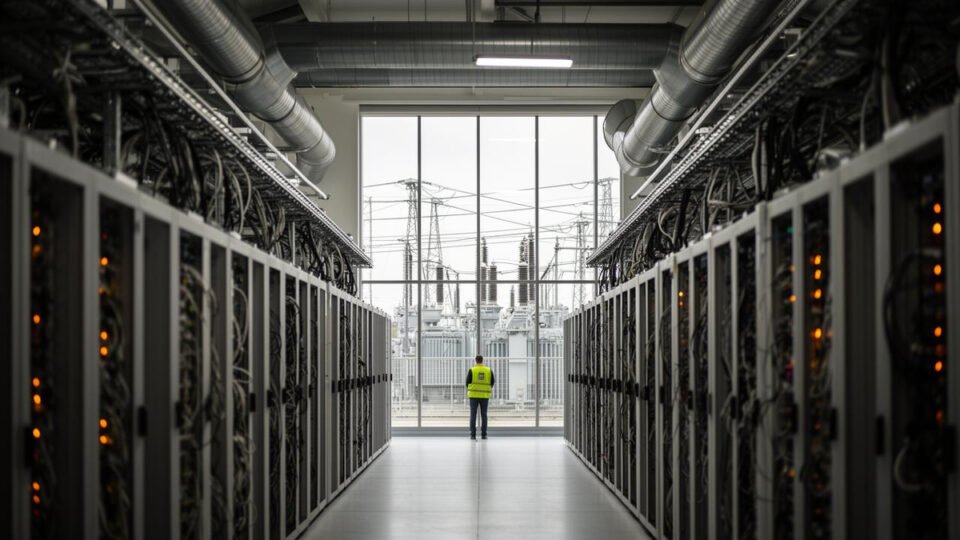
The financial bar for building AI infrastructure is rising fast. At CASPA’s 35th annual conference, held in the United States on October 23, SemiAnalysis founder and CEO Dylan Patel and Bernstein Managing Director and Senior Analyst Stacy Rasgon discussed the outlook for the semiconductor industry. The core question was no longer whether demand exists, but how fast this expansion can proceed and who will pay for it.
One figure Patel cited was striking: building a 1-gigawatt AI data center now costs more than $60 billion, up from about $40 billion in 2024, covering chips, land, power and facility infrastructure. At the same time, the yield on the U.S. 10-year Treasury has topped 5%, and unsecured bonds from emerging cloud providers yield close to 15%.
Financing Capacity Becomes the Dividing Line
Rising financing costs affect players of different sizes asymmetrically. Rasgon noted that the hyperscalers that have generated the strongest cash flow in the past are now consuming large amounts of free cash flow on AI infrastructure, and companies such as Meta and Google may eventually need equity financing to support their investments. Meta’s commitments on computing and data centers are said to have reached $1.4 trillion, a scale large enough to make capital markets wary.
The pressure is more concentrated among emerging cloud providers. Patel estimates that construction demand taken on by non-hyperscale cloud providers accounts for nearly half the total market, but such companies generally lack sufficient balance-sheet support. In the financing for Voluta’s cluster build for Anthropic, for example, the bonds carried a coupon of about 12% but were sold at 95 cents on the dollar, for an effective yield of close to 15%. His assessment: without long-term purchase commitments from hyperscalers or large AI labs, project financing will be very difficult.
The supply chain has begun designing its own financing structures. Nvidia is providing support for some compute cluster projects through revenue-sharing arrangements; when Lambda built a cluster for Anthropic, its revenue-sharing ratio with Nvidia was about 10%. Broadcom, meanwhile, supplies chips to Anthropic under a similar installment-payment arrangement.
| Key Cost and Financing Metrics | Data |
|---|---|
| 1 GW compute build cost (2024) | About $40 billion |
| 1 GW compute build cost (current) | More than $60 billion |
| U.S. 10-year Treasury yield | Above 5% |
| Emerging cloud provider unsecured bond yield | Close to 15% |
| Voluta bond coupon for Anthropic | About 12% (issued at a discount, effective ~15%) |
| Memory industry gross margin | 88%-90% |
Note: Build costs cover chips, land, power and data center facilities, among other components.
Rasgon cautioned that slower growth due to constraints is not necessarily all bad. During the dot-com bubble, vast amounts of dark fiber were laid, ultimately resulting in overbuilding; today’s financing and supply-chain constraints may instead produce a better match between supply and demand and stretch out the expansion cycle.
Substrates and Memory Are Harder to Expand Than Power
On the ranking of supply-chain bottlenecks, Patel’s view differs from market intuition. He believes that, apart from memory, the most severe bottleneck today is substrates, including packaging substrates and PCB materials. Japanese suppliers of related materials tend to expand capacity conservatively, and AI accelerators, CPUs and other products will be significantly constrained over the next two years. The third bottleneck is optical interconnect: even if co-packaged optics (CPO) ramp up production around 2028, lasers and fiber-optic connection components could still be in short supply.
By contrast, while power is constrained, there are more ways to ease the problem. Patel expects data centers under construction worldwide to total nearly 50 GW in 2027, including about 35 GW in the United States, with on-site gas turbines, reciprocating engines and fuel cells partially offsetting the power shortfall.
Memory is another constraint. Rasgon noted that producing the same capacity of HBM requires about three to four times as many wafers as DDR5, so HBM expansion will directly squeeze ordinary DRAM capacity needed for PCs and smartphones. He also poured cold water on optimistic market expectations for wafer fab equipment (WFE): forecasts that the global WFE market will exceed $200 billion in 2026 are too optimistic. By raising utilization at existing fabs, the market could rise from about $120 billion expected at the start of the year to about $155 billion, but new cleanrooms will not come online until 2027, with more capacity expected to be released in 2028-2029.
When the memory shortage ends depends not on a fixed date but on when new capacity begins to exceed incremental demand. The memory industry’s gross margin is said to have reached 88%-90%, yet the sector’s forward price-to-earnings ratios are only in the single digits, reflecting investors’ concern that supply will be released in a concentrated wave after 2028 and prices will fall.
How Long Can Nvidia’s Premium Last?
Nvidia remains at the center of this expansion, but the competitive landscape is changing. Rasgon believes its product iteration still supports pricing: from Ampere to Hopper, average selling prices roughly doubled while performance rose about 10-fold; from Hopper to Blackwell, prices rose about 50% while performance is said to have improved 3- to 30-fold. As long as performance gains continue to outpace price increases, customers have an incentive to buy.
But in-house chips are giving large customers alternatives. Google TPU is already being sold to external customers, Amazon Trainium continues to improve support for the PyTorch ecosystem, and OpenAI and Anthropic are also advancing in-house chip plans. Patel disclosed that SemiAnalysis tested OpenAI’s first-generation chip using the open-source inference benchmark InferenceX, and the results showed performance exceeding Nvidia’s Blackwell.
He further estimates that if the profits of chip design players such as Nvidia, Broadcom and Marvell could be stripped out, the cost of the same scale of compute might be only about $20 billion. This economic incentive is precisely why cloud providers are accelerating in-house development. Nvidia’s share of coprocessor wafer and HBM demand has begun to decline, with growth slowing in 2025 and falling further in 2026.
Rasgon noted that Nvidia’s valuation relative to the Philadelphia Semiconductor Index is at a historic low, even below where it stood when he wrote his report nine to ten months ago. The market is worried not only about whether AI demand can be sustained but also about competition eroding pricing power.
On the enterprise application side, the two analysts believe most companies will not build their own compute to run private models but will buy tokens through cloud services. Rasgon cited his own team as an example: using Claude to build a financial model covering ten years of historical data and multiple business restructurings took about 1 hour and 20 minutes, whereas the same work assigned to an analyst might take a week. Such value first shows up as efficiency gains; whether it can translate into sustainable revenue remains to be seen.