
Synopsis: To ensure economic stability, the government will boost revenues, prioritise core spending and manage financial risks to safeguard fiscal sustainability.
The government projected Cambodia’s economy to grow by 4.0% in 2026 before accelerating to 4.8% in 2027, supported by industry, services and agriculture, while gross domestic product (GDP) per capita is expected to rise to $3,277 next year.
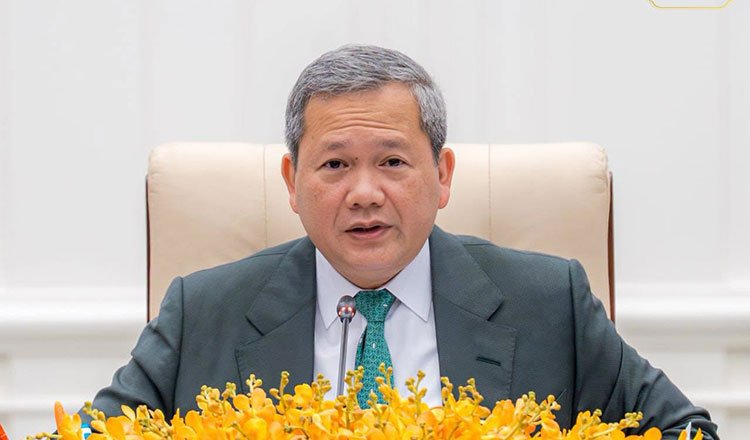
The forecast was outlined during a cabinet meeting chaired by Prime Minister Hun Manet to review and decide on four key agenda items at the Peace Palace in Phnom Penh on Friday.
Among the four agenda items, the first focused on assessing the country’s macroeconomic performance during the first nine months of this year and revising the Medium-Term Fiscal Framework for 2027-2029.
According to a press release from the Office of the Council of Ministers, the Ministry of Economy and Finance updated the framework using data from the first nine months to ensure a realistic assessment of economic developments and strengthen the credibility of public fiscal policy formulation and the draft budget law for next year.
The revision also complied with Article 51 of the Law on Public Financial System. Under the revised assessment, the government expected economic growth to reach 4.0% in 2026 and accelerate to 4.8% in 2027. GDP per capita is projected to increase from approximately $3,098 this year to $3,277 next year.
The government identified three main sectors expected to drive growth in 2027. In industry, key contributors include garment manufacturing, non-garment manufacturing, food and beverage production and tobacco manufacturing.
The services sector is expected to benefit from hospitality and food services, wholesale and retail trade, transportation and storage and information and communications technology. Meanwhile, agriculture is expected to receive support from crop production, livestock and fisheries.
To support economic stability and growth, the government said it would continue strengthening revenue mobilisation, prioritising expenditure and improving spending efficiency while prudently managing public finance risks to preserve fiscal space and ensure public finance sustainability over the medium term.
The government’s outlook is more optimistic than the latest forecasts from several key international institutions, which have highlighted challenges facing the Kingdom’s economic recovery.
The Asian Development Bank projected Cambodia’s economy to grow by 3.9% in 2026 and 4.7% in 2027, citing weaker-than-expected activity in tourism and related services as key factors.
The World Bank forecasted growth of 3.5% this year, followed by 4.0% in 2027 and 5.0% in 2028, attributing the near-term slowdown to higher energy prices, tighter credit conditions and declining remittances as migrant workers return home.
Meanwhile, the ASEAN+3 Macroeconomic Research Office projected growth of 3.9% in 2026 and 4.9% in 2027, warning that a potential El Niño phenomenon could threaten agricultural production, rural incomes and food prices.
The International Monetary Fund offered a more cautious outlook, projecting growth of 3.0% in 2026 and 4.0% in 2027, citing higher energy costs, weaker tourism and remittances, slowing garment exports, subdued domestic demand and tighter financial conditions.
The differing forecasts underscored uncertainty surrounding Cambodia’s economic outlook, with external pressures and domestic challenges posing risks despite the government’s expectations of stronger growth in 2027.