
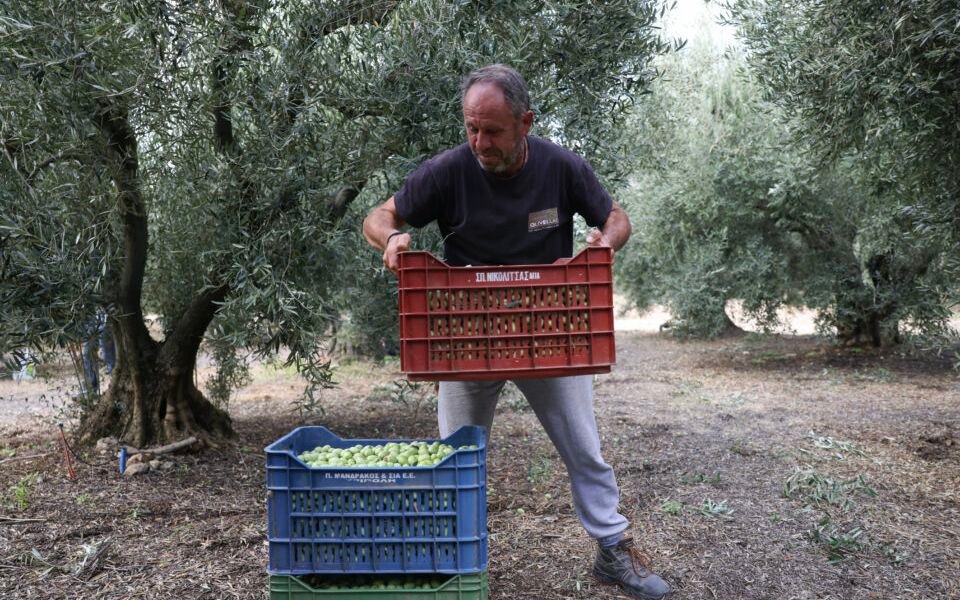

Thanasis Halatis, head of the Agricultural Olive Cooperative of Halkidiki, helps fill plastic crates with the green olive harvest at his orchard in Kalyves. [Alexandros Avramidis]
Reeling him into the beguiling world of Wall Street, Matthew McConaughey offers Leonardo DiCaprio an olive to go with their martinis. They’re “Halkidiki,” he assures. The scene in the 2013 drama “The Wolf of Wall Street” embodies what was the brass ring for thousands of farmers in the northern Greek region: seeing the green olive become a luxury product being exported across Europe and the United States.
The appearance of the Halkidiki olive in a Hollywood blockbuster is one of Thanasis Halatis’ favorite stories. The president of the Agricultural Olive Cooperative of Halkidiki says that the owner of a major local olive processing plant claims to have paid half a million dollars for those few seconds of indirect advertising. But that was then. Today is a whole different story.
Kathimerini met with Halatis in a grove just outside the village of Kalyves as workers harvest olives. Picking an olive off a tree, explains how the same product he sold last year to processors and exporters for €1.80 per kilogram is fetching €1.20 at best this year. “That’s a 40% drop,” he says – and for him, that spells disaster.
After a decade of continuous export growth, one of the country’s strongest exports suffered its first slump this year, driven by the wars in Ukraine and the Middle East, US President Donald Trump’s tariffs on European products and rising prices that are putting such “luxuries” out of many households’ reach. For the US in particular, which is one of the product’s key markets, the drop in the first half of the year came to 6%.
‘I feel like we’re barely surviving, so why would I encourage a young person to follow this path?’
As a result of these developments, processors are offering growers very low prices this year. Halatis argues this will hurt the industry, potentially leading to a decline in both the quantity and quality of green olives produced. With cultivation costs rising and revenues falling, he believes small and medium-sized growers may choose not to cultivate their crops next year. Even if they do, he adds, they may not have the money to look after them properly – including providing proper fertilization and pest protection – ultimately affecting the quality of the product.
Dimitris Evangelinos, president of the Biolivia Agricultural Cooperative of Organic Olive Producers of Olynthos in Halkidiki and a board member at the Organization for Table Olives, says that the current crisis is likely to spur changes to the area’s production model.
“I believe small- and mid-scale growers will either lease out their land or abandon it altogether. Land is changing hands constantly. We’ve seen it happening every day over the past five years,” he tells Kathimerini, adding that the concentration of cultivation in fewer hands will have a negative impact on the quality of green olives.
“Small and medium-sized growers always put more care into cultivation. When someone has 40,000 or even 80,000 trees, and labor has become so expensive, it is only natural that quality will decline significantly,” he says.

Beginning of the end?
Yiannis Koufidis, president of the Halkidiki Chamber of Commerce and the region’s deputy governor, is also concerned about the future of olive cultivation as a whole and the impact on the local economy. He fears the region may be witnessing the beginning of the end for one of its major export products.
“Quality is bound to decline. With high production costs looming next year – in fuel, diesel, fertilizers, pesticides, energy, water and wells – growers simply won’t have enough money to cultivate their crops again. And what does that mean? It means lowering the quality of the product, which is our only advantage over other olives produced in the Mediterranean.”
That would be disastrous for Halkidiki, whose economy relies heavily on green olives. According to Koufidis, they are as important to the region as tourism, with revenue from the crop distributed much more widely across the local economy.
“Many people think Halkidiki is all about tourism. They’re wrong. Halkidiki is the green olive. We have more than 100 green olive processing plants in Halkidiki, and that means substantial investments, jobs at those businesses and an entire economic chain that depends on them.” He also points out that farmers currently lack the capital needed to switch to other crops.
Halatis, hurrying to bring crates to the workers as they pick the olives from the branches by hand, doesn’t even want to contemplate giving up a crop he loves so much. Almost instinctively, he picks up the good olives that escape the workers and fall to the ground, tossing them into the steadily filling crates.
“It’s backbreaking work,” he says, but he would never want Halkidiki to turn away from olive growing and rely solely on tourism. “I think the green gold produces more than the Blue Flags,” he says, referring to the flags awarded to beaches for the quality of their services and bathing waters.
But Halatis is also concerned about the future of the crop and the next generation of producers. He points out that the average age of olive growers right now is around 50 and believes it is unlikely that a new generation will step in if current conditions persist. His own son is near the age when he’ll have to decide on a career path. “I feel like we’re barely surviving, so why would I encourage a young person to follow this path?”