
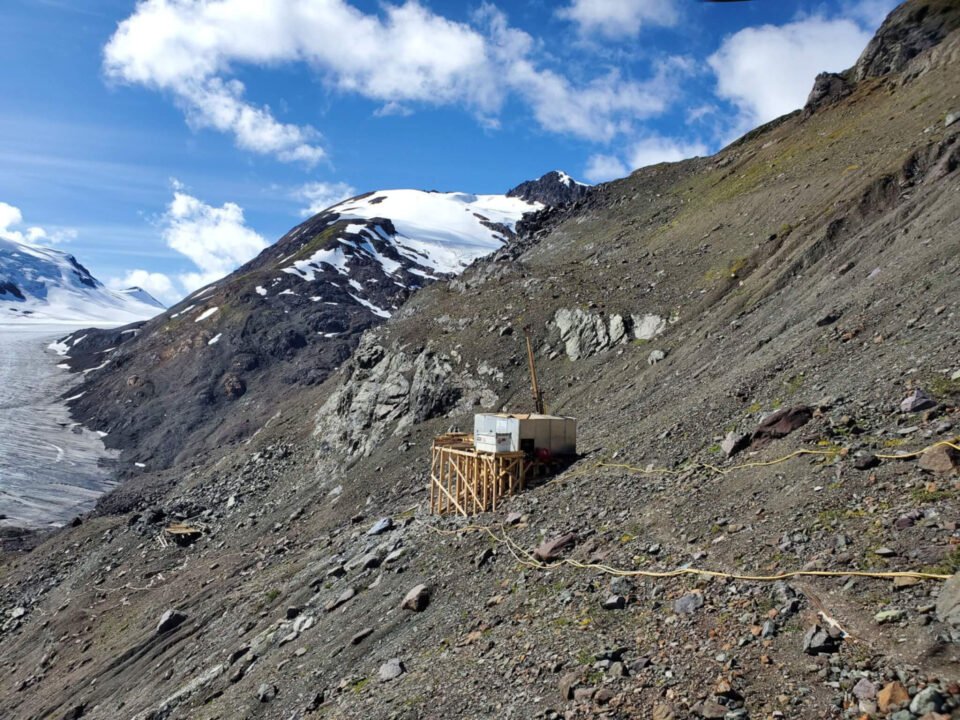
- Management sees Tudor Gold’s shares trading in line with the gold price and its peers.
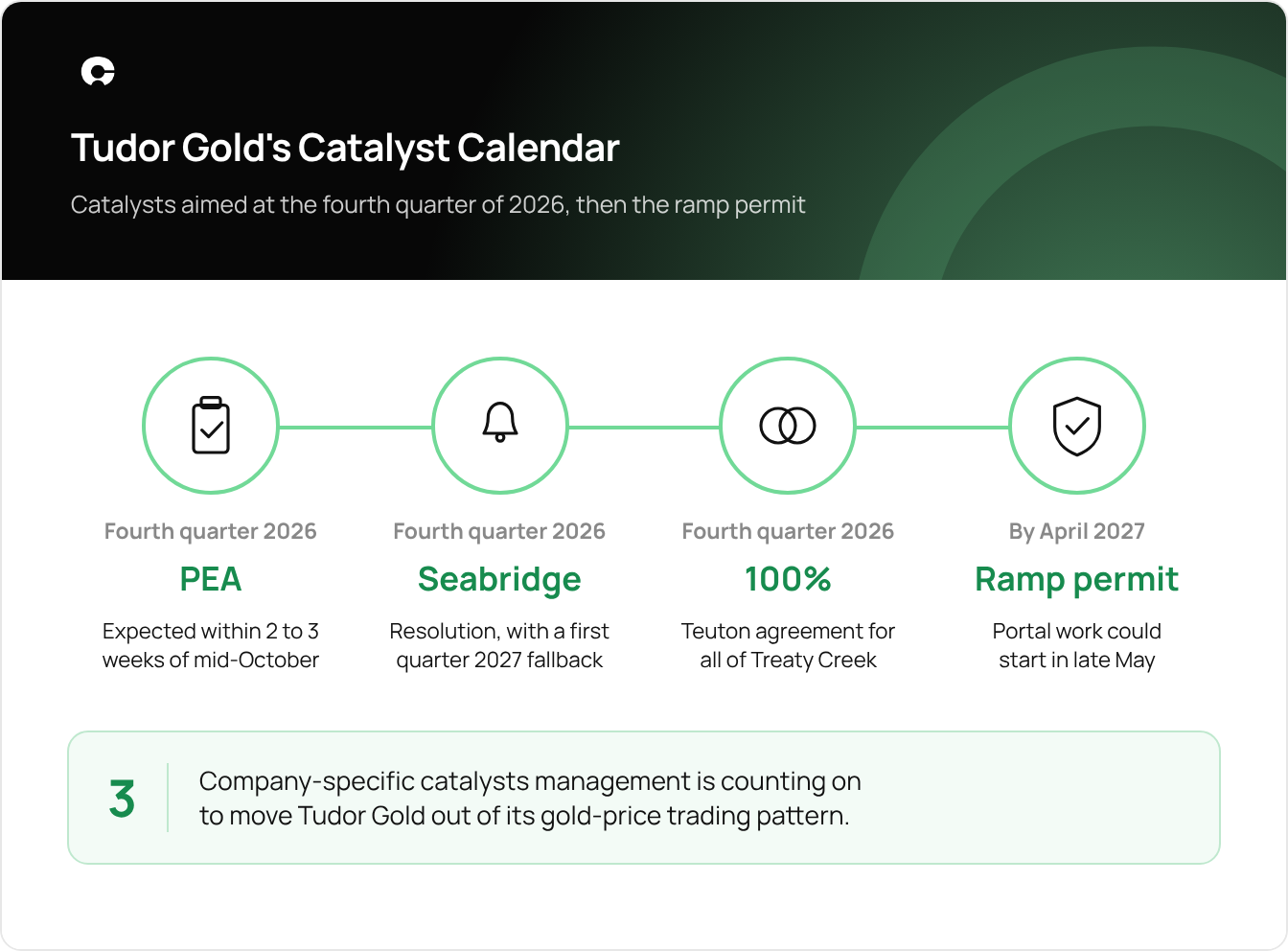
- It names 3 catalysts to break that pattern, all aimed at the fourth quarter of 2026.
- The Goldstorm preliminary economic assessment (PEA) was expected within 2 to 3 weeks of mid-October.
- A Seabridge resolution has a stated fallback of the first quarter of 2027.
- The underground ramp permit may slip into 2027, but a permit by April still fits a late-May portal start.
Treaty Creek & the Gold-Price Trading Pattern
Tudor Gold (TSXV: TUD) holds an 80% interest in the 17,913-hectare Treaty Creek Project in the Golden Triangle of northwestern British Columbia, after acquiring American Creek Resources. The property borders Seabridge Gold’s KSM property to the southwest. Goldstorm is the only deposit defined on Treaty Creek to date. It hosts Indicated resources of 24.9 million ounces (Moz) of gold, 148.7 Moz of silver, and 3.048 billion pounds of copper. Those resources total 912.3 million tonnes grading 0.85 grams per tonne (g/t) gold, 5.07 g/t silver, and 0.15% copper.
As of June 30, 2026, Tudor Gold had 411,494,958 shares issued and 479,509,481 on a fully diluted basis, for a market capitalization of C$413.20 million at C$1.01 per share. Insiders held 28.0%. Eric Sprott’s 2176423 Ontario Ltd. held 14.0%, Tudor Holdings 12.0%, institutions 13.6%, and retail investors 60.4%. The shares have traded in line with the gold price and with peers, by management’s reading, and company-specific catalysts are its route out of that pattern. Tudor Gold has named 3: releasing a preliminary economic assessment (PEA) on Goldstorm, resolving its issues with Seabridge, and reaching an agreement with Teuton Resources under which it would own 100% of Treaty Creek.
President and Chief Executive Officer of Tudor Gold, Joseph Ovsenek, names the 3 events he is counting on to lift the shares this quarter:
“The three catalysts we are working hard on are getting the PEA out, resolving our issues with Seabridge, and working something out with Teuton Resources, where we own 100% of the Treaty Creek project. And so, I’m still cautiously optimistic that we will accomplish all three of those catalysts this quarter.”
The 2 catalysts beyond the PEA each need a second company to agree. Ovsenek led the Pretium Resources executive team that took the Brucejack Mine, 20 kilometers (km) south of Treaty Creek, from discovery to commercial production in under 8 years. Several of Tudor Gold’s current officers also worked at Pretium.
Goldstorm PEA Timing & Scope
Fuse Advisors Inc. is preparing the PEA, which examines an underground mining operation focused on the higher-grade gold mineralization at Goldstorm outlined in the 2026 resource estimate. The study was being finalized as of October 14, 2026. Tudor Gold had aimed to publish it in September and missed that date, and as of October 15, 2026, expected to announce results within 2 to 3 weeks. Many large deposits never become mines because their economics do not work, in management’s view.
The concept under study is an underground long-hole stoping operation producing about 10,000 tons per day, modeled after the Young-Davidson mine in Ontario. Long-hole stoping is a method that involves drilling and blasting blocks of rock between underground levels. Tudor Gold aims to produce 200,000 to 300,000 ounces (oz) of gold per year, with a mine life of 20-plus years to start. It is assessing 2 to 3 g/t higher-grade gold-copper mineralization for initial mine development. For the study, management currently expects a net smelter return cut-off value below US$125, in the US$100 to US$125 range, drawing on the upper, central, and lower zones.
Ovsenek presents the study as a first mining route for Goldstorm, with refinement still ahead:
“We want to show everyone that, look, our Goldstorm deposit is going to be a mine, and the way it’s going to be a mine is along this path.”
At the US$125-per-tonne sensitivity in the resource estimate, Goldstorm contains Indicated resources of 102.1 million tonnes at 1.78 g/t gold for 5.8 Moz. At US$175 per tonne, the figure is 45.1 million tonnes at 2.33 g/t gold for 3.4 Moz. The completed metallurgical program returned gold recoveries of 86.3% from the Upper Zone concentrate, 87.3% from the Lower Zone, and 82.1% gold and 94.1% copper from the combined concentrate of the Central Zone. Tudor Gold expects the SC-1 Zone to grow once it is drilled from underground and would probably prepare another PEA at that stage to adjust the mine plan to reflect that growth.
Consolidation With Teuton & the Seabridge Issues
Consolidating the Treaty Creek ownership structure and resolving overlapping interests are part of Tudor Gold’s strategy, and project consolidation is among its open objectives for 2026. Teuton Resources is working to separate its other assets from the company so it is in a position to negotiate on Treaty Creek.
On Seabridge, Tudor Gold is aiming for a resolution in the fourth quarter of 2026 and, if that fails, in the first quarter of 2027. Work on the PEA has slowed that effort. Seabridge wants to move ahead with its own project, and keeping the 2 companies apart is good for neither, by management’s assessment.
Seabridge’s KSM property hosts 5 deposits. Tudor Gold’s PSP Zone at Perfectstorm lies about 4 km northeast of Seabridge’s Iron Cap Deposit, on the northeast-southwest trending Sulphurets corridor, which hosts multiple porphyry deposits and prospects. A porphyry deposit is a large, generally lower-grade copper-gold deposit formed around a body of cooled magma.
The SC-1 Ramp Permit & the Critical Path
Tudor Gold has filed a permit application to construct an underground ramp to drill the high-grade gold SC-1 Zone at Goldstorm, and receiving that permit is another open 2026 objective. As of October 15, 2026, review had stalled. The British Columbia government had called an election about a month earlier, with voting about 10 days away, and departments stood down during that period. Tudor Gold also still needed to submit some data, and put the delay at about 6 weeks.
The company is still optimistic about receiving a permit in 2026, though it may slip into 2027, and it will update the market once timing is clearer. Tudor Gold does not plan to start work on the ramp portal until the snow has largely cleared, probably in late May, to avoid paying to clear snow that would melt within weeks. A permit by the end of the first quarter of 2027 into April would still leave time to mobilize crews.
Ovsenek separates the schedule risk from the missed commitment:
“I’m not worried about the timing as much as we said we would get this done this year and we haven’t, and we like to deliver on what we say we’re going to deliver.”
The permit timing still fits within the project’s critical path, and management’s stated concern is the missed 2026 commitment more than the start of underground work.
Catalyst Sequence & Open 2026 Objectives
Tudor Gold set 7 objectives for 2026 and has completed 2: refining the resource estimate to provide better visibility into the higher-grade material, and completing the metallurgical program. The open items are consolidating Treaty Creek, completing the 2026 drill program, receiving the underground ramp permit, developing a resource estimate for an additional deposit, and completing the PEA.
Drilling at Perfectstorm serves the additional-deposit objective. Perfectstorm had 21,119 meters (m) drilled to date as of October 2026, against more than 190,000 m at Goldstorm, and its PSP Zone porphyry system extends about 850 by 750 m, open in all directions. As of October 15, 2026, 3 drills were active, and the program was expected to wrap up around mid-November if the weather held, at more than 20,000 m and possibly close to 25,000 m. Assays from the porphyry were expected to run almost to Christmas. Tudor Gold aims to drill enough of it for a maiden resource before the weather ends the season, if all goes well.
In order, the PEA comes first, with the Seabridge resolution and the Teuton Resources agreement aimed at the fourth quarter of 2026. Perfectstorm assays follow through December, a ramp permit still fits the plan if it arrives by April 2027, and portal work could start in late May. Each delivered item gives investors a dated check on whether the 3 catalysts move Tudor Gold out of its gold-price trading pattern.
The Investment Thesis for Tudor Gold
- Management sees Tudor Gold’s shares trading in line with the gold price and its peers, and cites company-specific catalysts as the path forward.
- The 3 catalysts are the Goldstorm preliminary economic assessment, a resolution with Seabridge, and an agreement with Teuton Resources for 100% of Treaty Creek.
- The preliminary economic assessment evaluates an underground long-hole stoping mine producing about 10,000 tons per day, with a target of 200,000 to 300,000 ounces of gold per year.
- The Goldstorm Deposit hosts Indicated resources of 24.9 million ounces of gold, 148.7 million ounces of silver, and 3.048 billion pounds of copper.
- The underground ramp permit may slip into 2027, but a permit by April still fits a portal start in late May.
Over the next 2 quarters, the investment case turns on delivery against dates management has set itself. The Seabridge resolution and the Teuton Resources agreement depend on counterparties, with Seabridge already carrying a fallback to the first quarter of 2027. The permit delay costs Tudor Gold its 2026 commitment, though a permit by April still fits within the critical path for underground work.
TL;DR
Tudor Gold has set 3 catalysts, each with a target date, to move its shares out of a pattern that tracks the gold price and peers, according to management. They are the Goldstorm PEA, a resolution with Seabridge, and an agreement with Teuton Resources for 100% of Treaty Creek. All 3 are aimed at the fourth quarter of 2026, with Seabridge carrying a fallback to the first quarter of 2027. The PEA was expected within 2 to 3 weeks of mid-October and tests an underground mine targeting 200,000 to 300,000 oz of gold a year. The ramp permit may slip into 2027, but a permit by April still fits a late-May portal start.