
Alternative financing is gaining ground as a means of driving business and property projects, complementing bank credit and diversifying investments. Its flexibility and ability to intervene in the early stages of operations have made it an increasingly common tool in the market.
Its potential and the challenges it faces in the Balearic Islands were the focus yesterday of the 2nd Conference organised by El Económico and Ultima Hora, held under the title Alternative and Traditional Financing and Investment: Drivers of Investment, Development and Growth in the Balearic Islands.
The event, held at the Castillo Hotel Son Vida, was sponsored by TQ Eurocredit and TQ Alternative Investments and supported by SDC Analistas, ETL ILIA and Renta 4 Corporate. The CEO of Grup Serra, Pedro Rullán, welcomed the attendees and emphasised that “there is still some way to go before alternative financing – which, alongside traditional financing, is the economic driving force of our society – becomes fully established”.
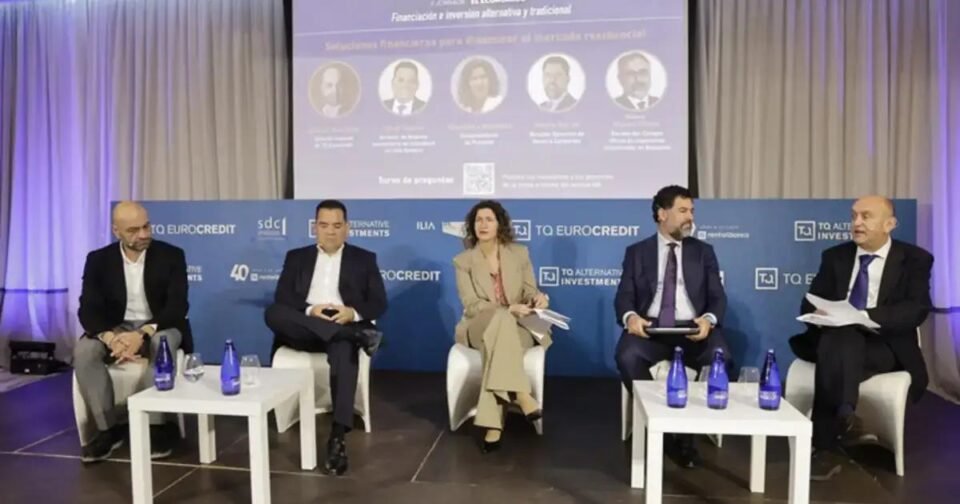
The first round table, moderated by Pep Verger, editor-in-chief of El Económico, addressed financial solutions to revitalise the residential property market. “We are going to try to see whether alternative financing can be part of the solution,” he suggested.
Participants included Bernat Martínez, managing director of TQ Eurocredit; Omar García, director of property business at CaixaBank in the Balearic Islands; Alejandra Marqués, vice-president of the Proinba property developers’ association; and Pedro Durán, executive director of Renta 4 Corporate.
The participants agreed that the lack of land and administrative hurdles make it difficult to get new developments off the ground. Marqués pointed out that “administrative delays are the main problem – the obvious bottleneck that, from start to finish, prevents us from securing funding and starting construction”. She also noted that “strategic residential projects have been on hold for 25 years”.
Speaking on behalf of CaixaBank, García argued that there is capacity to finance property developments. “There is money available,” he assured, although he warned that the market demands greater guarantees.
A clear example of this was the 39,000 million euros mobilised by property financing in Spain last year, 12 per cent more than in the previous financial year. However, he made it clear that, “banks do not finance profit expectations, but rather projects undertaken by a developer with proven experience, in markets with established demand and with a level of pre-sales” that demonstrates their viability.
Martínez explained that alternative financing meets needs that traditional banks do not always address. “It is fast and flexible; we take risks but with an extremely rigorous analysis,” he stated.
Durán, for her part, warned that the Balearic Islands remain attractive but that “regulatory uncertainty, as well as uncertainty regarding timelines and costs, is causing many investors to delay their investments”.
The fact is that the islands’ insularity also affects property developments. Alejandra Marqués put the additional cost of imported materials at 30 per cent and advocated industrialised construction to reduce lead times, although she acknowledged that there is still insufficient supply to consolidate this industry on the island. The speakers called for greater legal stability and planning. “The bottleneck is the lack of land. We need to change the regulations and plan land reserves with a long-term view,” argued Martínez.
The second panel, dedicated to New forms of investment. Portfolio diversification, was moderated by Antoni Alcover, economist and senior lecturer in Applied Economics at the UIB. The panellists were Rafael Domingo, tax adviser at ETL ILIA; Luis Alberto Ferreyra, CEO of SDC Analistas; and Josep Ravés, director of TQ Alternative Investments.
Ravés explained that the company is celebrating its 20th anniversary and operates in four areas: a private debt fund, a property development arm, an industrial division and investment in seed-stage companies. Ferreyra presented SDC as a private banking firm specialising in listed assets. Domingo, for his part, defended the role of business consultancy firms, “even if we are called tax advisers”, he said.
The experts defended alternative investment as a good complement to traditional portfolios, although they emphasised the need to analyse each transaction and the investor’s profile. Ravés highlighted that it provides “stability and a more ‘real’ economy”, whilst Ferreyra summarised the balance that any investment should seek: “liquidity, profitability and security form a triangle, and you choose two”.
Domingo shifted the debate to the Balearic economy and warned that the housing shortage also threatens business activity, as “there is no longer enough housing for staff, and what is available is unaffordable”, he stated. Furthermore, he called for capital from the Islands to help finance projects in the archipelago. “Balearic investors must start investing in the Balearic economy. We need to ensure that the money flowing out stays here, and we must make the product attractive.”