

Listen to this article
Estimated 5 minutes
The audio version of this article is generated by AI-based technology. Mispronunciations can occur. We are working with our partners to continually review and improve the results.
Officials with the company pitching an $8-billion data centre campus in Nova Scotia have committed in writing that they will not ask for or take any government money, a pledge that comes as the chief financial officer for Everwind Fuels says project financing has closed on the first facility.
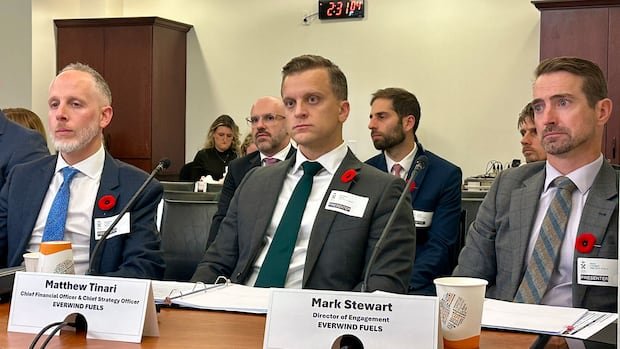
Matthew Tinari made the pledge to forgo any public financial assistance in a letter he sent this week to Finance Minister John Lohr. The letter comes on the heels of protests last week against the project.
In an interview, Tinari said the letter was intended to address feedback the company had received during recent open house meetings on the project.
“We wanted to be really clear that this is 100 per cent privately funded,” he told CBC News on Tuesday.
“We are taking debt and equity against our 20-year lease and there will be no tax dollars invested in this project.”
In the letter, which CBC News has viewed, Tinari said the pledge includes saying no to tax credits, capital grants, payroll rebates, forgivable loans or any other provincial contribution. Lohr had said several weeks ago that the province had not ruled out incentives.
Phase 1 ready to close financing
Lohr told CBC News that he was surprised to receive the letter.
“The reality is, many, many businesses in Nova Scotia do things and never ask for assistance,” he said.
Last month, Everwind and government officials converged on the Point Tupper industrial park where the company’s CEO announced plans for the campus that would include two data centers built in two phases. The project would also include a $2-billion spend on four onshore windfarms.
Tinari said the investing and lending community is showing “significant interest” in the project’s finace bonds and the company has raised “sufficient equity” to close project financing on the initial 95-megawatt facility.
That phase includes a data centre that will be leased to artificial intelligence behemoth Anthropic for 20 years, with power for the facility coming from the provincial grid. Everwind and Anthropic officials have said they would pay for any necessary grid upgrades.
Outlining potential spinoffs
Company officials have said the first data centre should be online by the end of next year. The second phase, which would include a data centre with capacity for 325 megawatts, is proposed to be ready in 2028. The plan is for it to eventually get power from the windfarms when they are complete.
Tinari’s letter also provides details about economic spinoffs from the project based on socioeconomic and financial modelling commissioned by the company.
Among other things, it says there will be about $1.5 billion in corporate income tax generated during the initial 20-year operating term of the full data centre development. It also says there will be about $75 million in personal income tax associated with construction and an annual estimate of $8.4 million during full operations.
The company has said the project will create about 2,000 construction jobs during peak development and 215 permanent jobs at full development.
The letter says the combined data centre and wind development is projected to generate more than $400 million in municipal tax revenue over the respective project lives, with almost three quarters of that being related to the four onshore windfarms planned.
Documents to be made public
Tinari told CBC that the company will make public “at minimum the executive summary that goes through the methodologies and the key takeaways” used to derive those numbers. He said it would be released “any day now.”
Lohr said he has no reason to doubt the numbers, but said officials in his department would be doing their own calculations.
“Once there’s a signed agreement and a project is in place, we would work that data out ourselves. So I’m not saying that I disrespective his data or disagree with it, I’m just saying that we would verify that data independently rather than use it.”
Tinari’s letter also includes a reference to something he raised last month while appearing before a legislative committee: an implementation agreement that he said company officials continue to work on with provincial government representatives.
That the agreement would include commitments to minimize water usage, prioritize preservation of drinking water, cause no increase to power rates as a result of the data centre campus, decline any government assistance, and outline terms for community benefit agreements.
Tinari said it would be a binding document aligned with the non-binding parameters Prime Minister Mark Carney and Premier Tim Houston have previously said they would require of any company looking to construct a data centre and that it would include “consequences.”
MORE TOP STORIES