
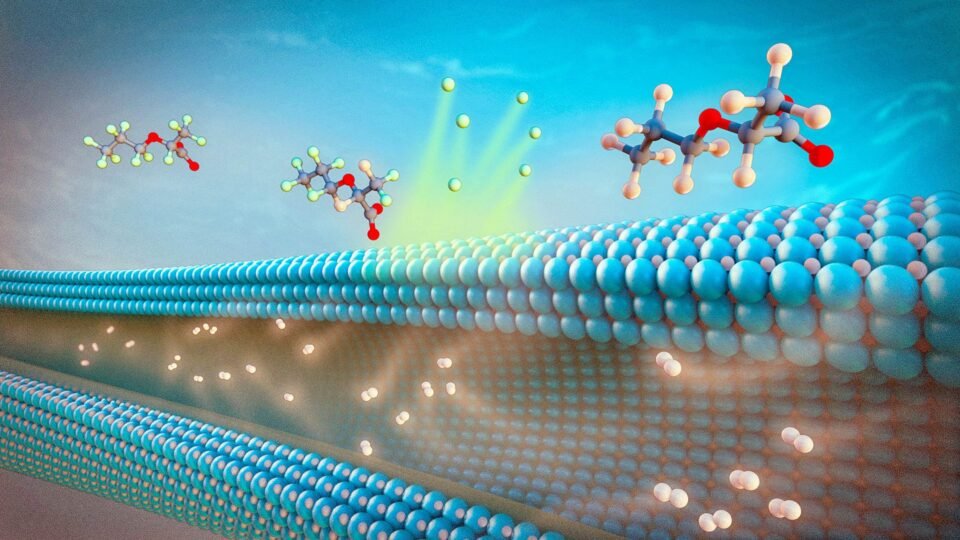
A palladium membrane fed hydrogen from inside breaks the bonds in forever chemicals at room temperature instead of just trapping them.
PFAS “forever chemicals” got their name because almost nothing can break them down. They essentially last forever.
Most water filters only trap toxic forever chemicals without actually destroying them. Once the filter is full, that toxic trash still has to go somewhere.
To fix this, scientists invented a new metal-coated filter that uses hydrogen gas to completely break the chemicals apart.
By swapping out the atoms that make these chemicals so tough, the new filter destroys them at normal room temperature.
In tests, it wiped out over 90 percent of the chemicals, proving we can finally destroy this pollution instead of just moving it from the water to a landfill.
PFAS are hard to break down
Bruce Rittmann, who directs the Biodesign Swette Center for Environmental Biotechnology at Arizona State University, led the work with Min Long and Jie Cheng.
Colleagues at Rice University, the National University of Singapore and two universities in China also took part. The whole study ran in a glass reactor about a foot (30 centimeters) long.
“PFAS are hard to break down, and normal processes that we use don’t work,” Rittmann said. PFAS is the family’s chemical name, and the chemicals are in water, soil, food and people.
“We all have PFAS in us,” he said. “They stay in the environment. They move up the food chain, and so they’re a big legacy problem.”
Fluorine shields the chain
PFAS, or forever chemicals, are chains of carbon atoms wrapped in fluorine. The coating is what lets nonstick pans and waterproof jackets shed oil and water, and it’s in firefighting foam too.
“It’s called the strongest bond in organic chemistry,” Rittmann said.
In 2024, the EPA set drinking water limits of 4 parts per trillion for PFOA (perfluorooctanoic acid) and PFOS (perfluorooctanesulfonic acid). Three others, including GenX, got a limit of 10 parts per trillion.
Feeding hydrogen from inside
The reactor holds 120 hollow plastic fibers coated with a film of palladium. Hydrogen gas is pumped into the hollow core of each fiber, so it reaches the palladium from underneath while the contaminated water sits against the outside.
Palladium splits hydrogen molecules into single atoms. Some stay on the metal’s surface, and others slip in between the palladium atoms and are stored inside the metal, which swells by about 4 percent as it fills.
The study’s central finding is that the two kinds of hydrogen do different jobs.
“The palladium attracts the PFAS molecule, and the palladium attracts the hydrogen and puts them together,” Rittmann explained.
In control runs, hydrogen without palladium did nothing to PFOA. Palladium without hydrogen took about 30 percent of the PFOA out of the water but released no fluoride, likely because the molecules stuck to the metal without breaking.
Stored hydrogen breaks bonds
Hydrogen on the surface helps the membrane capture a PFAS molecule and hold it flat against the metal. The hydrogen stored inside the metal supplies the energy that swaps a fluorine atom for a hydrogen atom, one bond at a time.
Chains with no fluorine left were among the end products.
The team tested that by feeding hydrogen either through the fiber cores or into the air space above the water. PFOA left the water at about the same rate either way. However, feeding through the fibers doubled the rate at which fluoride was released.
The team also ran a commercial palladium-on-carbon catalyst, which holds stored hydrogen for a shorter time. It removed about 85 percent of the PFOA but freed only 37 percent of the fluorine, compared with 51 percent for the membrane film.
In an interview with Earth.com, Rittmann said the way the gas arrives is what sets this reactor apart. Delivering hydrogen straight to the base of the palladium film creates a highly reactive palladium hydride, and that, he said, is what speeds the reaction up.
Longer chains break down faster
In the batch tests, each chemical spent 44 hours in the reactor on its own, in water acidified to pH 4, which is more acidic than tap water.
The longer the carbon chain, the faster the chemical was removed and the more of its fluorine came off. PFNA (perfluorononanoic acid), with nine carbons, lost 59 percent of its fluorine.
In contrast, four-carbon PFBS (perfluorobutane sulfonate) lost 26 percent, while PFOA, PFOS and PFHxS (perfluorohexanesulfonic acid) fell in between.
A longer chain sticks to palladium more strongly, the team’s calculations found, and it carries more of the weaker carbon-fluorine bonds that hydrogen can attack first.
One forever chemical did something different
GenX didn’t follow the pattern. It has six carbons but an oxygen atom linking two halves of its chain, and that link made it stick less and resist more. Only 27 percent of its fluorine came off, about the same as PFBS.
For Rittmann, the point of the paper is that the membrane took apart all six regulated forever chemicals, which argues for one mechanism that should work across the family.
He told Earth.com that “more than 20,000 PFAS compounds have been produced, and many more than the six are in use.”
Tested for 58 days
For the long test, the team mixed all six chemicals into one feed at 50 micrograms per liter each and pumped it through the reactor without a break.
Over 58 days the membrane removed between 93 and 99 percent of every compound, and the fluoride in the outflow works out to 83 percent of the fluorine coming off.
Fifty micrograms per liter is also 50,000 parts per trillion, more than 10,000 times the EPA limit for PFOA. In no run did the water reach the drinking-water limits themselves. About 10 percent of the palladium was lost over the run.
“I was not at all surprised that we had good long-term performance,” Rittmann said.
His group has run these reactors for longer than 58 days, he said, and has measured the palladium loss directly and found the rate very low. The catalyst keeps working as long as it is not overloaded with PFAS.
The cost of palladium
“Palladium is expensive,” Rittmann said. “It’s around $50,000 a kilogram.”
Using less of it was not part of this study, Rittmann said, but finding a way to do so “is one of our prime topics these days.”
One approach he would describe is a biofilm, a layer of bacteria that builds up on the outside of the fibers and holds the palladium particles in place.
With the metal inside that film, the palladium reaction and the bacteria’s own breakdown of the chemicals run side by side. “This makes the overall process notably faster,” he said.
Looking ahead to the next steps
Arizona State also described a role alongside existing treatment. Carbon filters or a conventional membrane would first concentrate the PFAS from a large volume of water into a small waste stream. The palladium membrane would then destroy that stream instead of storing it.
Every feed in this study was mixed in the lab, and the team reports no test on water from a real contaminated site.
Whether the membrane can take forever chemicals from parts per billion down to the parts-per-trillion limits that utilities must meet is still an open question.
The group is now scaling the reactor up for pilot tests through a spin-off company, Metric Water Catalyst.
“If things go well, we may be able to do pilot testing in 2027,” Rittmann said.
The full study was published in the journal Proceedings of the National Academy of Sciences.
—–
Like what you read? Subscribe to our newsletter for engaging articles, exclusive content, and the latest updates.
Check us out on EarthSnap, a free app brought to you by Eric Ralls and Earth.com.
—–