
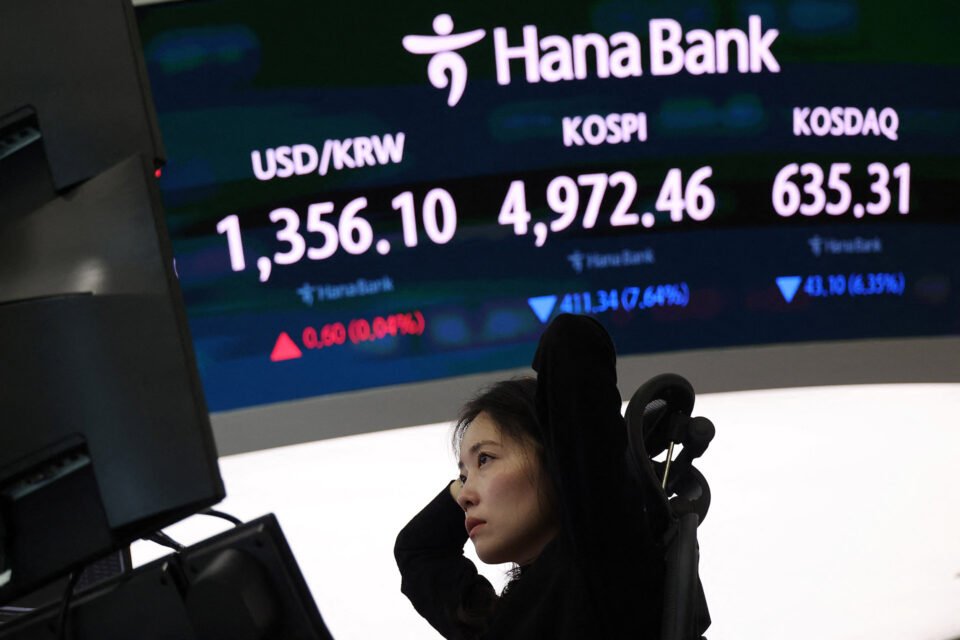
Global long-short equity hedge funds — stock pickers that wager on prices rising and falling — have cut the size of their books by 10.7% since late June, with the first week of November marking the fastest reduction in more than a decade, Bloomberg reports, citing a note from Morgan Stanley’s prime brokerage desk, which lends to these funds and watches their positions. The figure adds up every position a fund holds, so it falls when a manager closes a trade, buys back a short, or sees the market mark down what it still owns. In the first week of November, all three happened at once.
The trigger was a rout in AI stocks that gathered pace after the US midterms. Fears that an incoming Democratic Congress would slow the data center buildout knocked 5.5% off the Nasdaq on 5 November and wiped USD 2.5 tn off the Nasdaq 100. The index has recovered since, but the AI trade has not. The S&P 500 gained 2.5% last week, its best week since August, while Nvidia lost almost USD 600 bn of market value, according to the Associated Press, and Jensen Huang resigned as CEO.
Every region but China lost money, and Asia lost the most. The average Asia-based fund fell 1.5% in the first week of November, against a drop of more than 5% in the MSCI Asia-Pacific Index. That cut Asian funds’ YTD gains to about 2.6%, against roughly 6% for US peers.
Tech took the heaviest cuts, especially in Taiwan and South Korea, where funds sold shares they owned and opened new short positions in others. Fundamental stock pickers, those that pick stocks by studying companies, did most of the selling. The multi-strategy, macro, and quant funds (which spread money across markets and models) spent the week closing their bearish wagers.
SOUND SMART- Leverage is what turns a fall into a sale. A fund that borrows to hold shares has less of its own money behind each position, so a 5% drop costs it far more than 5% of its capital, and it cuts the book to stay inside the limits its lenders and its own risk teams set. Gross leverage among Asia equity long-short funds, which counts every position, fell three points in a week to 124%, one point above the 123% low it hit when US President Donald Trump’s tariff announcements shook markets in April 2025. Net leverage among US long-short funds, which counts longs and shorts against each other, fell five points in a single session to 42%.
However, across Goldman Sachs’s whole prime book, total leverage was still 314.2% on 6 November, in the 85th percentile of the past year, Bloomberg reports separately. The borrowing has been cut, but it has not gone.
Then there’s China: Hong Kong and China, which Morgan Stanley counts as one market, were the only places where funds bought more than they sold in the first week of November. Support from state-led funds pushed managers to buy back the mainland-listed shares they had shorted, the bank said, and the squeeze hit consumer names, local chipmakers, and state-owned companies. China stock-picking was the only strategy that made money on average, up 1.1%, which takes it to 6.7% for the year. Buying by the state funds known as the national team has climbed to a record high, Bloomberg reported last week.
Why this matters for us: The same selloff is marking down Gulf sovereign balance sheets, but those funds are not in the position the hedge funds are in. The listed AI holdings of sovereign wealth funds are worth USD 30.5 bn less than at the end of June, Semafor reports, citing consultancy GlobalSWF. Mubadala, among the funds with the largest disclosed exposure, may be worth USD 17.5 bn less than it was in June, mostly on a more than 50% slide in chipmaker GlobalFoundries, while Saudi Arabia’s Public Investment Fund is estimated to have lost USD 5.64 bn on its AI holdings, largely on SpaceX.
Those losses are on paper, and nobody can make them sell. A sovereign fund bought with cash, so a fall in the price costs it nothing it has to pay today, and it can wait for the price to come back. But a fund running 124% gross leverage cannot. That’s the difference between a loss you have to take and a loss you can carry. “We would not expect strategic investors to retreat wholesale from AI,” GlobalSWF head of research Daniel Brett told Semafor, adding that lower valuations “could create [openings] for long-term funds to increase exposure selectively, although this does not imply an imminent rebound.”
OUR TAKE- China’s outperformance looks more like a wager on policy than on incomes: funds bought back shares where state money was holding the price up. The bigger signal is the borrowing. Because the borrowed money had already gone, a week that cost Nvidia its CEO still ended with the S&P 500 up 2.5%, by our read. The AI trade’s next two tests are Nvidia’s results on 17 November and Anthropic’s expected listing on 19 November.
MARKETS THIS MORNING-
Asian markets dropped earlier today. Japan’s Nikkei fell 1.4% and South Korea’s Kospi slipped roughly 2.6%. MSCI’s broadest index of Asia-Pacific shares outside Japan eased 0.1%.
|
ADX |
9,667 |
-0.6% (YTD: -3.3%) |
|
|
DFM |
6,198 |
-0.6% (YTD: -2.5%) |
|
|
Nasdaq Dubai UAE20 |
5,187 |
-0.6% (YTD: +6.1%) |
|
|
USD : AED CBUAE |
Buy 3.67 |
Sell 3.67 |
|
|
EIBOR |
3.6% o/n |
4.8% 1 yr |
|
|
TASI |
10,258 |
-0.7% (YTD: -2.2%) |
|
|
EGX30 |
52,187 |
+0.3% (YTD: +24.8%) |
|
|
S&P 500 |
7,562 |
-0.4% (YTD: +10.5%) |
|
|
FTSE 100 |
10,903 |
+0.4% (YTD: +9.8%) |
|
|
Euro Stoxx 50 |
6,387 |
-0.2% (YTD: +10.2%) |
|
|
Brent crude |
USD 95.47 |
-0.4% |
|
|
Natural gas (Nymex) |
USD 3.17 |
-1.9% |
|
|
Gold |
USD 3,884 |
-0.1% |
|
|
BTC |
USD 65,165 |
+2.6% (YTD: -25.6%) |
|
|
Lunate JP Morgan UAE Bond UCITS ETF |
AED 3.59 |
0.0% (YTD: -5.0%) |
|
|
S&P MENA Bond & Sukuk |
148.34 |
-0.4% (YTD: -2.3%) |
|
|
VIX (Volatility Index) |
19.30 |
+3.2% (YTD: +29.1%) |
THE CLOSING BELL-
The ADX fell 0.6% on Friday on turnover of AED 1.8 bn. The index is down 3.3% YTD.
In the green: Phoenix Group (+6.9%), Sharjah Cement and Industrial Development Co. (+4.3%), and Eshraq Investments (+3.1%).
In the red: Abu Dhabi National Takaful Co. (-5.0%), Investcorp Capital (-4.7%), and Two Point Zero Group (-2.9%).
Over on the DFM, the index fell 0.6% on turnover of AED 840.5 mn. Meanwhile, Nasdaq Dubai was down 0.6%.