
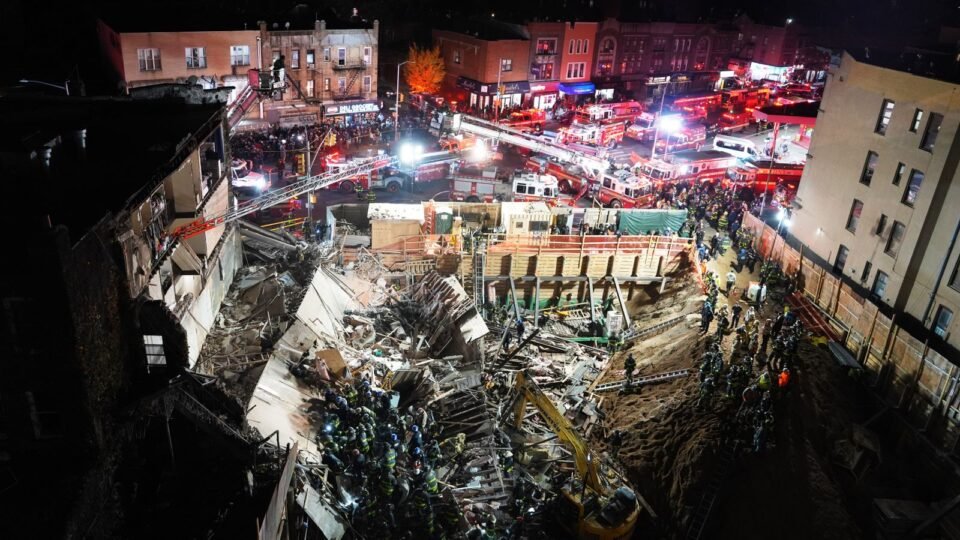
The tragic collapse of a three-story mixed residential and commercial building in the Flatbush section of New York City’s borough of Brooklyn on November 11 graphically exposes the iron grip of the city’s real estate industry on its working-class residents, aided by the city’s feeble regulatory structure. Eight people died, including two children and three construction workers. Eighteen others, including four firefighters, were injured.
Most of the dead were immigrants from Latin America and the Caribbean.
The immediate cause of the disaster was the failure to properly shore the excavation for the foundation of a planned new building at 2625 Bedford Avenue, resulting in the catastrophic collapse of much of the adjacent standing building at 1321 Flatbush Avenue.
The collapse was entirely predictable. Multiple red flags had been raised. City agencies had issued notices of several regulatory violations. They had given orders to stop work and levied fines. All were ignored by the developer and construction contractor, with no effective enforcement by city agencies. This lack of control by the municipal authorities, who are supposed to protect the public from such dangers, can only be understood in the context of a political regime totally subordinated to the city’s financial and corporate elite.
As in much of the country’s urban areas, there is an acute, long-standing and well-known shortage of affordable housing in New York City. As a result, landlords and real estate industry in general operate in a “seller’s market.” This has created a bifurcated housing market.
On the one hand, luxury development of housing for the city’s elite is highly profitable, thus focusing much construction on building for the high-end market. This results in a high demand for real estate, mostly containing existing structures, to locate new housing for the elite, either by renovating existing buildings or constructing new ones, thus encroaching on working-class neighborhoods in a process known as “gentrification.”
Housing availability for the city’s large working-class population is further diminished. As a result, landlords who own properties in these latter areas can maximize rents on their working-class tenants who are under pressure to take whatever is available, at exorbitant prices. At the same time, due to a lack of effective enforcement of city health and safety regulations against these slumlords, maintenance and repair is kept to a minimum. The consequence of combining crowded living space and poor maintenance has resulted in numerous deadly fires in low-income neighborhoods.
The recent disaster in Brooklyn clearly illustrates this combination of factors. The developers of the 2625 Bedford Avenue, a mid-sized operation by New York standards, have been pushing the construction project as quickly as possible, ignoring feeble attempts by the city to exercise regulatory oversight.
- March 2026: DOB (NYC Department of Buildings) issued a stop-work order during the demolition of the site’s previous structure because contractors failed to install required overhead protections for neighboring properties.
- April 2026: The developers unlawfully ignored the stop-work order and completed the demolition. They were fined just $10,000.
- May 2026: Inspectors cited the site again for deviating from approved plans and continuing to neglect adequate protections for adjacent properties.
The developers secured initial earthwork and support-of-excavation permits for a 3-story building, which face significantly lower administrative, geological and structural scrutiny. Once digging commenced, they filed zoning amendments (as recently as November 9, 2026) to expand the project to a 9-story luxury tower. This allowed them to aggressively dig a massive 14-foot trench while effectively bypassing the heavy upfront safety reviews required for a high-rise foundation.
The developers were able to continue excavating despite red flags because the penalty structures do not match the financial incentives. A $10,000 fine for illegally ignoring a stop-work order is a negligible rounding error against a $4 million land acquisition and the multi-million-dollar projected payout of a 9-story luxury complex. Paying the fine allowed the DOB to lift the stop-work order by May 8, effectively rewarding the developers for prioritizing speed over compliance.
Turning to the collapsed building, the landlord of 1321 Flatbush Avenue, Olufemi Falade, of Isolag Realty Corporation, owns at least a half-dozen properties across Brooklyn and has appeared on the New York City Public Advocate’s annual “worst landlords” list multiple times.
The property carried 98 open Department of Housing Preservation and Development (HPD) violations dating back to 1972. Of these, 21 were Class C (“immediately hazardous”), citing conditions such as defective fire-retardant material, exposed wiring, peeling lead paint, leaks and vermin. In 2006, Falade was sentenced to jail time in connection with severe housing violations after amassing roughly 650 infractions across three other buildings in his portfolio.
The failure of the city to effectively carry out its supposed mission to protect residents’ health and safety is in part due to the division of oversight responsibility between two agencies—HPD and DOB—which do not coordinate their activities.
Falade was able to keep the building operational and occupied because he weaponized the bureaucratic separation between city agencies. While HPD recorded nearly 100 severe maintenance and health violations, the DOB (which monitors structural integrity) had no active structural violations on file for the property. Because HPD rarely forces building evacuations for maintenance issues, rent-paying tenants remained trapped in a fundamentally unsafe environment.
Slum landlords frequently outlast tenant complaints by exploiting delays in housing court. They absorb minor HPD fines or do the absolute bare minimum to downgrade Class C violations, allowing them to extract rent indefinitely without making structural investments.
The building’s extreme fragility was formally documented. The developers’ own pre-construction survey from March 5, 2026, rated Falade’s building’s north masonry facade as being in “Poor” condition with major cracking. Neither the landlord (to fix the cracks) nor the developers (to alter their excavation plans) acted on this documentation, resulting in a fatal regulatory blind spot where both parties accepted a catastrophic level of risk.
The tactics utilized by the developers of 2625 Bedford Avenue and the landlord of 1321 Flatbush Avenue are not anomalies; they are part of the widespread, systemic exploitation of New York City’s regulatory enforcement structures. This shows the role played by the city government in service to the oligarchs, a subordination to capital where it is billionaires or petty slumlords. The real estate industry operates with relative impunity. Hundreds of buildings citywide, housing tens of thousands of units, operate under severe distress annually. Many have been subject to repeated fines and regulatory actions, which they either ignore or pay nominal judgements merely the “cost of doing business.”
The Democratic mayoral administration of Zohran Mamdani, a member of the Democratic Socialists of America (DSA), has pledged to improve this situation for the city’s working class. Despite this, the real estate industry continues to operate with effective immunity. The DOB is operating under severe staffing shortages, leaving field inspectors and plan examiners with an overwhelming backlog of active job sites to monitor. This capacity crisis collides directly with Mayor Mamdani’s “SPEED” Task Force (Streamlining Procedures to Expedite Equitable Development Task Force), which mandates that city agencies slash red tape and push through construction permits faster, supposedly to address the housing shortage.
According to the Real Estate Board of New York (REBNY), the real estate industry contributed a staggering $39.6 billion in tax revenue to the city in Fiscal Year 2025. Because this revenue funds roughly a third of the city’s entire budget, the industry holds unparalleled leverage over City Hall. Over the past five years, the real estate industry spent more than $13.5 million on lobbying efforts in Albany and New York City. In 2025, the sector accounted for 32 percent of all lobbying activity in the city, leading all other industries in targeting lawmakers to push back against tenant protections and secure development incentives.
Because the city government relies on real estate tax revenue, mayoral administrations are highly incentivized to keep developers building. Initiatives like the “SPEED” Task Force and widespread rezoning efforts are designed by design to clear regulatory hurdles and fast-track approvals. When the overarching political mandate is to generate housing supply and tax revenue quickly, agencies like the DOB are pressured to act as permit facilitators rather than strict safety enforcers, inevitably empowering private developers to prioritize timelines over human safety.
Mamdani’s approach to the housing crisis poses not significant challenge to the existing dictatorship of the real estate oligarchs over New York’s working-class population. The “SPEED” Task Force is not an administrative upgrade, let alone a socialist program to break the grip of the real estate industry over the needs of the working class. It is a massive deregulation campaign. What the administration and developers call “cutting red tape” is, in fact an assault on life-saving safety and environmental regulations. By fast-tracking permits and shepherding developers through the bureaucracy, the Mamdani administration is continuing and intensifying city agencies’ role as the enabler for capitalist exploitation and subjugation of the working class. In this, Mamdani and the DSA more broadly are yet again exposed as agents for the capitalist class in misleading the growing struggle of workers into a dead end.