
Newswise — Buildings and construction are among the most resource-intensive activities on the planet, consuming vast quantities of concrete, steel and aluminium and accounting for a substantial share of global energy use and energy-related carbon emissions. As extreme weather events intensify, the sector is under growing pressure both to reduce its climate impact and to become more resilient to it.
In a study published in the KeAi journal Risk Sciences, an international team of researchers from Australia, Finland, Morocco and Thailand examined how artificial intelligence (AI) could help. Following PRISMA guidelines, they systematically reviewed research published over the past decade and combined bibliometric and content analyses to map where AI is being applied, how mature those applications are, and what stands in the way of adoption.
“AI should not be treated as an isolated technological application,” says corresponding author Fahim Ullah of Victoria University, Australia. “It is a lifecycle-wide enabling technology. It can support predictive decision-making, optimise energy and carbon, improve resource efficiency, automate processes and monitoring, and it works best when integrated with complementary tools such as building information modelling, digital twins and the Internet of Things.”
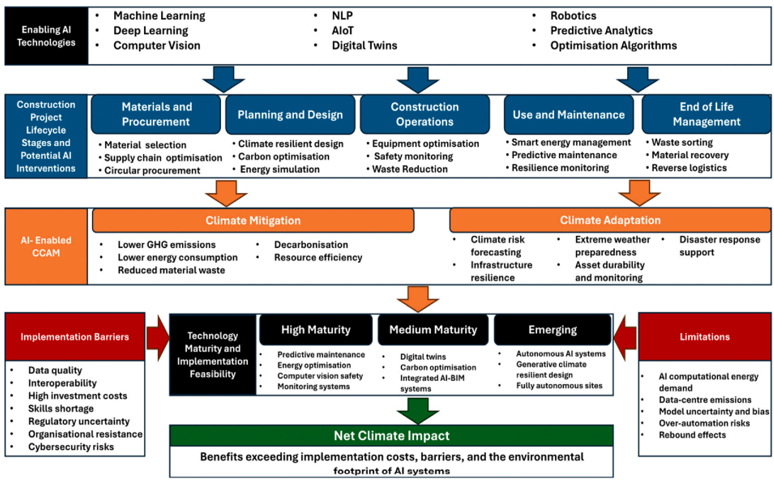
The review found that AI can contribute across the whole construction project lifecycle: enabling lower-carbon and more resilient materials, greener procurement and supply chains, energy-efficient and climate-resilient design, optimised equipment and scheduling on site, smarter building operation and maintenance, and better recycling and waste recovery at end of life. The team distilled these contributions into a conceptual framework that identifies three principal pathways: cleaner and more resource-efficient energy use, decarbonisation of the built environment, and responsible production and consumption of resources.
Notably, the evidence is unevenly distributed. Most studies focus on mitigation, such as cutting emissions and energy use, while far fewer explore adaptation, such as climate-resilient infrastructure or extreme-weather preparedness. Applications like predictive maintenance, building energy optimisation and computer-vision monitoring are relatively mature, whereas generative climate-resilient design and fully integrated digital twins remain largely at the pilot stage.
The authors also identify key barriers, including poor data quality, interoperability problems, high implementation costs, organisational readiness, regulatory uncertainty and cybersecurity concerns, and they stress that AI is not environmentally neutral.
“The presence of AI capability does not automatically produce a net-positive climate outcome,” Ullah adds. “Training and operating these models requires computational resources and electricity. The climate benefits of AI must be evaluated against its own environmental footprint. AI can make a major contribution to a low-carbon, climate-resilient construction industry, but it is neither a standalone solution nor inherently sustainable.”
###
References
DOI
Original Source URL
https://doi.org/10.1016/j.risk.2026.100065
About Risk Sciences
Risk Sciences is a general-interest journal that publishes academic research and industry practices on risks and disruptive technologies across all fields including agriculture, economics, engineering, environmental science, finance, health, law, management, natural sciences, and public administration.