
Singapore FinTech Festival (SFF): An On-the-Ground Report
AI Is Moving Money and Assets Are Becoming Tokens
“Risks from AI Advances Must Be Reduced Through Cooperation Between Countries”

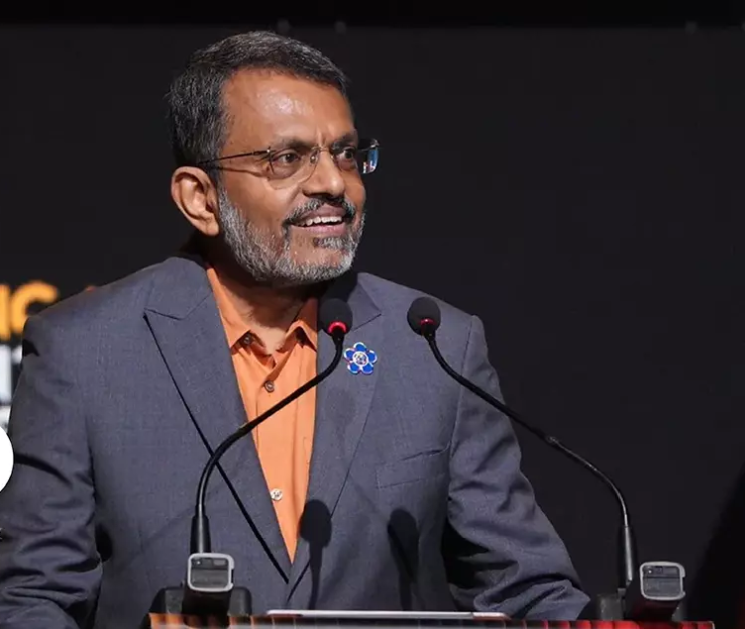
Ravi Menon, chairman of the board of the Global Finance & Technology Network (GFTN), delivers a keynote address at the Singapore FinTech Festival (SFF) 2026 in Singapore on the 20th. GFTN
“AI transactions conducted in Singapore are geoeconomically intertwined in complex ways, involving Taiwanese chips, AI models from Texas in the United States, gas-fired power from Qatar, and undersea cables crossing the South China Sea.”
“AI is making the world more interconnected and complex; cooperation is needed to mitigate risks”
Ravi Menon, Chairman of the Board of the Global Finance & Technology Network (GFTN), made the remarks on the 20th while delivering a keynote address on “AI and Geoeconomics” at the Singapore FinTech Festival (SFF) 2026, held at Singapore EXPO. “AI is reshaping systems as it takes center stage in a new wave of globalization,” Menon said, stressing that “this is affecting global trade, investment and supply chains.” He added that “every international transaction involving AI is exposed to geoeconomic risks” and argued that “countries must work together to reduce the risks that AI could create.”
“For AI to be widely adopted, we need to create an environment in which people can share in the benefits of technological progress,” he said, emphasizing that “we need to remember the lessons of past waves of globalization, when many people did not benefit.” He added that “AI could replace jobs, but it could also boost workers’ productivity, leading to wage increases or job creation. Which outcome prevails ultimately depends on the choices we make.”
The event, hosted by the Monetary Authority of Singapore (MAS) and GFTN over three days from the 18th, brought together more than 840 central banks, regulatory bodies and government agencies, more than 600 exhibiting and sponsoring companies, around 40 country pavilions, and more than 940 speakers. This year’s theme was “Reimagining the Future Financial System: New Risks, New Rules, New Growth.” The Asia Business Daily plans to co-host “GDAF Seoul 2027,” an international digital assets forum, with GFTN next year.
The event covered a wide range of topics, from geoeconomics and macroeconomics to national AI strategies, central banks’ technological sovereignty and next-generation AI agents. Michael Spence, a Nobel laureate in economics and professor at Stanford University, said in a discussion with Menon that “government choices on education, retraining and policy will be crucial to ensuring that productivity gains from AI are not concentrated among a small number of capital owners and highly skilled workers.”
“Signs of young workers being displaced are already emerging in professional services and the financial sector,” Spence said, stressing that “collaboration between humans and machines is important, and even if AI speeds up work, people still have to verify the results and take responsibility for them.” He added that “even if AI does not eliminate jobs entirely, the scope of work in virtually every occupation will change,” and predicted that “all occupations will face significant disruption for quite some time.”
An era in which AI moves money and assets become tokens has begun
Developments in finance powered by AI were also discussed. Chia Der Jiun, governor of MAS, outlined concrete milestones for the spread of tokenization and AI agents.
“In November, MAS bills were tokenized, issued and settled in Singapore-dollar central bank digital currency (CBDC),” Chia said. “Tokenized assets are fundamentally different from crypto assets without underlying assets, and collateral management will be the first use case.” On AI agents, he said, “AI-generated web traffic has already surpassed human traffic, but it is not safe to hand login credentials to personal agents,” adding that “autonomy must have limits, and actions and their consequences must come with accountability.”

Chia Der Jiun, Governor of the Monetary Authority of Singapore (MAS), speaks at the Singapore FinTech Festival (SFF) 2026 in Singapore on the 20th. Singapore – Photo by Kim Heeyoung
Brett King, CEO of The Futurists, asserted that “technology is accelerating so rapidly that 65% of the code for frontier AI models is already being written by previous-generation AI. The customer base of the top 20 retail fintech companies has surged 160% in five years to 4.2 billion, surpassing the 3.1 billion customers of the top 20 banks.” He added, “A bank’s first customer in the future will not be a human, but an AI agent.”
Companies with booths at the exhibition moved beyond technology demonstrations to unveil plans for commercialization. Visa, which set up a “Visa Commerce Arena” at the exhibition, announced the expansion of its “Agentic Ready” program with more than 50 acquirers and payment gateway providers, a B2B partnership with LianLian DigiTech, and global QR code integration with Alipay+.
Visa said that although generative AI usage rates were 90% in Singapore and 67% in Japan, only 20% to 30% of users were willing to delegate purchases, making it crucial to bridge the trust gap. “Innovation must go beyond potential and lead to solutions that people can use with confidence in their daily lives,” said Stephen Karpin, Visa’s Asia-Pacific president.

Visitors gather at the Visa booth at the Singapore FinTech Festival (SFF) 2026 exhibition in Singapore on the 20th. Photo by Kim Heeyoung
In the digital assets sector, Ripple showcased institutional custody and cross-border payment infrastructure, highlighting more than 75 licenses and a real-time payment network spanning around 60 markets. Coinbase also introduced “Singpass” streamlined onboarding based on its MAS license, along with PayNow deposit and withdrawal services. It attracted visitors with a promotion offering Patagonia bags to those who completed accredited investor verification.
South Korean companies also raised their profile. Hecto Financial set up its first joint booth with its affiliates, called “The Hecto Orbit,” focusing on global stablecoin remittances based on the Circle Payments Network (CPN), a single-integration payment gateway, and foreign-currency settlement services for overseas merchants without a Korean legal entity.

Jang Beomsik, CEO of The Asia Business Daily (center), listens to an explanation from an event official while visiting the exhibition hall at the Singapore FinTech Festival (SFF) 2026 in Singapore on the 19th. Singapore = Photo by Kim Heeyoung
South Korean fintech companies were also actively pursuing opportunities in ASEAN at the exhibition. As part of the Financial Services Commission’s “Fintech-Specific Overseas Expansion Support Program,” the Korea Fintech Center operated a 90-square-meter “K-Fintech Pavilion” with 10 South Korean fintech companies and held an overseas demo day. After completing three pre-departure mentoring sessions with local market experts to strengthen their English-language investor relations presentations and pitching skills, participating companies held consultations and partnership talks with global financial firms and venture capital firms (VCs) at the event, laying the groundwork for expansion into Southeast Asia.
Hot Picks Today

Jang Beom-sik, CEO of The Asia Business Daily, who attended the event, said, “At this year’s SFF, what stood out was not only the scale of participation, but also MAS’s efforts to take the lead in working with supervisory bodies in Japan and other major developed countries to expand the private fintech sector.” He added, “The direct involvement of central banks in leading the way in digital finance and the broader transformation of finance, as seen in the panel discussion featuring the heads of the central banks of Germany, Spain and Denmark, offers important lessons for us as well.”
This content was produced with the assistance of AI translation services.
© The Asia Business Daily. All rights reserved. Unauthorized AI training and use prohibited.