
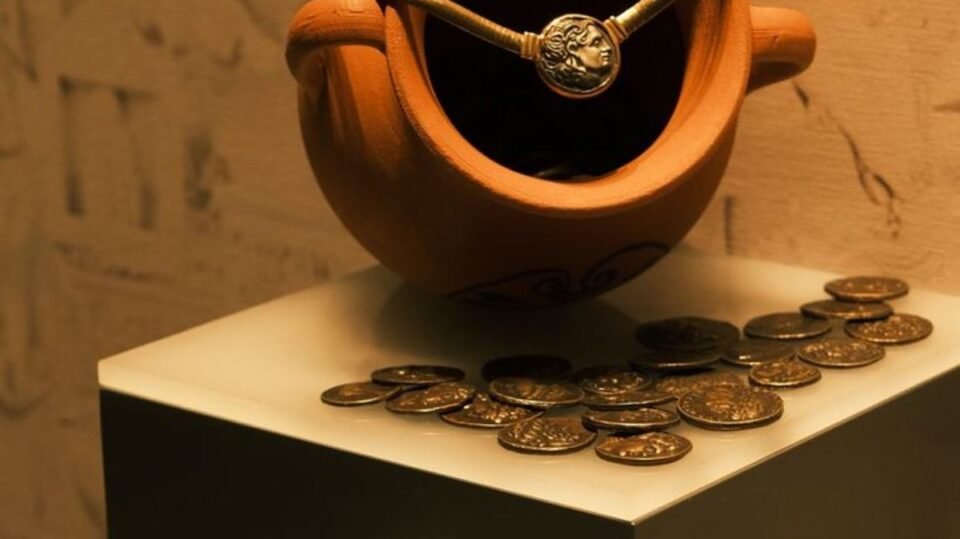
A remarkable archaeological discovery in western Hungary has revealed 208 Celtic silver coins dating back more than 2,000 years, alongside evidence of prehistoric settlements and Roman-era construction. The treasure was uncovered near Szombathely during archaeological investigations conducted between 2023 and 2025 ahead of construction work on an electrical facility, with findings detailed by Hungary’s National Archaeological Institute on November 17, 2026.
The coins, weighing approximately 2 kilograms, date from the late second century B.C. to the early first century B.C. Archaeologists found part of the collection inside a small ceramic vessel buried approximately 30 to 40 centimeters beneath the ground.
According to reporting by Live Science and details released by E.ON Hungária Group, agricultural activity had scattered some coins into the surrounding soil. Farmers had previously discovered individual specimens while plowing the former farmland, prompting archaeologists to investigate the area more extensively.
During the latest excavations, researchers initially identified several silver coins before expanding their investigation with metal detectors. This approach led them to the larger collection, which represents one of Hungary’s most significant comparable discoveries in decades.
Archaeologist Eszter Kreiter of Hungary’s National Archaeological Institute described the discovery as a rare European find.
“A rarity in Europe,” said Eszter Kreiter, an archaeologist at Hungary’s National Archaeological Institute.
She also noted that Hungary’s previous comparable discovery occurred in the late 1960s.
The coins belong to the Velem type, Celtic imitations of Greek silver tetradrachms. Each coin features a stylized head, probably representing the Greek god Apollo, on one side and a helmeted rider with a horse on the other.
Their name comes from Velem-Szent Vid, a fortified Celtic settlement approximately 15 kilometers west of the excavation site. Archaeologists believe the coins may have been produced in that area.
According to Live Science, citing British coin expert Christopher Howgego of the University of Oxford, Celtic communities in the Carpathian Basin began producing silver currency after their mercenaries encountered Greek monetary systems while serving with Hellenistic armies in Greece and Macedonia.
These coins combined Greek-inspired imagery with Celtic artistic elements. Howgego’s research indicates that Celtic communities generally preserved such valuable currency as stored wealth or deposited it for ritual purposes rather than using it for everyday transactions.
The excavation also documented approximately 400 archaeological features and thousands of artifacts, revealing human activity in the area spanning more than 7,000 years. Among the oldest objects was a polished stone woodworking tool dating to the fifth millennium B.C.
Other discoveries included a glass bead featuring a peacock-eye pattern, dated to the sixth or seventh century B.C., and Iron Age graves containing ceramic vessels. Researchers also identified two hand millstones associated with a Celtic-era structure, providing evidence of historical grain processing.
Centuries later, a Roman rural villa occupied the same location. Archaeologists reconstructed part of its central building, which covered approximately 300 square meters, including evidence of an underfloor heating system.
One particularly distinctive Roman artifact was a brick fragment carrying a dog’s paw print, apparently left when the clay was still wet before firing. The discovery preserves evidence of an animal’s presence in everyday life during the Roman period.
According to E.ON Hungária Group, selected artifacts from the excavation will be presented in a temporary exhibition at the Savaria Museum in Szombathely. An opening date has not yet been announced.