
Global silver mine production is expected to remain virtually unchanged this year despite a sixth consecutive annual market deficit.
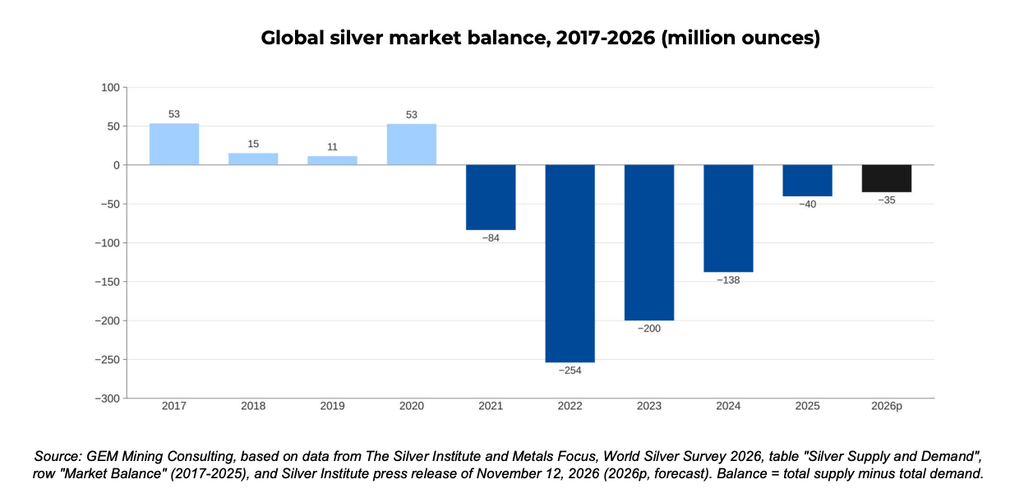
Demand is forecast to exceed supply by 35 million oz. in 2026, bringing the cumulative shortfall since 2021 to a projected 746 million oz., according to figures prepared by research firm Metals Focus for the Silver Institute. That represents nearly 90% of annual global mine output, projected at 834 million oz. this year.
“Peak silver scarcity is clearly in the rear-view mirror,” Deutsche Bank head of metals research Daniel Ghali wrote in an Oct. 2 report. He forecast that weakening industrial demand could tip the market into surplus as early as 2027.
The prospect of a surplus despite stagnant mine production highlights the limited response of silver supply to higher prices. New research by GEM Mining Consulting suggests the market’s ability to rebalance hinges more on changes in consumption, recycling and inventories than on miners expanding operations.
Between 2021 and 2025, annual silver demand averaged 1.17 billion oz., up 20% from the preceding four-year period, when the market recorded surpluses. Average annual mine output declined by 0.9%, while recycling increased by 15% between those periods.
The consultancy’s statistical analysis suggests production has a stronger relationship with prices from two or three years earlier than with current market conditions, although the limited number of observations warrants caution.
Byproduct dependence
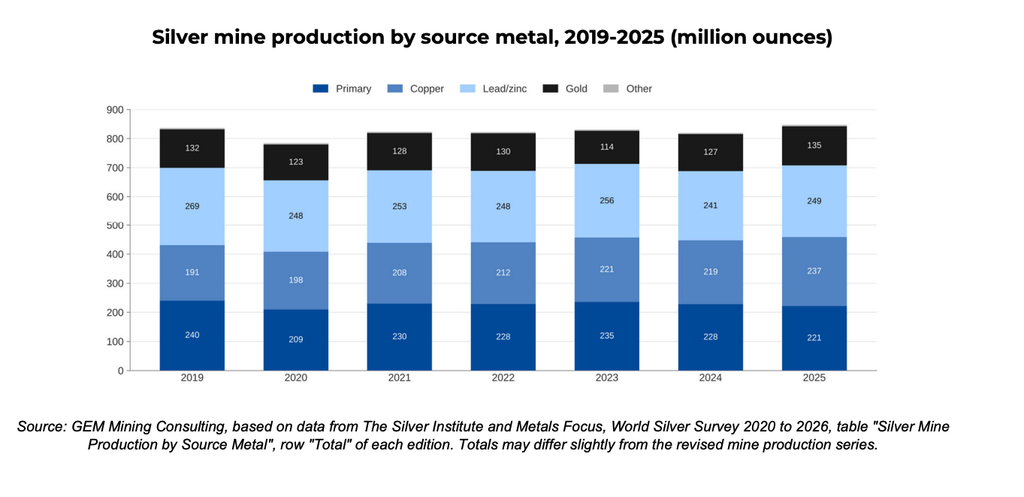
Primary silver mines accounted for just 26.1% of global mine supply in 2025, down from 28.7% in 2019 and the lowest proportion in Metals Focus’ data series, according to GEM’s comparison of annual surveys.
Lead and zinc operations contributed 29.4%, followed by copper mines at 28% and gold operations at 15.9%. Other sources account for the remainder.
“For them, a higher silver price improves revenues, but hardly justifies, on its own, extracting more ore,” Patricio Faúndez of GEM Mining Consulting wrote of operations that produce silver as a byproduct.
GEM calculates that silver output from copper mines increased by 24.5% between 2019 and 2025, supported by expanding global copper production, project ramp-ups in Chile and higher grades in Peru. Production from lead and zinc operations declined by 7.3%, while gold-related output edged 2% higher.
Chile illustrates the disconnect. Silver production from the country’s copper mines fell by 10% over the same period despite a 95% increase in inflation-adjusted silver prices, according to GEM’s analysis of Chilean Copper Commission data.
Dedicated silver operations have also struggled, with output falling by 7.9% between 2019 and 2025 amid declining grades and operational challenges, according to GEM.
Metals Focus expects primary mines to add 6.5 million oz. this year, largely through operational improvements in Mexico. Higher prices lifted their margins by 187% in the first half of 2026 despite a 47% increase in all-in sustaining costs.
The increase represents less than one-fifth of this year’s projected market shortfall.
Demand destruction
Silver briefly surpassed $120 (C$172) per oz. in January before retreating to $52 by Nov. 4, according to the Silver Institute. The earlier rally accelerated efforts among industrial consumers to reduce their reliance on the metal.
Deutsche’s October report estimated that global silver consumption in solar applications would decline by more than 20% this year, with Chinese demand falling 33%. Manufacturers are adopting thinner electrical contacts, silver-coated copper pastes and alternative cell designs to reduce costs.
Silver consumption per solar cell was forecast to fall 17% this year in the bank’s report.
Metals Focus, meanwhile, expects overall demand to decline by 5% in 2026 as jewellery and silverware purchases weaken. Recycling is projected to increase by 6%, reaching its highest level since 2012.
London’s commercial vaults held about 929 million oz. at the end of October, down 0.3% from September, according to the London Bullion Market Association. Deutsche’s October report estimated more than 300 million oz. were freely available for purchase at the end of August, up 70% since October 2025.
“Ultimately, this ties into the significant deterioration in silver’s demand profile, primarily relating to thrifting trends, which now threaten to create a glut,” Ghali wrote.
Deutsche’s October report forecast that spot silver prices would average $70 per oz. in the second quarter of 2027, with investment flows becoming increasingly important to the metal’s performance as industrial demand weakens.
For primary silver producers, the prospect of a surplus emerging before meaningful new mine capacity comes online could complicate expansion decisions, even as elevated prices support profitability.